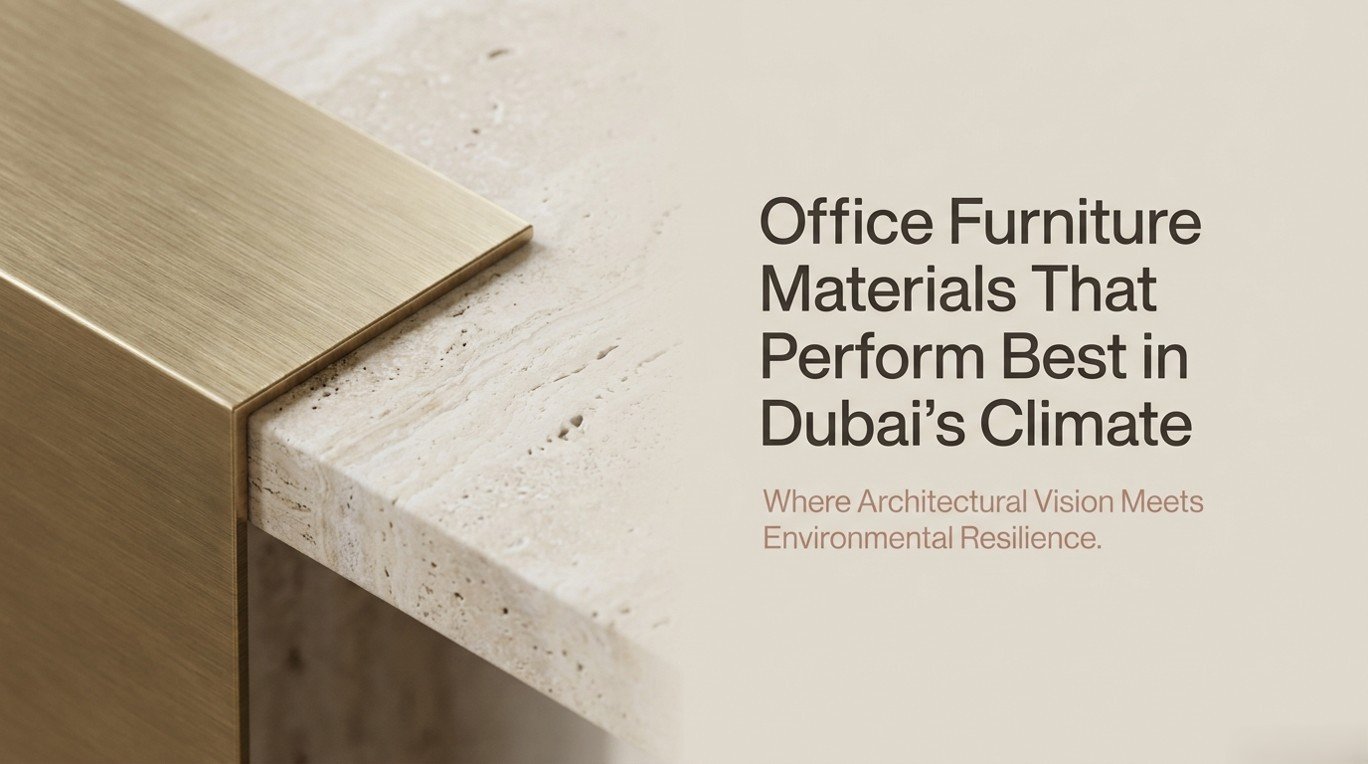
Why Material Selection Is a Business-Critical Decision in Dubai
Selecting office furniture in Dubai is not simply an exercise in aesthetics or budget management it is a strategic business decision that directly affects operational costs, employee productivity, brand perception, and long-term asset value. Dubai’s climate is among the most demanding on the planet for any material that must endure day after day, year after year. Summer ambient temperatures regularly breach 45°C outdoors, indoor environments cycle between extreme heat and aggressive air conditioning, coastal humidity fluctuates between 60% and 95% relative humidity during the humid season, and fine desert dust infiltrates even the most tightly sealed buildings.
Businesses that choose office furniture without accounting for these environmental realities routinely face warped panels, de-laminating surfaces, corroding metal components, cracked upholstery, and structural failures within two to three years — often on products that carry a five-year international warranty. This guide was developed specifically for decision-makers, procurement managers, interior designers, and facilities professionals operating in Dubai and across the wider UAE, offering a level of climate-specific material analysis that goes beyond anything available from generic furniture guides.
Throughout this article, you will find detailed breakdowns of every major office furniture material from engineered wood and solid timber to stainless steel, glass, mesh, laminates, plastics, and fabric upholstery — assessed against the precise conditions Dubai workplaces present. We also provide performance comparison tables, use-case recommendations, common purchasing mistakes, maintenance protocols, and a comprehensive FAQ section optimized for real procurement queries.
Expert Note
Material failure in Dubai’s climate is not covered by most international warranties. Always request UAE-specific climate testing data from suppliers before committing to large-scale office furniture procurement.
Understanding Dubai’s Climate Challenges for Office Furniture
The Four Primary Climate Stressors
Four distinct environmental forces act simultaneously on any furniture placed in a Dubai workspace. Understanding these forces helps explain why certain materials succeed where others fail catastrophically.
1. Extreme Ambient Heat and Solar Radiation
Dubai experiences a BWh (hot desert) climate classification under the Köppen-Geiger system. From May through September, daily maximum temperatures regularly range from 40°C to 48°C, with surface temperatures on sun-exposed materials exceeding 70°C. Even indoors, windows facing east or west allow significant solar gain that can raise localized surface temperatures well above the ambient air temperature. Wood-based materials respond to this by drying and contracting, adhesive bonds in engineered products weaken, and plastics with low heat deflection temperatures begin to deform.
2. Aggressive Air Conditioning Cycles
Perhaps the most underappreciated stressor for office furniture in Dubai is not the outdoor heat itself but the thermal shock created by aggressive air conditioning. The temperature differential between a sun-heated corridor and a heavily air-conditioned boardroom can exceed 20°C. Materials expand during heat exposure and contract during cooling — repeatedly, every day. Over months and years, this cyclic thermal stress causes micro-cracking in rigid materials, joint failure in assembled furniture, and surface de-lamination in multi-layer products such as veneers and high-pressure laminates.
3. Coastal Humidity and Seasonal Moisture Swing
Dubai’s proximity to the Arabian Gulf creates a bimodal humidity pattern. During the cooler months (November through March), relative humidity can drop to 30–40%, creating very dry conditions that cause wood shrinkage. From June through September, humidity regularly exceeds 80% and can spike above 95% during fog events, causing expansion, mold risk, and corrosion acceleration on ferrous metals. Materials must therefore cope with both extremes within a single calendar year, a demand that eliminates many standard furniture grades used in European or North American markets.
4. Fine Particulate Desert Dust
Airborne PM10 and PM2.5 levels in Dubai are chronically elevated relative to global standards, and episodic dust storms (shamal events) can drive particulate concentrations to hazardous levels within hours. Fine quartz particles infiltrate mechanical components — chair casters, drawer runners, swivel mechanisms — and act as an abrasive that accelerates wear. Surface finishes that hold static charges, including many plastics and synthetic fabrics, attract and retain dust, increasing cleaning frequency and risking surface micro-scratching over time.
Material-by-Material Performance Analysis for Dubai Workplaces
Engineered Wood: MDF, Particleboard, and Plywood
Engineered wood products dominate the global commercial furniture market because of their cost-effectiveness, dimensional consistency, and ease of surfacing. In Dubai’s climate, however, their performance varies dramatically depending on the specific product type and the quality of surface treatment applied.
Medium-Density Fiberboard (MDF): Standard MDF is highly susceptible to moisture absorption, particularly at cut edges and drill holes. In humid conditions, it swells irreversibly, causing drawer fronts to stick, door panels to bow, and surface laminates to bubble. Moisture-resistant MDF (MR MDF, often identifiable by a green tinting in the core) performs significantly better and is the minimum acceptable specification for Dubai offices. Even MR MDF, however, should not be used in locations with direct water exposure or high condensation risk (e.g., beneath poorly insulated air conditioning vents).
Particleboard: Standard particleboard has the worst moisture resistance of all engineered wood products and is unsuitable for most Dubai office applications beyond dry interior panels with complete surface encapsulation. Moisture-resistant (E1 or E0-rated) particleboard improves performance but still requires fully sealed edges — a requirement often compromised in budget furniture assembly. Formaldehyde emission ratings are also a relevant health consideration in Dubai’s tightly sealed, air-conditioned office environments.
Plywood: Marine-grade or cross-ply structural plywood offers the best moisture and thermal cycle resistance among engineered wood categories, owing to its alternating grain structure which distributes stress and resists warping. Commercial-grade plywood with exterior-rated adhesives (WBP bonding) is the preferred engineered wood substrate for Dubai furniture applications, particularly for structural components such as tabletops, shelving, and cabinet carcasses.
Dubai-Specific Insight
Specify a minimum E1 emission standard and moisture-resistant core for all MDF or particleboard furniture. Request test certificates — not just product descriptions — from suppliers.
Solid Wood
Solid hardwoods such as teak, oak, walnut, and mahogany have been used in furniture for centuries and possess natural properties that make them inherently better suited to climatic variation than most engineered alternatives — when properly sourced and finished. In Dubai’s context, several factors determine whether solid wood performs elegantly or fails prematurely.
Teak is the standout performer in humid and thermally variable conditions, owing to its naturally high silica and oil content, which resists moisture absorption, insect attack, and the drying effects of air conditioning. Well-seasoned teak furniture can last decades in Dubai offices with minimal maintenance. European oak and American walnut perform adequately when kiln-dried to low moisture content (8–10%) before manufacturing, but they require controlled humidity environments and periodic oiling or waxing to prevent surface cracking.
The primary vulnerability of any solid wood in Dubai is the annual humidity cycle: wood expands in summer humidity and contracts in winter dryness, and if furniture joinery does not allow for this movement — which is common in imported pieces designed for temperate climates — joints fail, panels crack, and surface finishes split. Dubai-sourced or UAE-manufactured solid wood furniture is typically better acclimated to local conditions.

Metal: Carbon Steel, Powder-Coated Steel, and Wrought Iron
Metal frames and structural components are widely used in Dubai office furniture, particularly for desking systems, shelving, and storage. The performance differential between metal types is significant in coastal, humid environments.
Carbon steel with standard paint finishes is the worst choice for Dubai’s coastal climate. Even in air-conditioned offices, micro-condensation cycles — particularly near external walls and under poorly insulated windows — provide enough moisture to initiate rust at any surface scratch, weld point, or joining hardware. Rust not only compromises structural integrity but migrates to adjacent surfaces, permanently staining flooring and carpeting.
Powder-coated steel offers dramatically superior corrosion resistance compared to liquid-paint finishes, as the thermoset polymer coating bonds at a molecular level to the metal substrate. Epoxy-polyester and polyurethane powder coatings rated to AAMA 2603 or higher standards provide adequate protection for most indoor Dubai office applications, provided the coating is applied at a minimum 60-80 micron thickness and all weld points are thoroughly per-treated.
Expert Warning
Furniture with exposed uncoated steel hardware — including screws, cam locks, and connector bolts — is one of the most common sources of furniture corrosion in Dubai offices. Always specify stainless steel or zinc-plated hardware for all connecting components.

Aluminum and Anodized Aluminum
Aluminum is an increasingly preferred structural material for premium office furniture in the UAE, and for sound reasons. Its natural oxide layer provides intrinsic corrosion resistance even in coastal environments, it is approximately one-third the weight of equivalent steel sections, and it responds well to both anodizing and powder coating to produce durable, premium-looking finishes.
Anodized aluminum — particularly Type II (architectural anodizing, 10–25 microns) or Type III (hardcoat anodizing, 25+ microns) — provides outstanding resistance to the combination of UV exposure from solar gain through windows, salt air from the Gulf coast, and the repeated thermal cycling inherent in Dubai’s air-conditioned buildings. Aluminum does not rust; at worst, it oxidizes slowly to a dull grey in untreated form, but anodized and powder-coated finishes maintain their appearance for eight to fifteen years in Dubai conditions.
The principal limitations of aluminum are its cost premium over steel (typically 25–40% higher for comparable structural sections) and its lower stiffness, which can result in slightly more deflection in long unsupported spans. For desking systems, storage frames, and chair bases, these limitations are insignificant; aluminum is the optimal metal choice for Dubai offices.
Stainless Steel
Stainless steel, particularly Grade 304 (18/8 chromium-nickel alloy) and Grade 316 (with added molybdenum for enhanced chloride resistance), represents the most durable metal option for Dubai office furniture applications, especially in coastal-facing offices within two kilometers of the Gulf shoreline. Its passive chromium oxide surface layer self-repairs when scratched, providing corrosion resistance that no coating can match in the long term.
Brushed (satin-finish) stainless steel is the predominant specification for premium UAE office environments and conceals minor scratching better than mirror-polished surfaces. Grade 316 is strongly recommended for offices in Dubai Marina, Palm Jumeirah, JBR, and other seafront developments where salt-laden air infiltration is frequent. The primary constraints are cost (Grade 316 stainless steel furniture commands a significant premium) and weight, which affects mobility for reconfigurable workspaces.
High-Pressure Laminates (HPL) and Low-Pressure Laminates (LPL)
Laminate surfaces represent the dominant finish for commercial office furniture worldwide, and their performance in Dubai’s climate is a function of both laminate grade and the quality of the substrate beneath.
High-Pressure Laminate (HPL, also known as Formica or compact laminate) is manufactured by fusing multiple layers of resin-impregnated paper under high heat and pressure (typically 700–1000 psi and 120–160°C). The result is a dense, dimensionally stable surface with excellent scratch resistance (typically 4–6 on the Taber abrasion scale), good thermal resistance up to approximately 180°C, and solid moisture resistance at the face — though exposed edges and substrates remain vulnerable.
Low-Pressure Laminate (LPL or melamine) is a single layer of printed paper impregnated with melamine resin, thermally bonded to a particleboard or MDF substrate under low pressure. It is significantly cheaper than HPL but correspondingly less durable. LPL surfaces in Dubai show edge chipping, moisture swelling, and print fading faster than HPL counterparts, particularly in high-traffic reception and meeting room environments.
For Dubai office applications, HPL with a minimum 0.8mm thickness on moisture-resistant substrates, with ABS or PVC edge banding applied with polyurethane hot-melt adhesive, represents the cost-to-performance optimum for most standard workspaces.
Wood Veneers
Wood veneer is a thin slice of real timber — typically 0.6mm to 3mm thick — bonded to an engineered substrate to provide the visual warmth and prestige of solid wood at lower cost and with greater dimensional stability. In Dubai, veneered furniture is widely used in executive offices, boardrooms, and reception areas where aesthetic quality is a priority.
The performance vulnerability of veneer in Dubai’s climate is concentrated at three points: the adhesive bond between veneer and substrate (which fails when moisture and heat act together), the veneer surface finish (which cracks under repeated thermal cycling if not sufficiently flexible), and the substrate itself (which must be moisture-resistant). UV exposure through window glass also bleaches and yellows lighter veneers over time unless UV-filtering glazing is installed.
Premium veneer furniture specified for Dubai should use two-component polyurethane or cross-linked PVA adhesives, marine-grade or MR plywood substrates, and UV-resistant polyurethane or conversion lacquer surface finishes applied at a minimum of 150 grams per square metre. When these specifications are met, quality veneer furniture can provide an eight to twelve-year service life in Dubai executive environments.
Glass Surfaces and Tempered Glass
Glass is a dimensionally stable, non-porous material that does not absorb moisture, resist thermal expansion far more predictably than organic materials, and does not support mold or bacteria growth — making it conceptually well-suited to Dubai’s office environments. In practice, the critical consideration is specification of the correct glass type for each application.
Tempered (toughened) safety glass — minimum 10mm for tabletops, 6mm for modesty panels — is the mandatory specification for any structural glass application under UAE building codes. Thermally tempered glass has four to five times the impact resistance of annealed glass and fractures into small, blunt fragments rather than dangerous shards. Laminated safety glass (two layers bonded with a PVB interlayer) provides an additional safety margin for overhead or suspended applications.
The primary performance challenges for glass in Dubai offices are thermal shock from direct air conditioning airflow impinging on sun-heated glass surfaces (which can cause spontaneous cracking in inadequately tempered or annealed glass), and the visual impact of fine dust, which shows prominently on clear glass surfaces and requires frequent cleaning. Low-iron (extra-clear) glass has become popular in UAE premium offices for its neutral color rendition without the green tint of standard float glass.

Mesh Upholstery for Ergonomic Seating
Ergonomic mesh chairs have become the dominant seating specification in Dubai offices, and climate performance is a central reason. In heavily air-conditioned environments, mesh allows air to circulate through the backrest and seat, significantly reducing heat and moisture accumulation at contact surfaces compared to foam-and-fabric or leather alternatives.
The key material distinction is between woven polyester mesh and elastomeric (typically elastane-nylon blend) mesh. Woven polyester mesh is more common and lower in cost but can sag over time as individual fibres relax — a process accelerated by heat. Premium elastomeric mesh (as found in OfficeMaster chairs) maintains its tension characteristics over years of use because the material’s recovery properties are inherent to the polymer structure rather than dependent on weave tightness.
In Dubai’s climate, UV stability is also relevant for mesh chairs positioned near windows: unprotected polyester mesh yellows and loses tensile strength under prolonged UV exposure. Specify UV-stabilised mesh compounds and position high-value ergonomic chairs away from direct solar paths where possible.
Fabric Upholstery
Fabric upholstery remains prevalent in breakout seating, soft seating areas, and conference room chairs throughout Dubai offices, but it is the most maintenance-intensive category in Dubai’s climate. The combination of humidity, dust, and climate-controlled air creates conditions that accelerate soiling, encourage mould growth in damp conditions, and cause fibres to fade under UV exposure.
Performance fabric specifications for Dubai offices should include: a minimum 50,000 double-rub Martindale abrasion rating; solution-dyed acrylic or polyolefin (Olefin) fibres for colorfastness; antimicrobial treatment (such as Microban or Sanitized-licensed treatments); and stain-resistant finishes. Crypton, Sunbrella Contract, and Kvadrat Febrik are international fabric lines that meet Dubai’s demanding performance requirements.
Avoid natural fibre fabrics — wool, linen, cotton blends — in high-traffic Dubai offices. Despite their aesthetic appeal, these materials absorb ambient humidity, are difficult to clean without specialist equipment, and degrade faster than high-performance synthetics in the local climate.
Leather and Faux Leather (PU Leather and Vinyl)
Genuine leather remains a prestige specification for executive seating, visitor chairs, and reception soft seating in Dubai’s corporate sector. Its performance in Dubai’s climate is nuanced: full-grain and top-grain leather, properly conditioned, ages gracefully and develops a patina over time. The risks are specific — leather in direct sunlight fades and dries rapidly, requiring more frequent conditioning (every 3–4 months rather than the annual conditioning typical in temperate climates), and leather near aggressive air conditioning vents can crack at the surface.
PU leather (polyurethane-coated split leather or fabric) and PVC vinyl represent the budget alternatives. In Dubai’s climate, PU leather with a 0.6–0.8mm topcoat thickness performs adequately for three to five years before surface flaking begins — a process considerably accelerated by heat and UV exposure. PVC vinyl is the most cost-efficient short-term option but has poor breathability, making it uncomfortable in the transition zones where air conditioning has not fully cooled the air.

Material Performance Comparison Tables
The following tables provide a structured, at-a-glance comparison of all major office furniture materials assessed against the specific demands of Dubai’s climate. Ratings are based on regional supplier data, manufacturer technical specifications, and on-the-ground performance feedback collected from Dubai facilities management professionals.
Core Material Performance Matrix for Dubai’s Climate
| Material | Heat Resistance | Humidity Resistance | Thermal Cycle Stability | Dust Attraction | Durability | Maintenance | Lifespan (Years) | Cost Range (AED) |
|---|---|---|---|---|---|---|---|---|
| MR MDF (HPL face) | ★★★ | ★★★ | ★★★ | Low | ★★★ | Low | 6–10 | 200–600/m² |
| Plywood (Marine) | ★★★★ | ★★★★ | ★★★★ | Low | ★★★★ | Low | 10–18 | 350–900/m² |
| Solid Teak | ★★★★★ | ★★★★★ | ★★★★★ | Low | ★★★★★ | Moderate | 20–40+ | 800–2500/m² |
| Solid Oak/Walnut | ★★★★ | ★★★ | ★★★★ | Low | ★★★★ | Moderate | 12–25 | 600–2000/m² |
| Carbon Steel (painted) | ★★★ | ★★ | ★★★ | Low | ★★★ | High | 4–8 | 100–400/m² |
| Powder-coated Steel | ★★★★ | ★★★ | ★★★★ | Low | ★★★★ | Low | 8–15 | 200–700/m² |
| Anodized Aluminum | ★★★★★ | ★★★★★ | ★★★★★ | Low | ★★★★★ | Low | 15–25 | 400–1200/m² |
| Stainless Steel 304 | ★★★★★ | ★★★★ | ★★★★★ | Low | ★★★★★ | Low | 20–30+ | 600–2000/m² |
| Stainless Steel 316 | ★★★★★ | ★★★★★ | ★★★★★ | Low | ★★★★★ | Low | 25–40+ | 900–2800/m² |
| HPL Laminate | ★★★★ | ★★★★ | ★★★★ | Moderate | ★★★★ | Low | 10–15 | 150–450/m² |
| LPL / Melamine | ★★★ | ★★ | ★★★ | Moderate | ★★★ | Low | 4–8 | 80–220/m² |
| Wood Veneer (quality) | ★★★★ | ★★★ | ★★★★ | Low | ★★★★ | Moderate | 8–15 | 300–900/m² |
| Tempered Glass (10mm) | ★★★★★ | ★★★★★ | ★★★★ | High | ★★★★★ | Moderate | 15–25+ | 400–1500/m² |
| Elastomeric Mesh | ★★★★ | ★★★★★ | ★★★★ | Moderate | ★★★★ | Low | 8–14 | Per chair |
| Polyester Mesh | ★★★ | ★★★★ | ★★★ | Moderate | ★★★ | Low | 4–8 | Per chair |
| Performance Fabric | ★★★★ | ★★★★ | ★★★★ | High | ★★★★ | Moderate | 5–10 | Per item |
| Full-grain Leather | ★★★ | ★★★ | ★★★ | Low | ★★★★ | High | 8–18 | High |
| PU Leather | ★★★ | ★★ | ★★★ | Low | ★★★ | Moderate | 3–6 | Low–Mid |
★ = Poor ★★ = Below Average ★★★ = Adequate ★★★★ = Good ★★★★★ = Excellent. Ratings reflect Dubai-specific climate conditions.

Recommended Materials by Office Zone
| Office Zone | Primary Surface | Structural Frame | Seating | Key Risk Factor |
|---|---|---|---|---|
| Executive Office | Solid teak / Quality veneer HPL | Anodized aluminum / SS304 | Full-grain leather / Elastomeric mesh | UV fading, dryness cracking |
| Open-Plan Workstations | HPL on MR plywood | Powder-coated steel / Aluminum | Elastomeric or UV-stable polyester mesh | Dust ingress, thermal cycling |
| Boardroom | Solid wood / Low-iron glass top | SS304 / Anodized aluminum | Performance fabric / Leather | UV bleaching, condensation |
| Reception Area | HPL (high-traffic grade) / Glass panels | Aluminum / SS316 | Performance fabric / PU leather | Dust, high traffic abrasion |
| Breakout & Lounge | HPL / Solid surface | Powder-coated steel | Performance fabric / Olefin | Humidity, food/drink staining |
| Server / Data Rooms | Powder-coated steel racking | Anodized aluminum / SS304 | N/A | Extreme thermal cycling |
| Coastal Offices (Marina / Palm) | HPL / Teak / Glass | SS316 / Anodized aluminum | Crypton fabric / Marine-grade leather | Salt air corrosion, humidity |
Best Office Furniture Materials for UAE Workspaces by Use Case
Beyond generic material rankings, procurement decisions in Dubai must account for the specific demands of each workspace typology. The following recommendations synthesize climate performance data with functional requirements and typical budget frameworks prevalent in the UAE market.
Reception and Lobby Environments
Reception areas represent the highest-traffic, highest-visibility furniture zone in any Dubai office, and they face the additional challenge of being located near building entry points where outdoor heat, humidity, and dust ingress are concentrated. Specify hard-wearing HPL surfaces with minimum 6mm thickness for reception counters, Grade 316 stainless steel or anodized aluminum structural bases, and seating in Crypton or equivalent antimicrobial performance fabric rated to 100,000+ double rubs. Avoid white or light-colored surfaces near entry points — fine desert dust makes maintenance prohibitive.

Open-Plan Workstation Environments
Open-plan offices require furniture that survives the daily wear of dozens of users while remaining cost-efficient across large quantities. The proven Dubai specification is: MR-grade MDF or marine plywood substrate with 0.8–1.0mm HPL face and ABS edge banding for horizontal work surfaces; powder-coated steel or aluminum extrusion frames for height-adjustable desk systems; UV-stabilized elastomeric mesh ergonomic task chairs with adjustable lumbar support; and powder-coated steel or aluminum storage solutions with anti-pick cylinder locks to resist dust infiltration.

Executive and C-Suite Offices
Executive office furniture in Dubai must simultaneously project corporate authority, demonstrate material quality, and endure decade-long service life with minimal visible degradation. The optimal material combination is: solid teak or kiln-dried European oak for the primary desk surface (with polyurethane lacquer finish renewed every three to four years), a structural base of powder-coated aluminum or Grade 304 stainless steel, and full-grain leather seating with genuine leather conditioned quarterly. For organizations with sustainability commitments, high-quality veneer over marine plywood with FSC certification provides a credible alternative to solid timber at lower cost.

Boardrooms and Conference Facilities
Boardroom furniture in Dubai corporate settings is subject to intense visual scrutiny and periodic VIP use, demanding premium aesthetics alongside reliable performance. A modular conference table system with Grade 304 stainless steel or anodized aluminum base, a solid timber or quality veneer top with UV-resistant polyurethane lacquer, and tempered glass cable management apertures provides the optimal combination of prestige and durability. Conference seating should priorities performance fabric over standard fabric for clean ability, with genuine leather reserved for fixed board seats where usage frequency is more predictable.

Common Mistakes Businesses Make When Choosing Office Furniture in Dubai’s Climate
Even experienced procurement teams and interior design practices make recurring errors when specifying office furniture for Dubai. The following catalogue of common mistakes is drawn from real project post-mortems and facilities management feedback across the UAE market.
Mistake 1: Relying on European or US Product Warranties as Performance Indicators
International furniture warranties are calibrated to temperate climate conditions and are typically void for climate-related failures in Dubai. A five-year European warranty on an MDF-based desk does not protect you against de-lamination caused by Dubai’s humidity cycles. Always request UAE-specific field performance data or references from local installations.
Mistake 2: Specifying Standard MDF Where Moisture-Resistant Substrates Are Required
Many budget furniture tenders in Dubai specify ‘MDF’ without qualifying ‘moisture-resistant.’ Standard MDF begins to swell within its first humid season and will de-laminate within two to three years. The cost difference between standard and MR MDF is typically only 8–15% — insignificant compared to the cost of early replacement.
Mistake 3: Ignoring Thermal Cycling in Joint Design
Furniture assembled with standard PVA adhesive and wood screws frequently fails at joints within two to three years in Dubai’s climate due to differential thermal expansion. Specify polyurethane or cross-linked adhesives and allow for movement in large timber assemblies.
Mistake 4: Placing Fabric-Upholstered Furniture Near Air Conditioning Vents
Air conditioning vents directing cold, dry air onto fabric-upholstered seating accelerate fabric drying, cause leather cracking, and create condensation micro-climates when the system cycles off. Maintain a minimum 800mm clearance between upholstered furniture and A/C discharge vents.
Mistake 5: Selecting Carbon Steel Furniture for Coastal Offices
Carbon steel with liquid paint finishes is a persistent specification error in Dubai Marina, JLT, and Palm Jumeirah offices. Salt-laden air causes rust through paint finishes within one to two years. Minimum specification for any coastal office is powder-coated steel; Grade 316 stainless steel is the preferred standard.
Mistake 6: Under-Specifying Chair Caster Hardness for Hard-Floor Offices
Dubai offices commonly use polished concrete, natural stone, or large-format porcelain tile flooring. Standard hard nylon casters on task chairs scratch these surfaces and accumulate fine dust as an abrasive compound. Specify soft polyurethane or dual-wheel casters rated for hard flooring, and install chair mats in high-traffic areas.
Mistake 7: Purchasing Flat-Pack Furniture for Permanent Office Installations
Flat-pack furniture assembled with cam locks and dowels lacks the structural integrity for humid climate cycling and continuous commercial use. In Dubai, flat-pack installations designed for residential use routinely fail at joints within eighteen months under commercial conditions. Specify factory-assembled carcasses for any permanent installation.
Mistake 8: Neglecting UV Exposure Planning in Furniture Layout
Dubai’s solar intensity is among the highest globally. Furniture positioned within two meters of east- or west-facing windows will experience UV-accelerated fading, drying, and surface degradation regardless of material quality. Account for solar paths in space planning, or specify UV-filtering window film as a prerequisite.
Material Maintenance Protocols for Dubai Office Environments
Maintenance frequency and protocol in Dubai must be re-calibrated relative to temperate climate standards. The following schedule reflects best practice for preserving office furniture performance and appearance across Dubai’s seasonal cycle.
Dubai Office Furniture Maintenance Schedule by Material
| Material | Daily Protocol | Monthly Protocol | Annual Protocol | Key Dubai Risk |
|---|---|---|---|---|
| Solid Wood | Dry microfiber dust removal | Light wax or oil application | Full sanding and re-oiling/lacquering | Cracking from A/C dryness |
| Engineered Wood (HPL) | Damp cloth; dry immediately | pH-neutral surface cleaner | Edge seal inspection and repair | Edge moisture ingress |
| Veneer Surfaces | Dry microfiber only | UV-stable furniture polish | Professional re-lacquering | UV fading, adhesive failure |
| Powder-coated Steel | Dry wipe | Mild detergent wash; dry fully | Scratch touch-up with matching paint pen | Rust at scratches |
| Anodized Aluminum | Dry or damp wipe | pH-neutral cleaner | Anodize sealant application | Staining at coastal offices |
| Stainless Steel 304/316 | Microfiber; buff to grain direction | Stainless steel cleaner; passivation wipe | Passivation treatment | Fingerprint visibility |
| Glass Surfaces | Glass cleaner spray; lint-free cloth | Anti-static glass treatment | Inspect seals and fixings | Dust attraction, thermal shock |
| Elastomeric Mesh | Vacuum (low suction) | Mild soap solution; air-dry | UV protection spray | UV degradation, sag |
| Performance Fabric | Vacuum; blot spills immediately | Professional upholstery clean | Antimicrobial reapplication | Dust retention, mold |
| Genuine Leather | Dry wipe | Specialist leather conditioner | Full conditioning and re-sealing | Cracking from A/C dryness |
Expert Recommendations: Building a Resilient Dubai Office Furniture Specification
Based on extensive experience supplying and maintaining office furniture across Dubai’s corporate, government, and hospitality sectors, the following principles consistently differentiate high-performing long-term furniture investments from expensive early-replacement cycles.
- Priorities substrate quality over surface finish. The most common failure mode in Dubai is moisture infiltration through unprotected edges and joints — not surface wear. Invest in superior substrates and edge protection before specifying premium visible finishes.
- Standardize on moisture-resistant and thermally stable materials as a baseline, not as an upgrade. MR-grade substrates, polyurethane adhesives, and corrosion-resistant hardware should be non-negotiable minimums in all Dubai office furniture specifications, regardless of budget tier.
- Account for a 15–20% lifecycle cost advantage for premium materials in Dubai. The total cost of ownership over ten years for anodized aluminum over painted steel, or marine plywood over standard particleboard, is substantially lower when replacement, repair, and downtime costs are included.
- Require UAE installation references from all furniture suppliers for projects above AED 500,000. Imported brands that perform well in European or Asian markets frequently under-perform in Dubai without local adaptation of their manufacturing specifications.
- Engage a certified ergonomics consultant for task seating specifications. Dubai’s predominantly desk-based work culture creates musculoskeletal risk profiles that are best addressed through correct chair specification — and ergonomically inadequate seating is a significant indirect cost driver through reduced productivity and increased sick leave.
- Include a climate-specific furniture care programme in all supplier contracts for installations above AED 200,000. The first twelve months are the highest-risk period for material failures as furniture acclimatizes to Dubai’s humidity and temperature cycles.
Sustainability and Green Building Considerations for Dubai Office Furniture
The UAE’s Net Zero by 2050 strategy and Dubai’s Integrated Energy Strategy 2030 have elevated sustainability criteria in office furniture procurement, particularly for organizations pursuing LEED, WELL, or Estidama Pearl Rating certification. Material selection intersects directly with these frameworks.
Low-formaldehyde engineered wood products (E0 or CARB Phase 2 compliant) contribute to better indoor air quality (IEQ) credits in LEED v4 and WELL Building Standard. Recycled-content aluminum (typically 50–80% post-consumer recycled content in commercially available extrusions) contributes to Materials and Resources credits. FSC-certified solid wood or veneer demonstrates responsible forestry sourcing. Furniture manufacturers participating in Cradle to Cradle certification or operating take-back programmes provide end-of-life material recovery pathways valued under circular economy frameworks.
Ergonomic furniture investment also supports WELL Building Standard credits under the Movement and Ergonomics concept, with adjustable-height desks, certified ergonomic seating, and sit-stand workstations all contributing to point accumulation. For Dubai organizations pursuing WELL or Fitwel certification, furniture specification is a material component of achieving certification thresholds.
Total Cost of Ownership Analysis: Dubai Climate Premium
The additional cost of specifying climate-appropriate materials over budget alternatives must be evaluated against the full ten-year lifecycle rather than the initial procurement budget. The following framework illustrates the financial logic for three common specification decisions in Dubai offices.
Ten-Year Total Cost of Ownership Comparison (Per Workstation, AED)
| Cost Element | Budget Spec (Standard) | Mid-Market Spec (MR+) | Premium Spec (Marine Ply/Alu) | Notes |
|---|---|---|---|---|
| Initial Procurement | 3,500–5,000 | 6,000–9,000 | 12,000–18,000 | Per workstation incl. task chair |
| Year 3–4 Repairs | 1,500–3,000 | 500–1,000 | Negligible | Edge de-lamination, joint repair |
| Year 5–6 Replacement | Full replacement | Minor refresh | None | Budget spec rarely exceeds 5 yrs |
| Year 7–10 Maintenance | N/A (replaced) | 800–1,500 | 500–1,000 | Polishing, touch-ups |
| 10-Year Total (est.) | 12,000–18,000 | 9,000–14,000 | 14,000–21,000 | Budget appears cheapest but isn’t |
| Productivity Impact | High (discomfort, failures) | Low–Moderate | Minimal | Ergonomic and aesthetic factor |
Key Finding
Mid-market specifications using moisture-resistant substrates, powder-coated aluminum frames, and UV-stable ergonomic chairs deliver the lowest ten-year total cost of ownership for most Dubai offices, outperforming both budget and ultra-premium specifications on a lifecycle cost basis.
Frequently Asked Questions: Office Furniture Materials in Dubai
What is the best office furniture material for Dubai’s humidity?
Anodized aluminum and marine-grade plywood with HPL surfaces are the two best performing materials in Dubai’s humidity conditions. Anodized aluminum is completely non-porous and does not corrode in high-humidity environments, while marine-grade plywood with moisture-resistant adhesive bonding resists swelling and de-lamination better than any other timber-based substrate. For upholstery, elastomeric mesh or antimicrobial performance fabric rated to 50,000+ Martindale is the optimal specification. Avoid standard particleboard, carbon steel, and standard polyester mesh in high-humidity Dubai environments.
Does wood furniture survive in Dubai offices?
Yes, but material selection and finishing are critical. Solid teak is the premier choice due to its inherently high oil and silica content, providing natural resistance to both humidity and the drying effects of air conditioning. Kiln-dried European hardwoods such as oak and walnut perform well if specified with polyurethane lacquer finishes and maintained with quarterly oiling in Dubai’s dry winter months. Avoid solid pine, standard MDF, and unfinished timber products. All timber furniture in Dubai should be kept at least 800mm from air conditioning discharge vents and 1,500mm from east- or west-facing windows without UV film.
How long does office furniture typically last in Dubai compared to Europe?
Budget-grade office furniture in Dubai has a typical effective service life of three to five years compared to seven to ten years for the same products used in Northern European offices. This is due to the combined effects of thermal cycling, seasonal humidity variation, UV solar radiation, and fine particulate abrasion. Mid-market specifications using moisture-resistant materials and corrosion-resistant hardware achieve six to twelve years of service life. Premium specifications using solid hardwoods, anodized aluminum, and Grade 304 or 316 stainless steel routinely achieve fifteen to twenty-five years, making them significantly more cost-effective on a lifecycle basis despite higher initial investment.
Is metal office furniture good for Dubai offices?
Metal office furniture can perform exceptionally well or poorly in Dubai, depending entirely on the specific metal and surface treatment specified. Anodized aluminum and Grade 304/316 stainless steel are outstanding performers in Dubai’s climate — corrosion-resistant, thermally stable, and low-maintenance. Powder-coated steel is an acceptable mid-market choice for interior applications away from coastal zones. Carbon steel with standard paint finishes is the worst choice for Dubai and should be avoided entirely, particularly in Marine Drive, Palm Jumeirah, Dubai Marina, and JBR locations where salt-air infiltration accelerates corrosion dramatically.
What office chair materials are best for Dubai’s hot climate?
Elastomeric mesh ergonomic chairs provide the best combination of thermal comfort, durability, and hygiene for Dubai’s climate. Mesh backrests allow air circulation through the backrest contact surface, significantly reducing heat and moisture build-up compared to foam-backed alternatives. For the seat, high-density moulded foam with a breathable mesh or performance fabric cover is preferable to solid leather in regularly occupied task seating. Genuine leather executive chairs are appropriate for visitor and client-facing seating with lower occupancy rates, provided they are conditioned quarterly and positioned away from direct air conditioning vents and window solar paths.
How does air conditioning affect office furniture in Dubai?
Air conditioning is a primary cause of furniture degradation in Dubai, operating through three mechanisms. First, cyclic thermal stress: the repeated expansion and contraction of materials as they transition between heated and cooled states weakens adhesive bonds, fatigues metal fasteners, and causes micro-cracking in surface finishes. Second, extreme dryness: in the winter months, air conditioning in Dubai buildings can reduce indoor relative humidity to below 30%, causing solid wood to shrink and crack and leather to dry and split. Third, direct cold-air impingement: air conditioning vents directed at furniture surfaces create localized condensation micro-climates and accelerate material drying at the impinged surface. Position furniture to avoid direct A/C discharge zones and specify flexible adhesives and movement-tolerant joinery for all timber components.
What is the most cost-effective office furniture material for Dubai startups and SMEs?
For budget-conscious organizations in Dubai, the optimal cost-performance specification is moisture-resistant MDF (MR MDF) or MR particleboard with high-pressure laminate (HPL) surfaces minimum 0.8mm thickness and ABS edge banding, mounted on powder-coated steel frames. This combination is widely available from UAE-based furniture manufacturers and distributors at a price point of AED 3,500–7,000 per workstation (including task chair), and delivers a reliable six to eight-year service life with basic maintenance. Avoid laminate-on-standard-particleboard products marketed at AED 1,000–2,500 per workstation — these invariably require full replacement within three to four years in Dubai conditions, producing a higher lifetime cost than the mid-market alternative.
Does UAE building regulation specify office furniture material standards?
UAE building regulations (UAE Fire and Life Safety Code, Dubai Civil Defence guidelines, and Trakhees regulations in free zone developments) specify requirements for office furniture flammability, formaldehyde emissions, and structural safety, but do not mandate specific climate performance standards for furniture materials. LEED, WELL, and Estidama certification frameworks impose additional material health and sustainability requirements for qualifying projects. Organizations procuring large office furniture installations in government or semi-government buildings should additionally comply with the Emirates Authority for Standardization and Metrology (ESMA) standards relevant to wood-based panel products and office seating.
How does desert dust affect office furniture in Dubai, and how can it be mitigated?
Fine desert dust — composed primarily of quartz and calcite particles in the 1–10 micron range — affects Dubai office furniture in three ways: physical abrasion of surface finishes when dust is rubbed across furniture during cleaning; accumulation within mechanical components such as drawer runners, caster mechanisms, and hinge knuckles, increasing wear; and electrostatic attraction to plastic and synthetic surfaces, requiring more frequent cleaning. Mitigation strategies include: specifying smooth, hard-wearing surface finishes that release dust without abrasion (HPL, anodized aluminum, glass); using anti-static surface treatments on plastic and glass elements; installing high-efficiency HVAC filters (MERV 13 or higher) in the building ventilation system; and training cleaning staff to use dry microfibre cloths rather than abrasive cleaning materials.
Is glass furniture suitable for Dubai offices?
Tempered safety glass is an excellent choice for Dubai office furniture surfaces, provided it is correctly specified. Glass is non-porous, does not absorb humidity, has no organic components that degrade under UV exposure, and is dimension-ally stable across the temperature ranges found in Dubai interiors. The key specifications are: minimum 10mm toughened glass for table and desk tops (BS EN 12150 or equivalent), laminated safety glass for overhead or suspended applications, and low-iron (extra-clear) glass for premium visible installations to avoid the green tint of standard float glass. The limitations are dust visibility (clear glass shows dust prominently), requirement for frequent cleaning, and vulnerability to thermal shock if cold-water cleaning is applied to sun-heated glass surfaces.
Are imported office furniture brands suitable for Dubai’s climate?
Premium international brands generally perform well in Dubai because they specify high-quality materials, precision manufacturing tolerances, and flexible adhesives that accommodate thermal movement. The challenge is with mid-market imported brands that use European-climate-calibrated materials and assembly specifications. Many European mid-market brands specify standard MDF, standard PVA adhesives, and carbon steel hardware that are adequate for their home markets but under-perform in Dubai within two to three years. When specifying international brands for Dubai, always request the manufacturer’s climate suitability data and check for UAE client references. Local UAE manufacturers who understand the climate and adjust their specifications accordingly often provide superior lifecycle value in the AED 5,000–12,000 per workstation budget range.
What questions should I ask when procuring office furniture for a Dubai office?
Key procurement questions include: What substrate is used (particleboard, MDF, plywood — and is it moisture-resistant grade)? What adhesive system is used for laminate bonding and joinery? What is the corrosion protection specification for all metal components, including concealed hardware? Does the supplier have UAE-based completed project references with similar specifications? What is the warranty and what climate-related failures are explicitly covered or excluded? Is the surface finish UV-stable and rated to what hours of UV exposure? What is the formaldehyde emission rating (request E0 or E1 certification)? Does the seating carry an ergonomic certification relevant to UAE workplace health regulations? By obtaining clear answers to these questions, procurement teams can filter out under performing suppliers before, rather than after, a costly installation.
Building for Dubai’s Future
Dubai’s office furniture market is one of the most demanding and dynamic in the world. The intersection of extreme climate conditions, rapid corporate growth, rising sustainability expectations, and increasingly sophisticated occupier demands creates a procurement environment where material knowledge is a genuine competitive advantage. Businesses that invest in climate-appropriate material specifications consistently achieve lower total costs of ownership, more productive work environments, stronger corporate image, and better sustainability outcomes than those that select furniture primarily on initial purchase price.
OfficeMaster.ae specialists in supplying, specifying, and maintaining office furniture calibrated to the specific demands of Dubai and the wider UAE market. Our product range encompasses the full spectrum of climate-optimized materials — from marine-grade plywood and teak executive suites to anodized aluminum workstation systems and Grade 316 stainless steel reception furniture — all backed by UAE-based after-sales support and climate-specific warranty terms.
Whether you are fitting out a single executive office or procuring 500 workstations for a new commercial tower in DIFC, our team provides specification-level material guidance, complete project management, and post-installation support designed specifically for Dubai’s unique operational environment. Contact OfficeMaster.ae to request a consultation or to download our full Dubai Climate Office Furniture Specification Guide.