The 73 cm Problem That Is Hurting Millions of Workers
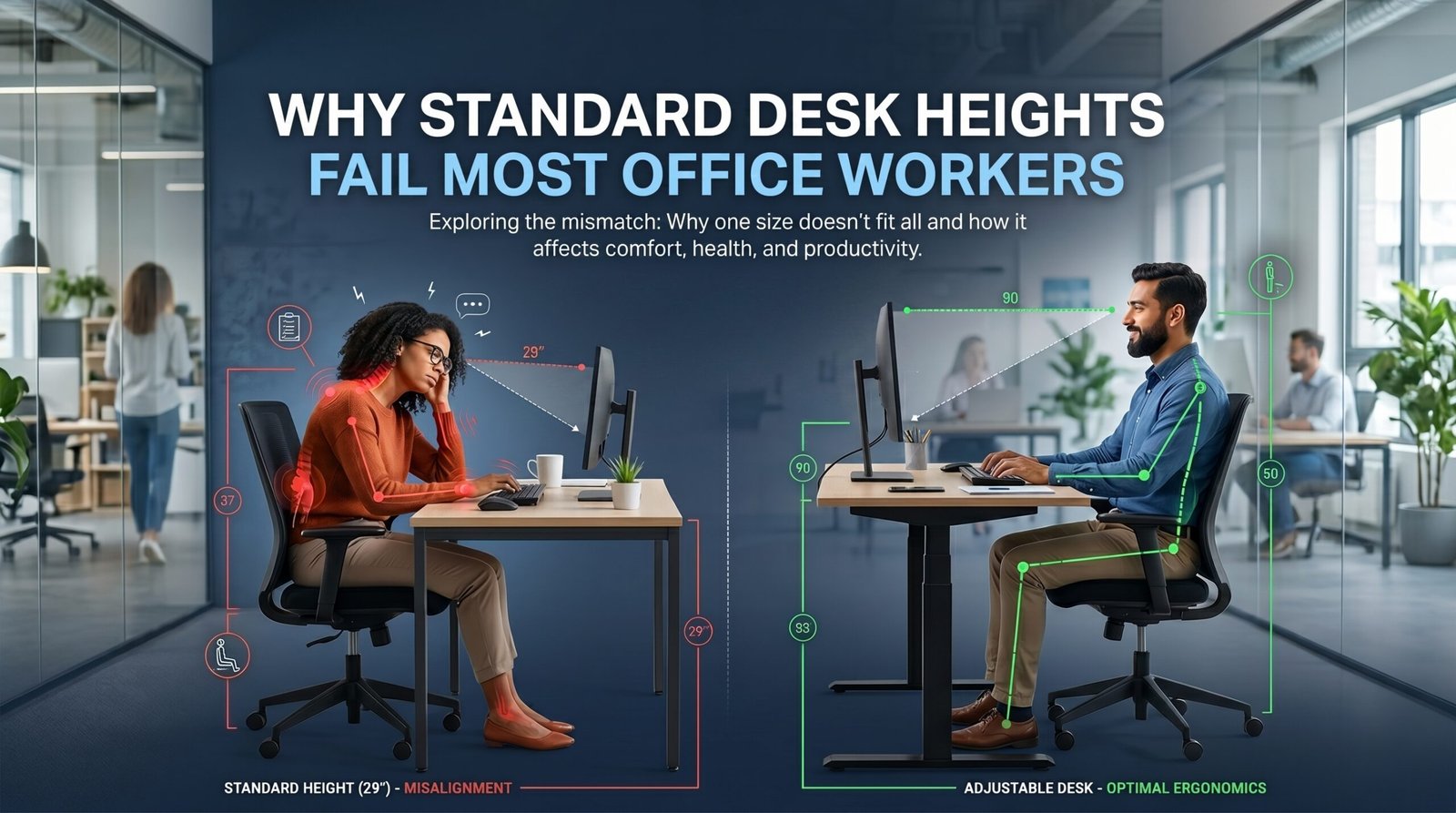
Walk into virtually any conventional office in Dubai, Abu Dhabi, or Sharjah, and you will find the same piece of furniture repeated from one end of the floor to the other: a desk standing precisely 73 to 75 centimeters from the ground. This dimension was not derived from biomechanical research or population-wide anthropometric studies. It emerged from the manufacturing constraints of mid-twentieth century furniture production, when standardization was an industrial necessity and the workforce was assumed to be broadly uniform in body size.
That assumption was never accurate, and in today’s radically diverse workplaces it is actively harmful. The UAE alone draws talent from over 200 nationalities, producing one of the most anthropometrically heterogeneous office populations on the planet. A Filipino accountant standing 155 cm tall sits at the same fixed desk as a Dutch engineer measuring 195 cm. Neither individual works at a height that supports neutral posture, and both pay the price in daily discomfort, reduced concentration, and, over months and years, cumulative musculoskeletal damage.
This article goes beyond generic ergonomics advice. Drawing on established biomechanical principles, international anthropometric data, and the realities of working life in the UAE, it presents the scientific, economic, and practical case for rethinking the standard desk — and for choosing the adjustable desk UAE professionals increasingly demand.
1: Understanding the Anatomy of a “Standard” Desk Height
Where Does 73–75 cm Come From?
The 73 cm desk height became a de facto global standard during the 1950s and 1960s, driven largely by the American furniture industry’s need to mass-produce a single height for office and home use. Early ergonomics studies of that era, such as those influencing the United States General Services Administration’s furniture specifications, were based on samples of predominantly white, male, American workers — a demographic whose average stature was roughly 175 cm.
The arithmetic was straightforward: for a 175 cm man seated in a chair of approximately 45 cm, a desk surface at 73 cm placed the forearms at a roughly horizontal position, which was considered adequate for typewriter use. Today, neither the workforce demographics nor the nature of desk-based tasks are remotely comparable to those conditions, yet the furniture dimension persists largely unchanged.
ISO 9241-5, one of the primary international ergonomics standards covering workstation layout and postural requirements, explicitly acknowledges that a fixed-height desk cannot satisfy the full range of human body dimensions and recommends adjustability as the preferred solution. Despite this, fixed-height desks continue to dominate most procurement budgets, particularly in markets where upfront cost is weighted more heavily than total cost of ownership.
The Myth of the “Average” Worker
Ergonomics science has long debunked the concept of an average worker whose body perfectly matches any standardized furniture dimension. A landmark study published in Human Factors demonstrated that designing for the fiftieth-percentile user simultaneously fails every individual who falls outside a narrow band around that midpoint — which, in a sufficiently diverse population, is nearly everyone.
In the UAE context, this problem is compounded by extraordinary demographic breadth. Research on South Asian populations, which make up a significant proportion of the UAE’s professional workforce, records average male stature figures ranging from 163 cm to 168 cm — well below the European benchmark around which the 73 cm desk was designed. Conversely, employees of Northern European or Sub-Saharan African origin regularly exceed 185 cm. A single fixed desk height cannot serve both populations; it fails all of them to different degrees.
Standard Desk Height vs. Ideal Ergonomic Range by User Stature
| User Height (cm) | Standard Desk (73–75 cm) | ISO-Recommended Range | Ergonomic Gap | Risk Level |
|---|---|---|---|---|
| 145–155 | 73–75 cm (far too high) | 58–62 cm | 11–17 cm above ideal | Very High |
| 156–163 | 73–75 cm (too high) | 62–66 cm | 7–13 cm above ideal | High |
| 164–170 | 73–75 cm (marginally high) | 66–69 cm | 4–9 cm above ideal | Moderate |
| 171–177 | 73–75 cm (near adequate) | 69–72 cm | 1–6 cm above ideal | Low–Moderate |
| 178–183 | 73–75 cm (borderline low) | 72–76 cm | Within ±2 cm | Low |
| 184–190 | 73–75 cm (too low) | 76–80 cm | 1–7 cm below ideal | Moderate–High |
| 191–200 | 73–75 cm (far too low) | 80–86 cm | 7–13 cm below ideal | Very High |
Based on ISO 9241-5 elbow-height methodology. All measurements assume standard seated posture with feet flat on floor. Source: OfficeMaster.ae Ergonomics Research.

2: The Ergonomics Science Behind Ideal Desk Height
The Elbow-Height Principle
The most reliable single measurement for determining ideal desk height is seated elbow height — the vertical distance from the floor to the underside of a relaxed, bent elbow when a person is seated with feet flat on the ground and the spine in a neutral, upright posture. Ergonomic guidelines from OSHA, the Health and Safety Executive (HSE), and ISO consistently recommend that the desk work surface should align within approximately 2 to 3 centimeters above or below this measurement.
When elbow height alignment is achieved, the upper arms hang naturally at the sides, forearms extend forward at a horizontal or slightly downward angle, and wrists remain in a neutral position — neither extended upward nor flexed downward. This configuration minimizes muscle activation in the neck, shoulders, and upper back, reducing the static load that accumulates over a full working day.
Critically, elbow height varies not only with overall stature but also with sitting height, torso length, arm length, and the height of the seat being used. A worker with a long torso and short arms will have a very different elbow height from a worker of identical total stature but different proportional dimensions. This variability makes a single fixed desk surface fundamentally inadequate, even within a narrow height range.
Wrist Neutrality and Keyboard Positioning
For keyboard-intensive roles — which includes the vast majority of modern knowledge workers — wrist neutrality is as important as elbow alignment. A wrist in extension (bent upward toward the back of the hand) places the carpal tunnel under compression, increasing the risk of carpal tunnel syndrome, tendinitis, and related repetitive strain injuries. A desk surface that is even modestly too high forces the forearms to incline upward, automatically pushing wrists into extension.
The correct ergonomic setup for keyboard use positions the keyboard surface at or slightly below elbow height, with wrists straight and fingers angling gently downward to the keys. Where a desk surface cannot be lowered, keyboard trays mounted on adjustable arms can partly compensate — but they introduce their own trade-offs in terms of stability, reach, and usability, and they do not solve the underlying monitor height problem that an overly tall desk typically produces.
Monitor Height, Neck Flexion, and Cervical Load
Desk height and monitor height are inextricably linked. In the overwhelming majority of office configurations, monitors rest directly on the desk surface or on a fixed riser. The height of the monitor’s top edge therefore tracks the height of the desk. An overly high desk — as experienced by shorter workers — forces the monitor up as well, causing the user to look upward. An overly low desk drops the monitor, forcing the neck into chronic forward flexion.
Biomechanical research published in Spine journal has quantified the cervical load at various neck flexion angles. At 0 degrees (fully upright), the head exerts approximately 5 kg of effective load on the cervical spine. At just 30 degrees of forward flexion — a posture common among workers whose monitors are placed too low — this effective load increases to approximately 18 kg. At 45 degrees, it reaches roughly 22 kg. Over hours and years, this load accelerates disc degeneration, facet joint stress, and the chronic neck pain that has become the defining occupational health complaint of the digital era.
The ideal monitor position, established by ISO 9241-303 and consistent with recommendations from the American Occupational Therapy Association, places the top edge of the screen at or slightly below eye level, with the viewing distance between 50 and 70 centimeters. Achieving this when the desk height is fixed and mismatched to the user’s body requires a chain of compensating adjustments — most of which are imperfect, unstable, or ergonomically counterproductive.

Seated vs. Standing Posture Mechanics
Extended static sitting — particularly in a poorly configured seated posture — is now well understood as an independent health risk factor. Studies published in journals including Annals of Internal Medicine have found that prolonged sitting is associated with elevated risks of cardiovascular disease, metabolic syndrome, and musculoskeletal disorders, independently of overall physical activity levels. This has driven substantial interest in sit-stand desk solutions that allow workers to alternate posture throughout the day.
When standing at a desk, the ideal work surface height follows the same elbow-height principle, but applied to standing elbow height rather than seated. For most adults, standing elbow height falls between 95 cm and 115 cm depending on stature, significantly higher than a standard fixed desk and therefore requiring a different surface position entirely. A height-adjustable desk that transitions between seated and standing positions addresses both requirements simultaneously — a capability that no fixed-height surface can provide.
Research from Lough-borough University and the Institute of Occupational Medicine suggests that alternating between sitting and standing at approximately 30-minute intervals produces the greatest benefits for both musculoskeletal health and self-reported energy levels. This rhythm is only achievable with a motorized or manually adjustable desk — making ergonomic workspace solutions that incorporate height adjustability a functional necessity rather than a premium luxury.
User Height vs. Recommended Seated and Standing Desk Heights
| User Height | Seated Desk Height | Standing Desk Height | Chair Height | Monitor Top Edge |
|---|---|---|---|---|
| 150 cm (4’11”) | 58–61 cm | 90–94 cm | 38–42 cm | 95–100 cm |
| 155 cm (5’1″) | 60–63 cm | 92–96 cm | 39–43 cm | 97–102 cm |
| 160 cm (5’3″) | 62–65 cm | 94–98 cm | 40–44 cm | 100–105 cm |
| 165 cm (5’5″) | 64–67 cm | 96–100 cm | 42–46 cm | 103–108 cm |
| 170 cm (5’7″) | 66–69 cm | 98–102 cm | 43–47 cm | 106–111 cm |
| 175 cm (5’9″) | 69–72 cm | 100–105 cm | 44–48 cm | 109–114 cm |
| 180 cm (5’11”) | 71–74 cm | 103–108 cm | 45–49 cm | 112–117 cm |
| 185 cm (6’1″) | 74–77 cm | 106–111 cm | 47–51 cm | 115–120 cm |
| 190 cm (6’3″) | 77–80 cm | 109–114 cm | 48–52 cm | 118–123 cm |
| 195 cm (6’5″) | 80–84 cm | 112–117 cm | 50–54 cm | 121–126 cm |
Derived from ISO 9241-5 elbow-height methodology. Ranges account for ±2 cm preference variation. Measurements assume a mid-range ergonomic chair with adjustable seat height. Source: OfficeMaster.ae Ergonomics Research.

3: The Health Consequences of Incorrect Desk Height
The health impacts of a mismatched desk height are neither theoretical nor minor. They manifest progressively over weeks, months, and years of daily exposure, beginning as minor discomfort and evolving into conditions that significantly impair quality of life, require medical intervention, and generate substantial economic costs for individuals and organizations alike.
Neck and Cervical Spine Disorders
Chronic neck pain is consistently ranked among the most common musculoskeletal complaints in office populations globally. A desk that is too low forces the monitor downward and causes habitual forward neck flexion. A desk that is too high causes the neck to extend backward or the head to tilt to one side to maintain viewing comfort. Both patterns create sustained asymmetric loading on the cervical vertebrae, facet joints, and supporting musculature.
Over time, this leads to tension myalgia — painful muscle spasm and knot formation in the trapezius, levator scapulae, and sternocleidomastoid muscles — and can progress to disc herniation, cervical spondylosis, and radiculopathy (nerve root compression causing radiating pain and weakness into the arms and hands). In the UAE’s high-intensity work culture, where long working hours are common and breaks are often infrequent, these risks are elevated beyond global averages.
Shoulder and Upper Limb Disorders
A desk set too high forces users to elevate their shoulders continuously to reach the keyboard and mouse — a posture that places the supraspinatus tendon and subacromial bursa under chronic compression. Rotator cuff tendinitis, shoulder impingement syndrome, and bicipital tendinitis are among the most prevalent upper limb disorders in keyboard-intensive workers and are strongly associated with elevated workstation heights relative to elbow height.
A desk set too low forces users to round their shoulders forward and downward to reach the work surface, creating a different but equally harmful pattern of anterior capsule stress and posterior muscle overload. Either configuration disrupts the delicate balance of the shoulder girdle and accelerates degenerative changes in joint structures that may require physiotherapy or surgical intervention.
Lower Back Pain and Lumbar Spine Loading
While lumbar spine health is more directly influenced by chair design and seat height than by desk height alone, the interaction between desk and chair is critical. When a desk is too high, users tend to raise their seat height to compensate, which often causes the feet to lose contact with the floor — shifting the load from the feet to the back of the thighs and increasing pressure on the ischial tuberosities while destabilising the pelvis. This pelvic instability leads to posterior pelvic tilt, flattening of the lumbar curve, and dramatically increased compressive load on the lumbar discs.
Research from the Occupational Ergonomics Handbook documents that lumbar disc pressure in a poorly supported seated posture can reach levels 40 to 50 percent higher than in well-supported neutral sitting. For workers spending eight or more hours per day in this configuration, the cumulative disc loading over a working week represents a significant accelerant of degenerative disc disease — one of the leading causes of chronic lower back pain and disability worldwide.

Wrist and Hand Disorders
Carpal tunnel syndrome, De Quervain’s tenosynovitis, and ulnar tunnel syndrome are all conditions with a strong occupational ergonomics dimension. They are driven partly by repetitive motion but significantly exacerbated by sustained wrist deviation — extension, flexion, or ulnar/radial deviation — while typing or using a pointing device. A desk that is even slightly too high relative to elbow height consistently produces wrist extension during keyboard use, as the forearm must incline upward to the surface and the wrist then bends back to keep the fingers on the keys.
Visual Fatigue and Headaches
Eye strain, headaches, and visual fatigue are often attributed solely to screen quality or lighting conditions, but workstation geometry plays a significant and frequently overlooked role. When the monitor is positioned too high — as occurs when a desk is too tall for a shorter user and a monitor sits directly on its surface — the eyes must remain in a sustained upward gaze position. The extraocular muscles responsible for this movement fatigue more rapidly than those used for downward gaze, producing ocular discomfort, blurry vision at the end of the day, and tension headaches radiating from the occiput.
Conversely, a desk set too low places the monitor below a comfortable viewing angle, causing the user to adopt a chin-to-chest posture that both strains the neck and creates an oblique viewing angle that demands additional vergence effort from the visual system. Correct desk height, producing correct monitor placement, eliminates an entire category of ergonomic risk that many workers and employers never identify as desk-related.
Health Risks of Incorrect Desk Height — A Structured Risk Matrix
| Health Condition | Desk Too High | Desk Too Low | Onset Timeline | Severity if Untreated |
|---|---|---|---|---|
| Neck / Cervical Pain | Neck extension & lateral tilt | Chronic forward flexion | 2–12 weeks | Severe — disc herniation risk |
| Shoulder Impingement | Elevated shoulders, rotator cuff strain | Rounded shoulders, anterior stress | 4–16 weeks | Moderate–Severe |
| Wrist / Carpal Tunnel | Wrist extension during typing | Wrist flexion, awkward reach | 8–24 weeks | Moderate — surgery risk |
| Lower Back Pain | Raised seat, feet off floor, pelvic tilt | Slouching, reduced lumbar support | 4–20 weeks | Severe — chronic disability |
| Eye Strain & Headaches | Monitor too high, upward gaze | Monitor too low, downward oblique gaze | Days to weeks | Moderate |
| Upper Back Tension | Trapezius overload from shoulder elevation | Thoracic flexion and kyphosis | 2–8 weeks | Moderate |
| Reduced Concentration | Discomfort creates cognitive distraction | Fatigue from postural compensation | Immediate | Significant productivity loss |
| Forearm / Elbow Pain | Lateral epicondylitis (tennis elbow) | Medial stress from low reach angle | 8–20 weeks | Moderate |
Timeline estimates based on aggregate ergonomics research and clinical occupational health literature. Individual variation is significant. Source: OfficeMaster.ae Ergonomics Research.

4: The UAE Workplace Context — Why This Problem Is Magnified Locally
Demographic Diversity and Anthropometric Spread
The UAE’s workforce diversity is unmatched in the Gulf region and rivals that of major global cities such as London or Toronto. Expatriates constitute approximately 88 to 90 percent of the country’s total population, drawn from South Asia, Southeast Asia, the Arab world, Sub-Saharan Africa, Europe, and the Americas. The resulting spread of body dimensions in any given office is therefore vast — typically spanning 40 centimeters or more between the shortest and tallest individuals on the same floor.
Standard-height office furniture Dubai suppliers and global catalogue products alike are designed to a European or North American benchmark. This creates a structural ergonomic disadvantage for the large proportion of the UAE workforce whose stature, arm length, and sitting height fall below that benchmark. Without workstation adjustability, these workers cannot achieve neutral posture regardless of how they position their chair, and the cumulative health impact falls disproportionately on the demographic groups least likely to raise formal occupational health concerns.
Long Working Hours and Heat-Related Fatigue
The UAE’s working culture in many sectors involves extended working hours, particularly in finance, legal services, real estate, and construction project management. When a worker is already contending with the postural stress of an incorrectly sized workstation, the duration of exposure multiplies the physiological burden. A misalignment that might produce only mild discomfort in a six-hour working day can become acutely painful over a ten or twelve-hour session.
Additionally, the UAE’s climate requires most workers to transition repeatedly between intense outdoor heat and heavily air-conditioned indoor environments. These thermal fluctuations affect muscle tone, circulation, and the sensitivity of musculoskeletal tissue to mechanical stress. Ergonomic workspace solutions that might partially compensate for postural mismatches in more temperate climates — such as short movement breaks and outdoor standing periods — are less available in a 45-degree summer environment, making the quality of indoor workstation setup even more consequential.
The Remote and Hybrid Work Dimension
Since 2020, remote and hybrid working arrangements have become standard across the UAE’s knowledge economy sectors. However, the transition to home-based work has not been accompanied by a corresponding transition in furniture quality. Most home environments in the UAE — whether apartments in Dubai Marina, villas in Arabian Ranches, or company accommodation in industrial zones — were furnished without ergonomic criteria in mind.
Kitchen tables, coffee tables, and general-purpose dining furniture are routinely repurposed as workstations, with virtually no correlation between their fixed heights and the user’s ergonomic requirements. The health impact of this arrangement compounds over months and years. For HR managers and corporate decision-makers, the office setup UAE issue now extends beyond the physical office to encompass home workstations — creating both a duty-of-care consideration and an opportunity to deploy ergonomic desk solutions as a meaningful employee benefit.

5: Adjustable Desks — The Evidence-Based Solution
Height-Adjustable Desks: What the Research Shows
The evidence base for height-adjustable desks has matured significantly over the past decade. A systematic review published in Applied Ergonomics examining multiple randomised and quasi-experimental studies found that sit-stand desk interventions reduced self-reported musculoskeletal discomfort by an average of 32 percent compared to fixed-height conditions. Participants using sit-stand desks also reported statistically significant improvements in energy levels, concentration, and job satisfaction.
A separate study conducted at a large corporate headquarters tracked productivity metrics alongside ergonomic assessments and found that workers transitioned to height-adjustable desks completed tasks requiring sustained concentration 46 minutes faster per eight-hour day compared to matched fixed-desk controls — a productivity gain attributable primarily to reduced discomfort-related distraction and improved postural comfort.
The standing desk Dubai market has grown substantially in response to this evidence, with both multinational corporations establishing UAE operations and domestic companies increasingly specifying adjustable workstations as standard fitout requirements. The economic case is compelling: the productivity gains and absenteeism reductions achievable through proper ergonomic desk solutions typically produce a return on the additional desk investment within twelve to eighteen months.
Electric vs. Manual Height-Adjustable Desks
Height-adjustable desks available in the UAE market fall into two primary categories: electrically motorized desks with push-button or touchpad controls, and manually adjustable desks using pneumatic, cranked, or pin-and-lock mechanisms. Each category has distinct trade-offs relevant to different office environments and individual use cases.
Motorized desks offer the lowest barrier to height adjustment — a factor that research has shown to be critical to actual usage rates. Studies tracking sit-stand desk behaviour in workplace settings consistently find that workers adjust their desk more frequently when adjustments require minimal effort and time. Desks requiring manual cranking are adjusted far less often, with many users ultimately parking the desk at a single height and abandoning the sit-stand behavior pattern within weeks of installation.
For corporate procurement in the UAE, motorized desks with programmable height presets represent the gold standard. Individual users can store their personal seated and standing heights as one-touch presets, eliminating the friction of daily adjustment entirely. When evaluating the best office furniture Dubai suppliers can offer, the quality of the lifting mechanism, the rated load capacity, and the stability under load are the primary technical specifications to verify.

Selecting the Correct Desk Height Range
Not all height-adjustable desks offer the same range of adjustment, and this is a critical specification that is frequently overlooked in purchasing decisions. A desk with an adjustment range of 68 to 117 cm will accommodate the needs of workers between approximately 155 cm and 195 cm in stature — covering the large majority of a typical UAE office population. However, organizations employing significant numbers of workers below 160 cm in height should seek desks with a lower minimum height setting, ideally reaching 60 cm or below.
The adjustable desk UAE market includes products at a wide range of price points, from budget-oriented manual models to premium motorized systems from European manufacturers. When selecting among options, procurement teams should priorities adjustment range, stability at maximum height, cycle durability of the lifting mechanism, and warranty coverage. The lowest-cost option frequently proves the most expensive over a three to five-year ownership horizon due to mechanism failure, limited adjustment range that fails shorter or taller employees, and insufficient load capacity for dual-monitor setups.
Complementary Ergonomic Investments
A height-adjustable desk is the central element of an ergonomic workstation, but it functions as part of an integrated system. To achieve the full health and productivity benefits that ergonomic desk solutions can provide, several complementary investments are also required: an ergonomic chair with seat height, lumbar support, armrest, and tilt adjustment; a monitor arm enabling independent height, depth, and tilt positioning; a keyboard tray where the monitor arm configuration does not bring the keyboard to optimal height through desk adjustment alone; and an anti-fatigue mat for standing periods.
OfficeMaster.ae offers a comprehensive range of office furniture designed and sourced with UAE workplace ergonomics as a primary criterion — from motorized sit-stand desks and ergonomic task chairs to monitor arms, keyboard trays, and coordinated office setup UAE packages for both corporate and home-office environments.

6: Practical Ergonomics Assessment — How to Identify and Fix a Mismatched Desk
The Four-Step Self-Assessment Protocol
Any office worker can conduct a basic ergonomic self-assessment in under five minutes using the following protocol, derived from guidelines published by OSHA and the Chartered Institute of Ergonomics and Human Factors:
- Sit in your chair with feet flat on the floor and spine upright against the backrest. Note whether the chair height allows this without your knees being above your hips.
- Relax your arms at your sides and bend your elbows to approximately 90 degrees. Note the height of your forearms above the floor. This is your seated elbow height.
- Compare your seated elbow height to your desk surface height. If your desk is more than 3 cm above your elbow height, the desk is too high for you. If it is more than 3 cm below, the desk is too low.
- Position yourself to type. Without adjusting your posture, observe your wrist angle. If your wrists are bent upward (extended), the desk is too high. If bent downward (flexed), it may be too low.
This four-step check identifies the presence and direction of desk height mismatch. It does not quantify the ergonomic risk with clinical precision, but it provides immediately actionable information about whether adjustment is needed and in which direction.
Interim Solutions While Awaiting a New Desk
Where procurement of a new adjustable desk is not immediately possible, the following interim measures can partially mitigate the health impact of a mismatched desk height, though none substitutes for a correctly sized workstation:
- For a desk that is too high: raise the seat height as far as possible while maintaining foot support, and use a footrest if feet no longer reach the floor. This raises your elbow height to bring it closer to the desk surface.
- For a desk that is too low: add a stable risers beneath the desk legs (where structurally appropriate) or switch to a chair with a lower minimum seat height.
- In both cases: use a separate monitor arm to position the screen independently of the desk surface, addressing the monitor height problem without resolving the keyboard height issue.
- Increase movement frequency: standing, walking, and stretching every 30 minutes reduces the total postural loading accumulated in a mismatched posture, even if the underlying geometry remains suboptimal.
A Workstation Ergonomics Checklist for HR Managers and Facilities Teams
For HR managers and corporate decision-makers conducting fleet assessments of an office population’s workstation setup UAE, the following criteria provide a systematic audit framework:
- Desk height range: Can the current desk accommodate all employees between 155 cm and 195 cm in height with elbow-height alignment?
- Chair height range: Does the chair’s minimum seat height allow shorter employees to achieve elbow-height alignment without raising the seat so high that foot support is lost?
- Footrest provision: Are footrests available for employees who require a raised seat height to reach a fixed desk surface?
- Monitor positioning: Are monitors independently position-able, or are they constrained to the desk surface height?
- Keyboard positioning: Is the keyboard surface at or below elbow height for all users, without wrist extension?
- Standing option: Do any workstations provide a standing height option, and is the use of that option actually encouraged and facilitated?
- Training and awareness: Have employees been informed of how to adjust their workstation and why correct setup matters?

7: The Business Case — Ergonomics ROI for UAE Organizations
For senior leadership and procurement decision-makers, ergonomic investment must ultimately be justified in business terms. The academic case is well-established; what matters for budget allocation is the return on investment.
The Liberty Mutual Workplace Safety Index, one of the most cited analyses of occupational injury economics, consistently estimates that musculoskeletal disorders the category most directly linked to poor workstation ergonomics account for over 30 percent of all workplace injury costs in knowledge-economy environments. In the UAE, where competitive talent acquisition costs are high and replacing a skilled knowledge worker can cost 50 to 200 percent of annual salary, musculoskeletal-related turnover represents a significant and frequently underestimated organizational expense.
Absenteeism data reinforces this picture. A study published in the Journal of Occupational and Environmental Medicine found that employees with work-related musculoskeletal disorders took an average of 14.5 additional sick days per year compared to peers without such disorders. For an organization with 100 knowledge workers, even a modest 10 percent prevalence of ergonomics-related musculoskeletal conditions represents approximately 145 additional absent days per year a productivity loss that a one-time investment in ergonomic workstations can substantially reduce.
Additionally, UAE Labour Law and Federal Decree Law provisions on occupational health create a compliance dimension. While specific regulatory requirements for workstation ergonomics are less prescriptive in the UAE than in some European jurisdictions, the general duty of care framework creates legal exposure for employers whose workers develop demonstrable musculoskeletal injuries attributable to identifiable inadequate workstation conditions.
When the combined value of productivity recovery, absenteeism reduction, talent retention improvement, and legal risk mitigation is set against the incremental cost of specifying adjustable rather than fixed workstations, the business case for ergonomic office furniture including motorized sit-stand desks from reputable suppliers of office furniture Dubai buyers can trust is compelling across virtually all modelling scenarios.

Frequently Asked Questions: Desk Height, Ergonomics, and Adjustable Workstations UAE
What is the ideal desk height for my height?
The ideal desk height equals your seated elbow height: sit upright with feet flat on the floor, relax your arms, and bend your elbows to 90 degrees. The distance from the floor to the bottom of your forearm is your target desk height. For most people this falls between 58 cm (for a 150 cm person) and 80 cm (for a 195 cm person). Use Table 2 in this article for precise recommendations by stature.
Why does my desk feel too high even though it is the standard height?
Standard desk height (73–75 cm) is calibrated for a person approximately 175–178 cm tall. If you are shorter than this benchmark, the standard desk will feel too high — because it is, relative to your body. Your elbows sit below the desk surface, forcing your shoulders to elevate and your wrists to extend. The solution is a lower desk surface, a raised chair with footrest, or — ideally — a height-adjustable desk.
Can my chair compensate for a desk that is the wrong height?
Partially but not fully. Raising or lowering a chair can bring your elbow height closer to a fixed desk surface, but this trade-off creates new problems. Raising the chair to reach a high desk often lifts your feet off the floor, eliminating foot support and destabilizing the pelvis. Lowering the chair to reduce reach to a low desk pushes your knees above your hips, compressing lumbar discs. A footrest can help with the first problem but cannot substitute for a desk at the correct height.
What is the correct desk height for standing?
For standing work, the desk surface should align with your standing elbow height — typically between 95 cm and 115 cm depending on your stature. Standing desk height should position forearms horizontally or slightly downward, with wrists neutral. This is significantly higher than any standard fixed desk, which is why a height-adjustable desk that transitions between sitting and standing heights is the only workstation format that supports both postures.
Is a standing desk actually better for you?
Standing desks are not inherently better — the benefit comes from alternating between sitting and standing rather than staying in either position for extended periods. Research supports 20 to 30-minute intervals of each posture as the most effective pattern for musculoskeletal health, cardiovascular function, and energy levels. A sit-stand desk that makes this alternation easy is the ergonomically optimal solution; standing all day introduces its own risks of lower limb fatigue and varicose vein development.
What desk height is right for someone 160 cm tall?
For a person 160 cm tall, the ideal seated desk height is approximately 62 to 65 cm, and the standing desk height should be approximately 94 to 98 cm. Standard desks at 73 to 75 cm place the work surface approximately 8 to 13 cm above the seated elbow height for this individual, forcing chronic shoulder elevation and wrist extension throughout the working day.
How do I know if my desk height is causing my neck pain?
If your neck pain worsens through the working day and improves on rest days or holidays, workstation ergonomics is a probable contributor. Specifically: if your monitor is positioned above eye level (desk too high for your stature), you are looking upward and extending your neck. If it is far below eye level, you are in chronic forward flexion. Both patterns produce exactly the type of progressive cervical muscle strain and tension headache pattern that characterises workstation-related neck disorders.
Are height-adjustable desks available in the UAE?
Yes. The adjustable desk UAE market has expanded significantly, with height-adjustable workstations available from international brands through local suppliers, as well as from UAE-based ergonomic office furniture specialists including OfficeMaster.ae. Products range from manual pin-lock and pneumatic designs to premium motorized systems with digital height memory presets, available in a range of finishes and sizes suited to both corporate and home office environments.
What is the best desk height for typing?
The ideal desk height for typing positions the keyboard surface at or just below your seated elbow height — typically 2 to 4 cm below — so that your forearms are horizontal or angled very slightly downward and your wrists remain in a neutral, unbent position. This places the key-striking fingers below the wrist line, reducing carpal tunnel pressure and minimizing the muscle activation required to sustain the typing posture.
How often should I switch between sitting and standing at a height-adjustable desk?
Ergonomics research converges on a recommendation of alternating between sitting and standing approximately every 20 to 30 minutes. In practice, a workday rhythm of sitting for 25 minutes and standing for 15 to 20 minutes — adjusted to task demands — produces the greatest combined benefits for musculoskeletal comfort, energy, and concentration. Anti-fatigue mats are recommended for standing periods exceeding 15 minutes.
Does desk height affect productivity?
Yes, significantly. Postural discomfort created by an incorrectly sized workstation is a continuous source of distraction that competes with cognitive focus. Studies measuring task completion rates and error rates consistently find productivity benefits when workers transition from poorly fitted fixed desks to correctly adjusted workstations. One corporate study found nearly 46 minutes per day of effective productive time recovered after adjustable desk deployment — a figure that compresses the return on investment timeline substantially.
What is workstation ergonomics, and why does it matter in UAE offices?
Workstation ergonomics is the science of designing work environments to fit the human body, minimizing physical strain and maximizing comfort, health, and performance. It matters in UAE offices for several compounding reasons: the workforce is extraordinarily diverse in body dimensions, working hours are typically long, remote and hybrid arrangements have expanded to less-controlled home environments, and competitive talent markets make employee health retention a significant economic variable. Ergonomic workspace solutions are therefore both a health imperative and a strategic business investment.
Can ergonomic desk height reduce sick leave?
Yes. Musculoskeletal disorders attributable to poor workstation ergonomics are among the leading causes of short-term and long-term sickness absence in office worker populations. Studies tracking absenteeism before and after ergonomic intervention programmes — including desk height correction and adjustable workstation deployment — consistently document reductions in musculoskeletal-related sick days of 25 to 50 percent. For organizations with large office populations, this represents a financially material impact on operational continuity and HR management costs.
What should I look for when buying an adjustable desk in Dubai?
When purchasing a standing desk Dubai market product, priorities: height adjustment range (ideally 60 to 125 cm minimum to maximum), stability under load at maximum height, motor quality and cycle-life rating for motorized models, surface area sufficient for your equipment, load capacity in relation to your monitor setup, warranty coverage, and supplier after-sales support. Choosing a supplier with UAE-based inventory and local service capability reduces lead times and resolves warranty claims more efficiently than ordering from overseas.
Is there a standard desk height in the UAE?
There is no UAE-specific regulatory standard mandating a particular desk height. UAE Federal Law on Labour Relations and the associated Ministerial Decisions contain general provisions regarding safe and healthy working conditions but do not prescribe specific furniture dimensions. In practice, most commercial office furniture supplied in the UAE defaults to the international de facto standard of 73 to 75 cm — a height that, as this article demonstrates, is poorly suited to a significant proportion of the UAE’s working population.
The Standard Desk Is a Relic — Your Workforce Deserves Better
The 73 cm desk is not a product of ergonomic research. It is an industrial legacy — a manufacturing convenience that has persisted through inertia for more than half a century while the science of human factors has developed unambiguous evidence that it fails the majority of people who use it. In the UAE, where workforces are among the most anthropometrically diverse on earth and working hours among the most demanding, the cost of this mismatch — in health, productivity, absenteeism, and talent retention — is both significant and preventable.
The solution is not complex. An adjustable desk, correctly specified and deployed within a fully ergonomic workstation setup, eliminates the postural compromises that fixed furniture forces upon workers of every height, proportion, and work style. The evidence for the health benefits is robust; the business case is compelling; and the product availability in the UAE market, through specialist suppliers of office furniture Dubai professionals rely on, has never been greater.
For HR managers, this is a workforce health and retention investment. For architects and fit-out teams, it is a design standard whose omission creates long-term liability. For individual professionals, it is a daily quality-of-life decision whose returns compound over every working year. And for corporate decision-makers, it is one of the highest-return ergonomic workspace solutions available within a standard office fitout budget.
OfficeMaster.ae provides expert guidance, specification support, and a curated range of ergonomic office furniture — including motorized height-adjustable desks, ergonomic chairs, monitor arms, and complete workstation packages — designed specifically for the UAE professional environment. Contact our team to arrange a complimentary ergonomic consultation or to explore our full range of ergonomic workspace solutions for teams of any size.