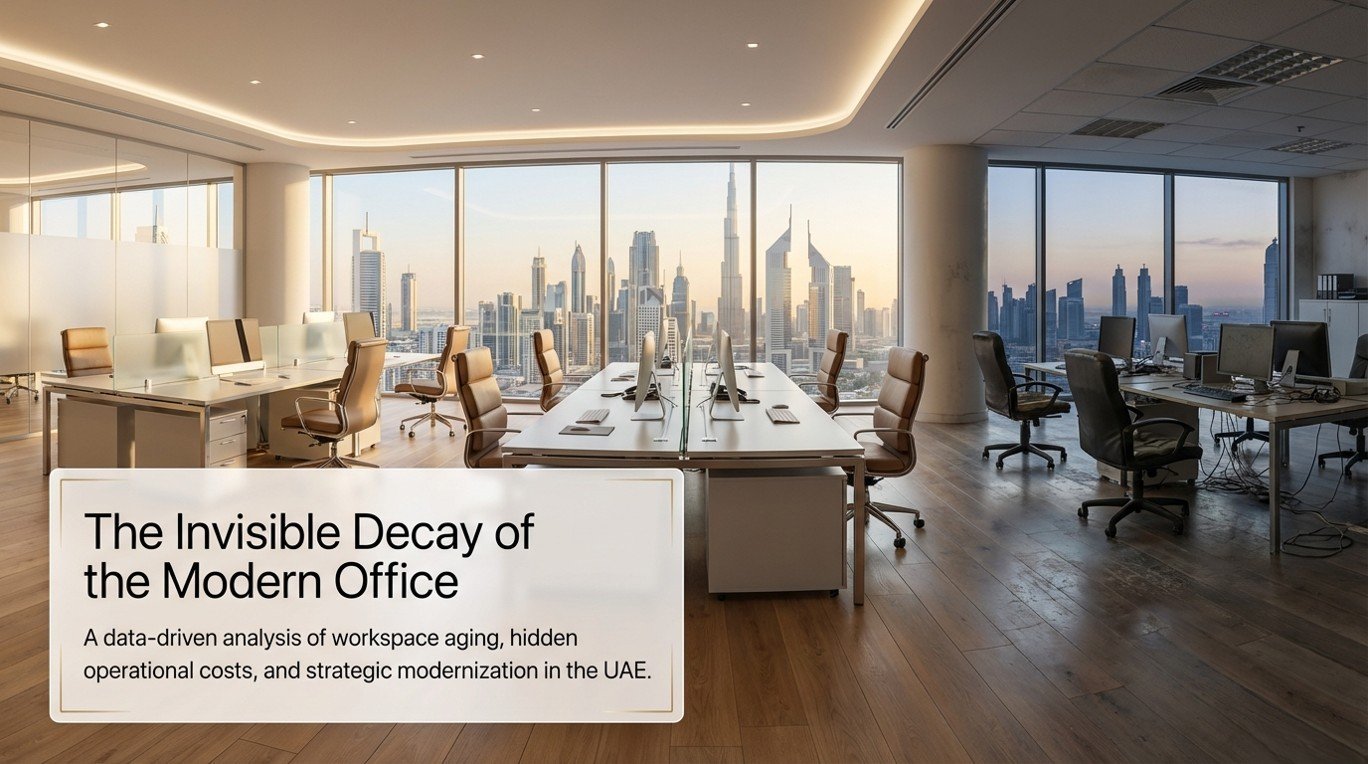
The Invisible Decay of the Modern Office
Every office ages. Unlike the sharp depreciation curve of a company vehicle or the visible deterioration of industrial machinery, the decline of an office workspace is insidious — incremental, often unnoticed until its effects have already undermined productivity, talent retention, and brand perception. The chair that was ergonomically exemplary in 2016 is a musculoskeletal liability by 2026. The open-plan layout that was progressive in 2012 is now an acoustic nightmare in a hybrid work era. The reception area that impressed clients a decade ago now communicates stagnation rather than success.
This is the aging curve of office workspaces: a predictable, data-traceable progression through identifiable lifecycle phases, each carrying measurable cost, health, and productivity implications. Understanding this curve is not merely an interior design consideration — it is a strategic business imperative.
For organizations across the UAE — where commercial property markets are dynamic, talent competition is intense, and economic diversification strategies demand globally competitive working environments — the timing and quality of workplace investment decisions carry exceptional weight. Whether you are selecting premium office furniture for a new headquarters in DIFC, planning a phased refurbishment of an established operation in Business Bay, or bench marking your workspace against global competitors, the intelligence contained in this guide is designed to inform every stage of that journey.
“The workspace is the most persistent physical expression of organizational culture. When it ages gracefully with intentional renewal, it signals ambition. When it deteriorates through neglect, it telegraphs stagnation to every employee and visitor who walks through the door.”
This article provides a comprehensive, data-backed examination of how office workspaces age, the lifecycle phases every corporate environment passes through, the direct and hidden costs of delayed action, and a practical framework for modernization that balances sustainability, budget efficiency, and workforce well being.
1: The Five Lifecycle Stages of an Office Workspace
Office workspaces do not fail abruptly — they decline through five identifiable phases, each characterized by distinct conditions, performance metrics, and financial implications. Understanding which phase your workspace currently occupies is the essential first step in strategic workplace planning.
| Lifecycle Phase | Characteristics | Est. Productivity Index | Maintenance Cost (% of original capex) | Recommended Action |
|---|---|---|---|---|
| Phase 1: Launch (0–2 yrs) | New fit-out, full equipment, high morale | 85–95% | Minimal | None |
| Phase 2: Maturity (2–5 yrs) | Normal wear, dated aesthetics begin | 75–85% | Low (5–10%) | Minor updates |
| Phase 3: Decline (5–8 yrs) | Ergonomic fatigue, outdated tech ports | 60–75% | Moderate (15–25%) | Ergonomic refresh |
| Phase 4: Obsolescence (8–12 yrs) | Structural damage, morale impact, talent loss | 45–60% | High (30–45%) | Full redesign |
| Phase 5: Crisis (12+ yrs) | Compliance risk, safety hazards, reputational damage | <45% | Very High (50%+) | Immediate replacement |
Phase 1 — Launch (Years 0–2): Peak Performance
The launch phase represents the high-water mark of workspace performance. A freshly fitted office benefits from new ergonomic office furniture calibrated to current standards, integrated technology infrastructure, and the psychological uplift that a considered, well-designed environment creates among staff. Absenteeism attributable to musculoskeletal conditions is lowest during this phase. Talent attraction is at its peak. Client-facing areas communicate investment and ambition.
In the Dubai commercial market, this phase typically accompanies a new lease, a company relocation, or a post-investment growth phase. UAE fit-out budgets for Grade A commercial office space currently average between AED 250 and AED 550 per square foot, depending on specification level and whether the project is a new build or a retrofit of an existing shell.
Phase 2 — Maturity (Years 2–5): Functional but Fading
The maturity phase is characterized by stable functionality combined with the early emergence of aesthetic and minor ergonomic wear. Furniture surfaces accumulate micro-scratches and color variation. Chair mechanisms begin to exhibit minor play in adjustment components. Cable management systems that were clean at launch begin to show the strain of cable additions as technology evolves.
This is often the most misunderstood phase because the workspace remains functional. However, the gap between the current environment and the emerging expectations of new hires — particularly those from younger demographic cohorts accustomed to progressive workspace design — begins to widen. Investment in targeted ergonomic maintenance and selective aesthetic refreshes during this phase can extend the productive lifecycle of the workspace by two to three years at a fraction of full redesign costs.

Phase 3 — Decline (Years 5–8): Ergonomic Fatigue Takes Hold
Phase three marks the point at which ergonomic degradation begins to materially affect staff health and productivity. Seat foam compression, lumbar support failure, and armrest mechanism deterioration are the most common presenting issues in chair-heavy environments. Desking systems that were height-adjustable begin to lose calibration precision. Collaborative furniture — lounge seating, meeting chairs, breakout tables — shows accelerated wear due to multi-user exposure.
Technology integration gaps become pronounced in this phase. USB-A ports installed in 2015–2018 are no longer compatible with current device standards. Wireless charging pads, USB-C pass-through, and HDMI 2.1 connectivity, now considered standard in any quality modern office furniture installation, are typically absent from Phase 3 workspaces. This infrastructure gap forces staff to use makeshift solutions — cable adapters, exposed extension leads, and personal hub devices — that both create safety hazards and undermine workspace aesthetics.
Phase 4 — Obsolescence (Years 8–12): Structural and Cultural Impact
Obsolescence is the phase at which delayed investment begins to compound into organizational risk. Structurally, furniture units show joint failures, surface de-lamination, and in the case of seating, base mechanism failures that create genuine injury risk. More insidiously, the workspace now actively communicates a narrative of under-investment to every employee, job candidate, client visitor, and board member who experiences it.
Research from JLL’s 2023 Future of Work report found that 54% of employees globally report that the physical quality of their workplace influences their decision to remain with or leave an employer. In the UAE, where professional mobility between organizations is high and the employer value proposition is scrutinized by an internationally mobile talent pool, a Phase 4 workspace is a measurable recruitment and retention liability.

Phase 5 — Crisis (12+ Years): Compliance, Safety, and Reputational Risk
The crisis phase is characterized by conditions that move beyond inconvenience or aesthetics into the domains of occupational health compliance, safety liability, and reputational damage. Chair bases fail. Desk frames develop structural instability. Acoustic panels de-laminate. Power modules create electrical hazards. In the UAE regulatory context, organizations are subject to the Federal Law on Labor and the UAE Ministerial Resolution No. 32 of 1982 concerning occupational safety, which impose obligations on employers regarding safe and appropriate working conditions.
Crisis-phase workspaces also consume disproportionate maintenance budgets. The compound cost of reactive repairs, temporary substitutions, and the productivity drag of dysfunctional equipment frequently exceeds the annualized cost of proactive replacement — making delayed action financially as well as operationally indefensible.

2: Total Cost of Ownership — The Financial Anatomy of Office Furniture Aging
Understanding the true financial cost of office furniture requires moving beyond the initial purchase price to a Total Cost of Ownership (TCO) framework that accounts for maintenance, productivity loss, and replacement costs across the full asset lifecycle. This perspective consistently reveals that the apparent economy of budget purchasing or delayed replacement is, in most cases, a false economy.
| Furniture Category | Initial Cost Range (AED) | Expected Lifespan | Annual Maintenance Cost | Replacement Cost (Quality) |
|---|---|---|---|---|
| Ergonomic Task Chair | AED 800–2,500 | 5–8 years | AED 200–500/yr | AED 3,000–6,000 |
| Executive Desk | AED 1,500–6,000 | 8–12 years | AED 150–300/yr | AED 5,000–12,000 |
| Meeting Table (8-seat) | AED 4,000–15,000 | 10–15 years | AED 400–800/yr | AED 8,000–20,000 |
| Open-Plan Workstation | AED 1,200–4,000 | 6–10 years | AED 200–400/yr | AED 3,500–8,000 |
| Storage & Filing Units | AED 600–2,000 | 10–15 years | AED 60–150/yr | AED 1,500–4,000 |
| Reception Counter | AED 5,000–20,000 | 8–12 years | AED 600–1,200/yr | AED 8,000–25,000 |
| Lounge/Breakout Seating | AED 2,000–8,000 | 5–7 years | AED 400–800/yr | AED 3,000–10,000 |
Note: Costs reflect mid-to-upper market specifications appropriate for Grade A commercial offices in Dubai. Costs for bespoke, branded, or luxury specification products will be higher. Data informed by OfficeMaster procurement data, CBRE UAE Fit-Out Cost Guide 2024, and industry benchmark surveys.
The Hidden Costs: Productivity, Health, and Talent
The costs captured in a procurement ledger represent only the visible portion of the total financial equation. The hidden costs of an aging workspace — those that manifest in HR data, medical claims, absenteeism records, and recruitment costs — routinely dwarf the direct cost of furniture replacement.
Consider the following compounding cost structure that a hypothetical 50-person team operating in a Phase 4 workspace might face annually:
- Ergonomic-related sick days: Average 3.2 additional sick days per employee per year at a blended daily cost of AED 850 = AED 136,000 annually
- Productivity reduction (conservative 10% estimate): 50 employees × AED 180,000 average annual total compensation × 10% = AED 900,000 annual value foregone
- Accelerated staff turnover (one additional resignation attributable to workspace): Average UAE replacement cost of AED 60,000–90,000 per professional
- Healthcare and occupational therapy costs: AED 5,000–15,000 per MSK-related claim
Cost Insight
A complete office furniture renewal for a 50-person team might cost AED 350,000–600,000 — potentially less than a single year of hidden aging costs for the same team.

3: The Ergonomic Decline Curve — When Comfort Becomes a Health Risk
Ergonomic office furniture is not simply comfortable furniture — it is a carefully engineered system designed to support the human body in its natural alignment during prolonged sedentary work. When the mechanical components of ergonomic furniture age and degrade, they do not merely become less comfortable; they actively undermine the bio mechanical support they were designed to provide, introducing musculoskeletal risk that accumulates over time.
| Ergonomic Component | Typical Degradation Point | Health Risk | Risk Level |
|---|---|---|---|
| Seat Height Mechanism | 3–5 years | Lower back pain, poor posture | High |
| Lumbar Support Foam | 2–4 years | Spinal strain, fatigue | Very High |
| Armrest Padding & Pivots | 3–6 years | Shoulder tension, nerve compression | High |
| Monitor Arm Range | 5–8 years | Neck strain, eye fatigue | Medium |
| Keyboard Tray Adjustment | 4–7 years | Wrist strain, RSI risk | High |
| Desk Surface Leveling | 8–12 years | Uneven posture, equipment instability | Medium |
| Sit-Stand Gas Actuator | 5–8 years | Loss of standing benefit, sedentary risk | High |
The World Health Organization estimates that musculoskeletal conditions — the category most directly linked to prolonged sedentary work in degraded ergonomic environments — affect 1.71 billion people globally, making them the leading contributor to disability worldwide. In the UAE, the National Health Survey has identified sedentary behavior as a priority public health concern, with occupational sitting identified as a primary contributing factor.
The Compounding Effect of MSK Risk in Office Environments
The ergonomic risk posed by aging furniture does not follow a linear progression — it compounds. An employee whose chair provides inadequate lumbar support will compensate by adjusting their seated posture. This compensation pattern loads different muscle groups and spinal structures, which in turn causes fatigue in secondary muscle groups, leading to further postural compromise. Over months and years, this cycle of compensation produces chronic musculoskeletal conditions that are significantly more expensive and time-consuming to treat than the original ergonomic deficiency was to prevent.
The financial calculus is unambiguous: an ergonomic task chair from a quality office furniture supplier — with a functional lifespan of 7–8 years at a cost of AED 1,800–2,500 — costs approximately AED 300 per year. A single occupational physiotherapy course for a lower back condition attributable to poor seating costs AED 2,000–4,500. The prevention ROI is decisive.

4: The Productivity Impact of Workspace Aging — Data-Driven Evidence
The relationship between physical workspace quality and employee productivity is one of the most robustly evidenced areas of workplace research. The following table synthesizes findings from major global studies and quantifies the productivity impact of specific workspace deficiencies that are characteristic of aging office environments.
| Aging Workspace Factor | Estimated Productivity Impact | Source |
|---|---|---|
| Inadequate lighting or glare | 8–15% reduction | Health & Safety Executive (HSE) UK |
| Outdated acoustic isolation | 10–20% reduction | Leesman Workplace Index 2023 |
| Poor thermal comfort (HVAC age) | 5–12% reduction | ASHRAE Standard 55 |
| Ergonomic non-compliance | 12–18% reduction | British Council for Offices 2022 |
| Lack of collaborative zones | 15–22% reduction | Gensler Workplace Survey 2023 |
| Technology integration gaps | 20–30% reduction | Deloitte Workplace Report 2023 |
| Outdated furniture aesthetics | 5–10% talent attraction loss | JLL Future of Work Survey 2023 |
The cumulative productivity impact of multiple concurrent aging factors — as is typical in a Phase 3 or Phase 4 workspace — can be devastating. A workspace with poor acoustics, outdated ergonomics, inadequate lighting, and technology integration gaps could reasonably impose a combined productivity reduction of 35–50% compared to a well-designed contemporary environment.
The Distraction Economy: Noise, Discomfort, and Focus Degradation
Contemporary neuroscience research has added important granularity to our understanding of how workspace conditions affect cognitive performance. The University of California, Irvine’s research on workplace interruptions found that it takes an average of 23 minutes and 15 seconds to return to a task after an interruption. In open-plan offices without effective acoustic treatment — a defining characteristic of 2000s-era office design — employees experience an average of 50–60 significant interruptions per day.
Modern office design addresses this through a variety of acoustic solutions: absorption panels, full-height partitioning for focus zones, phone pod installations, and careful spatial zoning of collaborative and concentration-intensive activities. These solutions are standard features of new office furniture and fit-out installations but are largely absent from workspaces that have not been refreshed in recent years.
Workspace Design and Employee Engagement
The Leesman Workplace Index — the world’s largest database of workplace effectiveness data with over 800,000 employee assessments across 70 countries — consistently identifies physical workspace quality as a significant predictor of employee engagement and advocacy. Organizations that score highly on Leesman’s “Lmi+” scale report engagement levels 12–18 percentage points above the mean.
For UAE-based organizations, this engagement premium carries additional strategic value. In a market where the war for talent spans international boundaries and the employer brand is scrutinized by prospective employees conducting due diligence through platforms like LinkedIn and Glassdoor, a workspace that elevates the Leesman score is simultaneously an engagement asset and a talent attraction tool.

5: Redesign Triggers — When the Evidence Demands Action
Identifying the right moment to invest in workspace redesign requires a structured approach that balances operational continuity, financial planning cycles, and the urgency signals generated by workspace aging. The following framework synthesizes the most reliable triggering conditions and provides actionable guidance for each.
| Trigger Condition | Response Timeline | Strategic Note |
|---|---|---|
| Headcount Growth >20% | Immediate | Space utilization below 60% or above 90% |
| Furniture Age >8 Years | 6–12 months planning | Budget 18–24 months ahead of cycle end |
| Lease Renewal / Relocation | Concurrent | Negotiate fit-out allowance with landlord |
| New Brand Identity | Within 12 months | Align workplace design with brand refresh |
| Hybrid Work Adoption >40% | Within 6 months | Right-size desk count; add collaboration zones |
| Wellness / HR Compliance Update | Within 3 months | Priorities ergonomic and biophilic elements |
| New Technology Rollout | Concurrent | Integrate cable management and power modules |
The Business Case Framework for Workspace Investment
For finance directors and CFOs evaluating workspace investment proposals, the most persuasive business cases combine three data streams: the quantified cost of inaction (productivity loss, health claims, recruitment costs), the projected ROI of the proposed investment (productivity uplift, retention improvement, brand enhancement), and the risk-adjusted cost of delay (regulatory exposure, accelerating maintenance costs, talent attrition acceleration).
In the UAE context, workspace investment proposals should also incorporate the strategic dimension of Economic Vision 2031, which emphasizes the importance of a knowledge economy underpinned by human capital development. A workspace strategy that demonstrably supports employee well being, productivity, and attraction of global talent aligns directly with national economic objectives — a framing that resonates with leadership teams across both public and private sector organizations.

6: Sustainability and the Circular Office Economy
The environmental dimension of office workspace renewal has moved from a peripheral consideration to a central strategic priority for organizations across the UAE and globally. The construction and fit-out sector is responsible for approximately 38% of global CO2 emissions, and commercial furniture manufacturing contributes significantly to resource consumption and waste generation. Forward-thinking organizations are addressing this through circular economy principles applied to their workspace strategy.
| Sustainability Action | Environmental Benefit | Business / UAE Context |
|---|---|---|
| Recycle steel & aluminum frames | Up to 95% recyclability | Reduces landfill by 60–70 kg/workstation |
| Donate used furniture (NGOs/schools) | Extends lifecycle 5–10 years | Supports UAE Vision 2031 social goals |
| Choose GREENGUARD certified pieces | Low VOC emissions, healthier air | Aligns with LEED v4 credits |
| Select FSC-certified timber | Sustainably sourced wood | Reduces deforestation impact |
| Modular/reconfigurable systems | 40–60% less waste on redesign | Reduces full replacement cycles |
| Reupholstering vs. replacement | Saves 70–80% of chair cost | Reduces CO2 by ~15 kg per chair |
| Local UAE manufacturer sourcing | Cuts transport emissions 30–50% | Supports local economy, faster delivery |
UAE Regulatory and Certification Context
The UAE’s commitment to sustainability — anchored by Net Zero 2050 and the COP28 legacy agenda — is increasingly reflected in commercial real estate requirements. Estidama’s Pearl Rating System and the Abu Dhabi Department of Municipalities and Transport’s building regulations include provisions relevant to interior fit-out sustainability. LEED certification, sought by an increasing proportion of Dubai’s Grade A commercial buildings, awards credits for low-emitting materials, optimized energy performance, and waste management strategies — all of which are directly influenced by office furniture specification choices.
Organisations that select GREENGUARD Gold certified office furniture, source from manufacturers with declared Environmental Product Declarations (EPDs), and implement structured end-of-life strategies for replaced assets are positioned to contribute meaningfully to their building’s sustainability credentials while advancing their own ESG reporting commitments.
The Business Case for Circular Workspace Strategy
Beyond environmental compliance, circular workspace strategies generate tangible financial value. Modular furniture systems that can be reconfigured as headcount and working patterns evolve eliminate the need for complete replacements at each redesign cycle — reducing capital expenditure by 40–60% compared to traditional fit-out approaches. Reupholstering high-quality chair frames extends asset life by 5–10 years at approximately 20–30% of the cost of full replacement. Structured furniture donation programmed generate corporate social responsibility value and community goodwill while reducing disposal costs.

7: Modernization Strategies — A Practical Framework for the UAE Market
Effective workspace modernization is not synonymous with complete replacement. The most financially and operationally efficient modernization strategies are phased, prioritized by the highest-impact interventions, and designed to extend the productive life of retained assets while strategically introducing new elements that reset the aging curve.
Strategy 1: The Ergonomic First Approach
For organizations in Phase 3 or early Phase 4 with budget constraints, prioritizing ergonomic seating and height-adjustable desking delivers the highest productivity and health ROI per dirham invested. Replacing all seating with quality ergonomic task chairs — available from leading office furniture Dubai suppliers at AED 1,500–4,000 per unit — immediately addresses the primary source of musculoskeletal risk while retaining functional storage, meeting furniture, and de-mountable partitioning.
Strategy 2: Zone-Based Phased Redesign
Zone-based phased redesign targets the highest-visibility, highest-impact spaces in sequence, allowing the modernization narrative to build progressively without requiring a single large capital commitment. The recommended sequence for most UAE commercial organizations is: reception and client-facing areas (Phase 1), collaborative zones and meeting rooms (Phase 2), individual workstations (Phase 3), back-of-house and support areas (Phase 4).
Strategy 3: Technology-Led Modernization
In offices where the fundamental spatial layout and furniture structures remain sound but technology integration is the primary aging factor, a technology-led modernization addresses the most acute productivity gap at a fraction of full redesign cost. This approach centers on installing modern power and data modules into existing desk surfaces, upgrading to wireless collaboration infrastructure in meeting rooms, and adding acoustic pods or phone booths to address concentration needs — without replacing the underlying furniture structures.
Strategy 4: Full Strategic Redesign
Phase 4 and Phase 5 workspaces, or those undergoing concurrent changes in headcount, working model, or brand identity, typically warrant a comprehensive strategic redesign. This is most effectively executed in partnership with an experienced fit-out consultancy that can deliver space planning, furniture specification, technology integration, and project management as an integrated service. The investment in professional planning typically 8–12% of total project cost consistently delivers superior outcomes in terms of spatial efficiency, budget adherence, and long-term flexibility.
When selecting office furniture for a full redesign, organizations should evaluate suppliers on the following criteria: product range depth and customization capability, ergonomic certification standards (BIFMA, EN 1335), warranty terms and after-sales service infrastructure, sustainability credentials, delivery and installation capability within the UAE, and demonstrable experience with comparable projects in the region.

Company Overview
OfficeMaster is one of the UAE’s leading providers of premium office furniture, offering an extensive collection of ergonomic seating, modular workstations, executive furniture, and collaborative zone solutions. With deep expertise in the Dubai commercial market and a portfolio spanning DIFC, Business Bay, JLT, and Abu Dhabi, the team delivers workspace solutions that combine global design standards with UAE-specific operational requirements.
Frequently Asked Questions (FAQ)
How long does office furniture typically last?
The average lifespan of quality office furniture ranges from 7 to 15 years, depending on usage intensity, material quality, and maintenance. Task chairs tend to wear fastest (5–8 years), while solid-wood desks and metal storage units can last 12–15 years. In high-traffic commercial environments like those common across Dubai’s business districts, furniture ages faster due to extended daily use and cooling systems that can dry out materials.
What is the best time to redesign an office workspace?
The optimal window for an office redesign is when at least two of the following conditions align: furniture age exceeding 8 years, headcount changes of more than 20%, lease renewal, or a shift in working model (e.g., adopting hybrid work). In the UAE, many companies align redesigns with the end of 3–5 year lease cycles to maximize landlord fit-out allowances.
How does outdated office furniture affect employee productivity?
Outdated office furniture contributes to musculoskeletal discomfort, reduced concentration, and lower morale. Research consistently shows that ergonomic deficiencies alone can reduce individual output by 12–18%. When combined with poor acoustics, inadequate lighting, and technology gaps typical of aging workspaces, productivity losses can exceed 30% compared to a well-designed modern environment.
Office refurbishment costs in Dubai typically range from AED 150 to AED 600 per square foot depending on scope. A phased approach — replacing only ergonomic seating and technology infrastructure in year one, followed by spatial reconfiguration in year two — can reduce upfront investment by 30–40% compared to a full fit-out. Sourcing from local office furniture Dubai suppliers further reduces logistics costs.
When should ergonomic office chairs be replaced?
Ergonomic office chairs should be evaluated for replacement every 5–8 years, or sooner if the seat height mechanism, lumbar support, or armrest pivots show functional degradation. Signs include inability to maintain correct seat height, collapsed foam cushioning, and non-adjustable armrests. A chair that no longer maintains its ergonomic calibration is not a minor inconvenience — it is an active health risk.
How do I know if my office workspace is outdated?
Key indicators of an outdated workspace include: visible wear and structural damage to furniture, lack of sit-stand desk options, insufficient power and data ports at workstations, absence of collaboration or quiet focus zones, poor acoustic performance, and employee feedback citing discomfort or distraction. If your workspace was last redesigned more than 8 years ago, it almost certainly lags behind current ergonomic and design standards.
What are the sustainability options for replacing old office furniture in the UAE?
UAE businesses increasingly priorities circular economy principles when upgrading their offices. Options include donating used furniture to schools and NGOs (supported by Dubai Municipality initiatives), working with suppliers who offer take-back and recycling programmes, selecting GREENGUARD or LEED-certified replacements, and choosing modular systems that can be reconfigured rather than replaced entirely when needs change.
What is the ROI of investing in modern office furniture?
Studies from JLL, Gensler, and Leesman consistently show that workspace investments yielding a 10–15% improvement in employee productivity deliver full cost recovery within 12–24 months. In the UAE, where talent acquisition costs are significant, improved workspace design that aids retention — reducing an average AED 45,000–90,000 replacement cost per employee — often justifies the investment independently of productivity gains.
What is activity-based working and is it right for my office?
Activity-based working (ABW) is a workplace design philosophy that eliminates fixed assigned desks and instead provides a variety of spaces suited to different work modes: focused individual work, collaborative team activities, informal social interaction, and confidential calls. ABW is most effective for organizations where fewer than 70% of employees are in the office simultaneously, which is increasingly common in Dubai’s hybrid-work landscape.
How does office design impact talent attraction and retention?
LinkedIn’s Global Talent Trends Report found that 60% of professionals consider workplace environment a key factor in accepting job offers. In Dubai’s competitive talent market — where multinationals compete with regional firms and free zone incentives — a modern, ergonomically sound, and aesthetically impressive workspace is a tangible recruitment asset. Conversely, an aging office communicates stagnation and undermines employer brand.
What are the latest office design trends in the UAE?
Current trends shaping UAE office design include biophilic elements (living walls, natural materials), wellness-first layouts with integrated air quality monitoring, neighborhood-style zoning replacing traditional department floors, tech-enabled collaboration rooms with hybrid meeting infrastructure, and sustainability commitments expressed through material choices and LEED certification strategies.
How do I calculate the total cost of ownership (TCO) for office furniture?
TCO for office furniture encompasses the initial purchase price, installation and delivery costs, ongoing maintenance and repair expenses, and eventual disposal or resale costs — all divided over the asset’s useful life. A quality ergonomic chair with an initial cost of AED 2,500 maintained over 8 years has a lower TCO than a budget chair at AED 800 replaced every 3 years due to failure and the associated procurement and downtime costs.
Yes. Sit-stand desks reduce sedentary behavior, lower the risk of musculoskeletal disorders, and improve energy levels — all well-documented outcomes. In the UAE context, where office hours can be long and the outdoor climate limits lunchtime physical activity for much of the year, the in-office wellness benefits are particularly pronounced. Entry-level electric sit-stand desks are available from quality office furniture Dubai suppliers from around AED 1,800–3,500.
What is the impact of poor office acoustics on productivity?
The Leesman Workplace Index consistently identifies acoustic conditions as one of the top five drivers of workplace dissatisfaction globally. Open-plan environments without acoustic treatment — a common feature of 1990s–2000s era office designs — expose workers to noise interruptions that fragment concentration. Research from University of California Irvine found that it takes an average of 23 minutes to regain deep focus after an interruption.
How should UAE companies plan an office redesign budget?
A phased budgeting approach works best for most UAE organizations. Allocate approximately 40% of the total redesign budget to ergonomic furniture and storage, 25% to technology integration and cabling, 20% to flooring, lighting, and acoustic treatment, and 15% to feature zones (reception, breakout, wellness areas). Build a 10–15% contingency into all project plans. Work with a fit-out partner familiar with Dubai Municipality guidelines and DEWA compliance requirements.
Time Is a Business Decision
The aging curve of office workspaces is not an abstract concept — it is a measurable, manageable, and strategically consequential business reality. Every organization with a physical office is somewhere on this curve. The question is not whether your workspace is aging, but whether you are managing that aging proactively or allowing it to compound into costs, health risks, and competitive disadvantage.
The evidence is unambiguous: early-stage ergonomic investment delivers decisive health and productivity ROI; phase-appropriate modernization extends asset life and protects talent; and full strategic redesign, when timed correctly and executed professionally, generates returns that comfortably justify the investment within 12–24 months.
For organizations across the UAE — from startups establishing their first professional office in a Dubai free zone to multinational corporations renewing their regional headquarters — the workspace is both a daily operational tool and a long-term strategic asset. Managing its lifecycle with the same rigor applied to technology assets, human capital, and financial instruments is a mark of organizational sophistication.
OfficeMaster brings deep expertise in office furniture and workspace design to every client engagement, combining access to world-class product ranges with the local knowledge and project management capability required to deliver exceptional workplaces across the UAE. From a single ergonomic chair selection to the complete fit-out of a flagship headquarters, the team is equipped to support every stage of the workspace lifecycle journey.
Ready to assess where your workspace sits on the aging curve? Contact OfficeMaster today for a complimentary workspace audit and consultation. Visit officemaster.ae or speak with a workspace specialist to begin the conversation.