When Every Square Foot Costs a Fortune
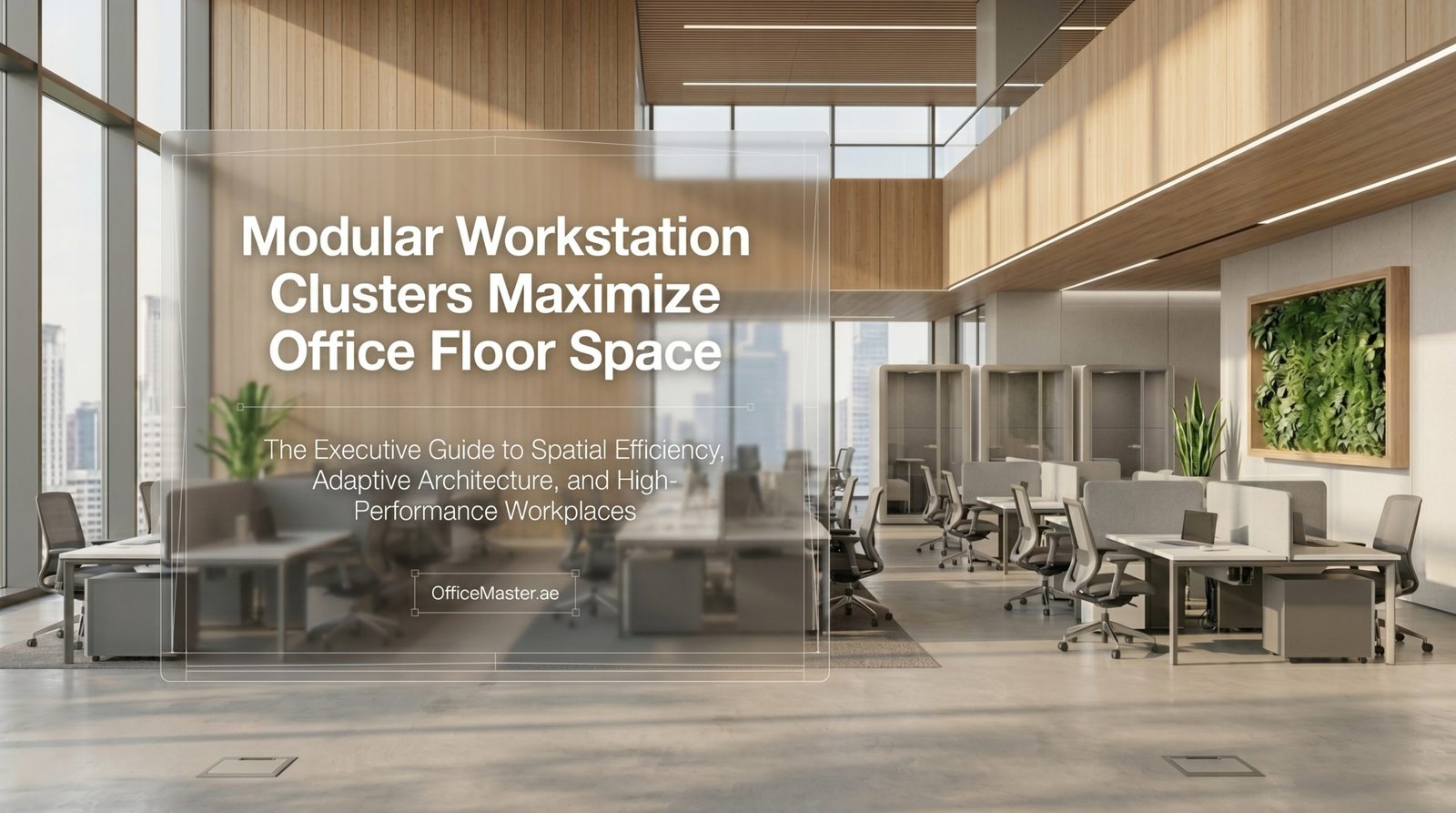
In the hyper-competitive commercial real estate landscape of Dubai and the wider UAE, commercial floor space is arguably your most expensive resource. According to CBRE’s 2025 MENA Office Market Report, Grade-A office rents in Dubai’s central business districts have surged by over 18% year-on-year, pushing businesses to rethink how they design, plan, and utilize every square meter available to them. Yet most organizations still operate with outdated, fixed-furniture layouts that consume space passively layouts engineered for a workforce model that no longer exists. Enter modular workstation clusters: a transformative approach to office furniture and space design that allows businesses to extract maximum utility from their commercial footprint without the need for costly expansions or relocations. Whether you manage a 500-square-foot startup suite in Business Bay or a multi-floor enterprise headquarters in DIFC, modular workstation clusters offer a scalable, intelligent, and visually striking solution to one of today’s greatest operational challenges — doing more with less space.
At OfficeMaster.ae, we have spent over a decade helping businesses across the UAE transform their offices into high-performance workspaces. In this comprehensive guide, we explore how modular workstation clusters work, why they outperform traditional office configurations, and what you need to know before investing in one for your organization.
What Are Modular Workstation Clusters?
Modular workstation clusters are interconnected, reconfigurable groups of individual work surfaces, storage units, privacy screens, and power-access modules that can be assembled and reassembled into a wide range of spatial configurations. Unlike conventional desks bolted to walls or fixed cubicles that carve the office into permanent silos, modular clusters are designed around the principle of adaptive flexibility.
Think of them as living architecture office furniture that breathes and evolves alongside your team. A cluster can take the form of a four-person pod arranged in a pinwheel pattern, a linear bench system running along a glass partition, a back-to-back dual-row arrangement optimized for collaborative teams, or a hybrid configuration that blends open and semi-private zones within the same footprint.
Core Components of a Modular Workstation Cluster
- Work Surface Panels: Height-adjustable or fixed tabletops in various widths and depths
- Structural Leg Frames: Freestanding or beam-mounted supports that anchor the cluster
- Privacy Screens and Acoustic Dividers: Fabric, glass, or perforated panel dividers for visual and acoustic separation
- Cable Management Systems: Integrated spine trays, desk grommets, and modular power columns
- Under-desk and Above-desk Storage: Pedestals, overhead bins, and wall-mounted shelving
- Mobile Elements: Rolling privacy screens, portable whiteboards, and wheeled pedestals
🔍 Key Insight
The true power of modular workstation clusters lies not in any single component but in the synergy of all elements operating as a cohesive, reconfigurable system. Organizations that fully leverage this system reduce real estate costs by 20%–35% compared to traditional layouts, according to JLL’s 2024 Workplace Strategy Report.

The Business Case: Why Space Optimization Is a Financial Imperative
Before examining the design advantages of modular clusters, it is important to appreciate the financial context that makes space optimization so strategically critical for modern businesses — particularly those operating in premium locations like Dubai, Abu Dhabi, and Sharjah.
“`html id=”modular_cluster_cost_savings_table_001″
| Cost Factor | Traditional Office Layout | Modular Cluster Layout | Potential Saving |
|---|---|---|---|
| Real Estate Utilization Rate | 55%–65% | 80%–92% | Up to 37% more space used productively |
| Reconfiguration Cost (per event) | AED 15,000–AED 60,000+ | AED 1,500–AED 8,000 | Up to 85% reduction |
| Furniture Replacement Cycle | 5–8 years | 12–20 years (modular upgrades) | Significantly extended asset life |
| Average Desk per Employee (sq ft) | 80–100 sq ft | 48–65 sq ft | 30%–40% floor space saving |
| Electrical/IT Rewiring on Refit | Full rewire often required | Minimal; modular power columns | 70% reduction in IT infrastructure cost |
| Employee Density (per 1,000 sq ft) | 8–10 employees | 14–18 employees | 60%–80% more capacity |
These numbers tell a compelling story: businesses that invest in modular workstation clusters do not merely create a better-looking office they fundamentally alter the economics of their real estate. For a 5,000-square-foot office in Downtown Dubai where monthly rent may exceed AED 120,000, a 30% improvement in space utilization effectively saves the equivalent of AED 36,000 per month or AED 432,000 annually without moving a single wall.

How Modular Workstation Clusters Maximize Commercial Floor Space
1. Eliminating Dead Space Through Pod Configurations
Traditional office layouts suffer from an underappreciated enemy: dead space. Corridors too wide, buffer zones between cubicles, desk-to-wall gaps that serve no functional purpose these silent space wasters accumulate rapidly. Research from Gensler’s 2024 Workplace Survey found that in conventional office environments, dead or underutilized space accounts for 20%–30% of total floor area.
Modular workstation clusters combat dead space by designing inward. Pod configurations particularly four-person or six-person pinwheel pods place all work surfaces facing a central core where cable management and shared power is housed. This means transitions between desks occur within the cluster itself rather than via external corridors, dramatically tightening the floor plan.
💡 Pro Tip
When planning a pod layout, aim for a minimum aisle width of 900mm (36 inches) between cluster rows for comfortable circulation, and 1,200mm (48 inches) for primary traffic corridors. This narrow-aisle approach, combined with under-desk storage rather than external filing cabinets, can recover up to 15% of lost floor area in a typical mid-size office.
2. Vertical Space Utilization: Going Up, Not Out
One of the most overlooked dimensions of commercial floor space is the vertical axis. Standard desk setups rely almost entirely on horizontal surface area, leaving the wall and overhead space completely dormant. Modern modular workstation clusters are engineered to exploit this vertical real estate through integrated above-desk storage systems, overhead bins, wall-mounted shelving rails, and monitor arm systems that eliminate the footprint of traditional monitor stands.
Height-adjustable (sit-stand) workstations within a cluster configuration further optimize vertical utility by adapting the working surface to the individual user, reducing the need for separate ergonomic accessories that consume horizontal space. Modular above-desk hutches and locker towers positioned at the perimeter of a cluster can consolidate all personal storage within the cluster’s own footprint rather than outsourcing it to separate filing rooms.
3. Activity-Based Working (ABW) Integration
Perhaps the most transformative feature of modular workstation clusters in contemporary workspace design is their natural compatibility with Activity-Based Working principles. ABW is the organizational philosophy that different tasks — focused individual work, collaborative discussion, video conferencing, casual ideation — require different physical environments. Rather than assigning every employee a permanent, one-size-fits-all desk, ABW distributes a variety of workspace typologies across the office, and employees choose the setting that best suits their current activity.
Modular clusters enable ABW integration by allowing a single office floor plan to feature multiple zone types without requiring permanent construction. A cluster of six height-adjustable desks can be re-positioned over a weekend to create a collaboration hub surrounded by acoustic screens. A linear bench cluster along the window can be reconfigured into a series of individual focus pods with modular privacy dividers. This ability to morph the office without construction costs is the hallmark of modular office furniture at its most intelligent.
4. Acoustic Zoning Without Walls
Noise is productivity’s silent enemy in open-plan offices. The challenge has historically driven businesses toward expensive acoustic wall installations or full cubicle returns. Modular workstation clusters solve this dilemma elegantly through integrated acoustic panel systems that can be attached, detached, and re-positioned without tools or professional installers.
High-performance fabric-wrapped panels with noise-reduction coefficients (NRC) of 0.70–0.95 can be mounted directly onto cluster frames, creating soft acoustic boundaries between work zones without physically enclosing them. This approach reduces ambient noise levels by 8–12 decibels — enough to measurably improve cognitive performance — while maintaining visual openness and natural light penetration across the floor plate.
| Acoustic Panel Type | NRC Rating | Best Application | Installation Method |
|---|---|---|---|
| Fabric-wrapped polyester core | 0.75–0.85 | Standard open-plan clusters | Clip-mount on cluster frame |
| Laminated glass divider | 0.30–0.45 | Visual privacy, minimal sound block | Bolt-on frame attachment |
| Perforated metal screen | 0.50–0.65 | Industrial aesthetic offices | Bolt-on or freestanding |
| Double-layer wool felt | 0.88–0.95 | Premium focus zones | Magnetic or clip-mount |
| PET recycled fibre board | 0.80–0.90 | Eco-certified workplaces | Frame-integrated panel slot |
5. Technology-Integrated Modular Clusters for Smart Offices
The intersection of modular office furniture and smart workspace technology is one of the most exciting frontiers in commercial interior design. Modern modular workstation clusters are increasingly engineered with built-in technology ecosystems that include wireless charging surfaces integrated into the desktop, USB-A and USB-C power outlets embedded in desk spines, IoT occupancy sensors that track real-time desk utilization, and motorized height-adjustment mechanisms controlled via smartphone apps.
For businesses in Dubai’s increasingly smart commercial districts — DWTC, One Central, and Dubai Design District among them — these technology-integrated clusters enable facilities managers to collect and act on workplace utilization data, ensuring that the office configuration always reflects how people actually work rather than how they were imagined to work five years ago.
🔍 Key Insight
A 2024 IFMA (International Facility Management Association) study found that offices equipped with IoT-integrated modular furniture achieved an average 28% reduction in energy costs due to occupancy-responsive lighting and HVAC systems that respond to real-time desk usage data.

Modular Workstation Cluster Configurations: A Practical Design Reference
Selecting the right cluster configuration depends on your team’s size, workflow patterns, collaborative requirements, and the specific geometry of your commercial floor plate. Below is a comprehensive reference guide to the most commonly deployed cluster types, their ideal applications, and the spatial requirements for each.
| Configuration | Ideal Team Size | Floor Space Required | Best For | Key Feature |
|---|---|---|---|---|
| 2-Person Back-to-Back | 2 | ~7–9 sqm | Paired roles, admin teams | Maximum density, shared screen visibility |
| 4-Person Pinwheel Pod | 4 | ~12–15 sqm | Cross-functional squads | Central cable management, all-round collaboration |
| 6-Person Linear Bench | 6 | ~18–22 sqm | Sales teams, call centres | High density, unified power spine |
| 8-Person Cluster Island | 8 | ~26–32 sqm | Large project teams | Modular zoning within a single island |
| L-Shaped Duo Cluster | 2–3 | ~9–12 sqm | Designers, analysts | Extended surface, dual-monitor support |
| Hot-Desk Rolling Cluster | Variable | ~6–10 sqm | Hybrid/remote-first offices | Mobile frames, no assigned seating |
| C-Shaped Focus Pod | 1–2 | ~5–8 sqm | Deep-focus individual work | Maximum acoustic enclosure without walls |

Office Furniture Dubai: What to Look for When Sourcing Modular Clusters
Dubai’s office furniture market is one of the most dynamic in the MENA region, with suppliers ranging from budget importers to premium European and Scandinavian brands with dedicated showrooms. When sourcing modular workstation clusters, the selection process should go well beyond aesthetics. Here is what separates exceptional office furniture Dubai suppliers from mediocre ones:
Structural Integrity and Load Ratings
A modular cluster is only as good as its structural backbone. Always request engineering certification for the desk frame’s load capacity — a quality modular desk should support a minimum of 100 kg distributed load per work surface. Beam-supported clusters shared between multiple users should be rated for cumulative loads of at least 250 kg per linear meter. Cheaper alternatives often use hollow steel sections with thin wall gauges (under 1.5mm) that flex under load, compromising both safety and long-term durability.
Surface Material Durability
The work surface material is subjected to daily friction, impact, moisture, and chemical exposure from cleaning agents. Premium modular clusters use surfaces with HPL (High Pressure Laminate) at a minimum of 0.8mm thickness over 25mm particleboard or MDF core, or solid compact laminate at 10–13mm for standing-height applications. In Dubai’s climate-controlled environments, surfaces should carry a minimum abrasion resistance of AC3 and be tested for resistance to common solvents and UV-stable edge banding to prevent de-lamination.
Cable Management Sophistication
In a cluster of four to eight connected workstations, cable chaos is the nemesis of the clean, professional aesthetic that modern offices require. Look for clusters with integrated cable spine channels running the full length of the bench, with accessible covers for maintenance, and multiple power column positions. The best modular systems offer snap-in cable covers, 360-degree rotating power columns, and provisions for future technology upgrades.

💡 Pro Tip
Always specify cable management load capacity when purchasing modular clusters for technology-heavy teams. A cluster serving graphic designers or video editors may have 3–4 cables per user plus external drives, requiring cable trays rated for at least 5kg per linear meter. Under-specified cable management becomes a maintenance nightmare within 18 months.
| Selection Criteria | Budget Tier | Mid-Range Tier | Premium Tier |
|---|---|---|---|
| Frame Steel Gauge | 0.8–1.0mm | 1.2–1.5mm | 1.5–2.0mm certified |
| Surface Laminate Thickness | 0.4–0.6mm HPL | 0.8mm HPL | Compact laminate or 1.0mm HPL |
| Height Adjustment | Fixed only | Manual crank | Electric dual-motor |
| Acoustic Panel NRC | 0.40–0.55 | 0.65–0.75 | 0.80–0.95 |
| Warranty Period | 1–2 years | 3–5 years | 7–10 years |
| Reconfiguration Tool Required | Yes, professional | Basic tools | Tool-free snap connections |
| Lead Time in Dubai | 8–12 weeks (import) | 4–6 weeks | In-stock or 2–4 weeks custom |

Sustainability and the Green Office Advantage of Modular Systems
The UAE’s commitment to carbon neutrality by 2050, reinforced by the Net Zero by 2050 strategic initiative, is reshaping how businesses approach office design and procurement. Modular workstation clusters offer significant sustainability advantages over traditional fixed furniture advantages that align with ESG (Environmental, Social, and Governance) reporting requirements increasingly demanded by investors and corporate clients.
Reduced Material Waste
Traditional office refurbishments typically send 60%–80% of existing furniture to landfill. Modular systems, by contrast, are designed for disassembly and component reuse. When a team grows or a layout needs updating, only the specific components that need replacing are swapped not entire furniture suites. This modular lifecycle approach dramatically reduces the environmental footprint of workspace changes over time.

Sustainable Material Certifications
When procuring modular office furniture in Dubai, look for products carrying recognized sustainability certifications including GREENGUARD Gold (low chemical emissions), FSC (Forest Stewardship Council for wood-based panels), LEVEL Certification (furniture lifecycle sustainability), and Cradle-to-Cradle (material health and recyclability). OfficeMaster curated portfolio of modular workstation systems includes options certified under multiple internationally recognized sustainability standards.
🔍 Key Insight
Buildings pursuing LEED or Estidama (UAE’s Pearl Rating System) certification benefit significantly from modular furniture procurement. Points are available under the Interior Fit-Out category for low-emission materials and adaptable design — modular clusters contribute directly to multiple credit categories.

The Hybrid Work Revolution: Why Modular Clusters Are the Future
The post-pandemic normalization of hybrid work where employees split their time between home and office has fundamentally altered the utilization patterns of commercial office space. Average office occupancy in Dubai’s corporate sector hovers between 55%–70% on peak days, yet businesses continue to pay rent for 100% of their floor plate every day. This occupancy-cost mismatch is the single most powerful argument for modular workstation clusters in today’s market.
In a hybrid-work-optimized modular cluster environment, workstations are not assigned to specific individuals but are shared across a rotating workforce. Cluster configurations are designed to accommodate maximum user density during peak attendance days while remaining visually and acoustically comfortable at lower densities during quieter periods. Mobile elements within clusters rolling pedestals, portable privacy screens, adjustable dividers allow facilities teams to rapidly expand or contract available workspace without professional intervention.
| Hybrid Work Scenario | Recommended Cluster Strategy | Expected Space Saving |
|---|---|---|
| 3 days office / 2 days remote | Hot-desk cluster ratio 1:1.3 (10 staff, 8 desks) | 20%–25% |
| 2 days office / 3 days remote | Hot-desk cluster ratio 1:1.6 (10 staff, 6–7 desks) | 35%–40% |
| Fully flexible (no fixed days) | Activity-based clusters with touchdown zones | 40%–55% |
| Staggered shifts (24/7 operation) | Shift-share clusters with personal locker banks | 45%–60% |
| Team-centric attendance pattern | Neighborhood clusters per department | 15%–20% |

Implementation Roadmap: From Concept to Commissioned Cluster
Successfully transitioning your commercial office to a modular workstation cluster layout requires a structured implementation process. Rushing this process or under investing in the planning phase is the most common reason modular office projects under perform expectations. Below is the proven eight-step roadmap that OfficeMaster recommends for clients across the UAE:
| Phase | Activity | Timeline | Key Deliverable |
|---|---|---|---|
| 1. Discovery | Workplace utilization audit using occupancy sensors or manual observation | 2–3 weeks | Utilization heat map and headcount forecast |
| 2. Programming | Define activity types, team adjacencies, privacy needs | 1–2 weeks | Workplace strategy brief |
| 3. Space Planning | AutoCAD or BIM cluster layout developed to scale | 1–2 weeks | Floor plan with cluster typologies |
| 4. Product Selection | Cluster system specification, finish selection, ergonomic options | 1–2 weeks | Furniture schedule and budget |
| 5. 3D Visualization | Photo-realistic renders of cluster configurations | 1 week | Client-approved design visuals |
| 6. Procurement | Order placement, lead time management, delivery coordination | 4–12 weeks | Confirmed delivery schedule |
| 7. Installation | Professional cluster assembly and cable management | 2–5 days (per floor) | Commissioned, tested cluster layout |
| 8. Post-Occupancy | User feedback survey, layout optimization review | 4–6 weeks post-move | Optimization recommendations |

Frequently Asked Questions (FAQ)
What is a modular workstation cluster and how is it different from a regular desk?
A modular workstation cluster is an integrated furniture system consisting of connected work surfaces, storage components, privacy screens, cable management solutions, and accessories that function together as a single workspace environment. Unlike a conventional desk, which operates as an independent furniture item with limited adaptability, a modular cluster is specifically engineered for flexibility and long-term scalability. Individual components can be added, removed, re-positioned, or reconfigured as organizational needs evolve. This means businesses can expand teams, change departments, introduce hybrid work models, or redesign office layouts without replacing their entire furniture investment. Modular clusters also create a more cohesive and efficient workspace by standardizing storage, technology integration, and workstation dimensions across the office. In modern workplaces, they are increasingly viewed not simply as furniture but as infrastructure that supports collaboration, productivity, and future growth. Their ability to adapt over time makes them significantly more cost-effective and operationally flexible than traditional desk-based layouts.
How much floor space can I save by switching to modular workstation clusters?
Organizations that replace traditional desk layouts with modular workstation clusters typically recover between 20% and 40% of their usable office floor area. The exact savings depend on workforce density, departmental structure, storage requirements, and attendance patterns. Traditional office layouts often contain significant inefficiencies because desks, cabinets, and accessories are purchased and positioned independently. Modular systems consolidate these elements into a unified footprint, reducing wasted circulation space and duplicate furniture. Companies implementing hybrid work policies often achieve even greater savings because modular clusters support shared seating, hot-desking, and activity-based workplace strategies. In some cases, businesses with flexible attendance schedules have reduced their workstation footprint by more than 50% while maintaining employee capacity. Given the high commercial rental rates in Dubai and other major business centers, these space efficiencies can generate substantial long-term financial savings while simultaneously improving workplace functionality and aesthetics.
Are modular workstation clusters suitable for small offices in Dubai?
Yes, modular workstation clusters are exceptionally well suited to small offices and often deliver their greatest value in compact environments. Office space in Dubai represents a significant operational expense, making efficient space utilization a critical business consideration. Modular clusters allow multiple employees to work comfortably within a smaller footprint by integrating desks, storage, power access, cable management, and privacy solutions into a single system. A compact cluster configuration can often accommodate the same number of employees as a traditional layout while requiring substantially less floor area. In addition to improving space efficiency, modular systems create a cleaner and more organized visual environment, which can make smaller offices feel larger and more professional. Their scalability is also advantageous for growing businesses because additional positions can be added without requiring a complete redesign. For startups, consultancies, agencies, and small corporate offices, modular workstation clusters provide an ideal balance of flexibility, functionality, and cost efficiency.
How long does it take to install a modular workstation cluster system?
Installation timelines for modular workstation clusters are generally much shorter than those associated with traditional office furniture projects. Because components are designed for standardized assembly and integration, installation teams can work quickly and efficiently without extensive customization on site. A typical four-to-six-person workstation cluster can often be assembled, positioned, leveled, and commissioned within two to four hours. Larger projects involving twenty or more employees may be completed within two to three days, depending on the complexity of the configuration and the level of technology integration required. Traditional office furniture installations frequently require longer schedules because individual desks, storage units, cable systems, and accessories must be assembled separately. Modular systems streamline this process by consolidating these elements into a coordinated package. Many professional installers also offer evening and weekend installation services, allowing businesses to complete office transformations with minimal disruption to daily operations and employee productivity.
Absolutely. Modern modular workstation clusters are increasingly designed to support height-adjustable working and employee wellness initiatives. Sit-stand functionality can be incorporated through electric dual-motor systems, triple-motor executive solutions, pneumatic mechanisms, or manual adjustment options. One of the major advantages of premium modular systems is that each workstation can operate independently, allowing individual users to adjust desk height without affecting adjacent colleagues. This flexibility supports a diverse workforce with varying ergonomic requirements and working preferences. Height-adjustable clusters also align with contemporary workplace wellness strategies aimed at reducing the health risks associated with prolonged sitting. Research continues to demonstrate the benefits of movement throughout the workday, including improved comfort, concentration, circulation, and energy levels. As a result, sit-stand workstation clusters are becoming increasingly common across corporate offices, government organizations, educational institutions, and professional service firms throughout the UAE.
What are the acoustic options available with modular workstation clusters?
Modern modular workstation clusters provide a broad range of acoustic solutions designed to improve concentration, reduce distractions, and create a more comfortable working environment. Basic systems may include low-profile fabric screens that offer visual separation while absorbing a modest amount of ambient sound. Mid-range solutions often incorporate thicker acoustic panels manufactured from PET felt, recycled fibers, or sound-absorbing fabrics that significantly reduce noise transfer between adjacent workstations. Premium systems can feature high-performance acoustic screens, privacy wings, desktop partitions, and even semi-enclosed workstation pods that create quiet zones within open-plan offices. For organizations operating in particularly demanding environments such as call centers, financial trading floors, customer support hubs, or creative studios, workstation clusters can be combined with ceiling baffles, acoustic wall panels, and sound-absorbing flooring systems to create a comprehensive acoustic strategy. Effective noise management not only improves employee comfort but also enhances productivity, concentration, and communication quality across the workplace.
How much does a modular workstation cluster cost in Dubai?
Pricing for modular workstation clusters in Dubai spans a wide range depending on configuration, materials, and brand tier. Entry-level imported clusters for four users start from approximately AED 3,500–AED 6,000 per person position. Mid-range configurations with ergonomic features and quality acoustic panels range from AED 6,000–AED 12,000 per position. Premium European and Scandinavian systems with sit-stand adjustment, high-NRC acoustics, and extended warranties range from AED 12,000–AED 25,000+ per position. OfficeMaster offers solutions across all three tiers with competitive pricing tailored to UAE market conditions.
Can I add more positions to my modular cluster as my team grows?
Yes. One of the defining benefits of modular workstation clusters is their ability to expand alongside organizational growth. Unlike traditional furniture systems that often require complete replacement when teams increase in size, modular clusters are designed around scalable frameworks. Additional work surfaces, support structures, privacy screens, storage modules, and accessories can usually be connected directly to the existing installation without disturbing current users. This flexibility allows organizations to respond quickly to recruitment, departmental expansion, or business growth while preserving their original furniture investment. Because new modules are manufactured to match existing systems, businesses can maintain visual consistency throughout the office without undertaking costly refurbishments. The result is a workplace that evolves organically with operational needs while minimizing disruption, reducing capital expenditure, and maintaining a professional and cohesive appearance across all departments.
Are modular workstation clusters compatible with smart office technology?
Yes. Premium modular workstation clusters are increasingly designed to support the requirements of modern smart offices and digitally connected workplaces. Many systems integrate seamlessly with occupancy sensors, workplace analytics platforms, desk-booking applications, building management systems, and automated environmental controls. Integrated technology features may include wireless charging pads, USB-C charging ports, power modules, sensor mounting points, and concealed cable pathways that support future upgrades. Organizations implementing hybrid work strategies can also benefit from real-time occupancy monitoring and workspace reservation systems that optimize office utilization. These integrations provide valuable data regarding employee attendance patterns, workstation usage, and space efficiency, allowing facilities managers to make informed decisions about future workplace planning. As businesses continue to embrace digital transformation, modular workstation clusters increasingly serve as a foundation for intelligent, connected, and highly adaptable office environments.
How do I plan the right cluster configuration for my team?
Selecting the ideal modular workstation cluster configuration requires careful evaluation of workforce requirements, organizational goals, and available office space. The process typically begins with understanding current headcount, projected growth, and the nature of day-to-day work activities. Teams engaged in highly collaborative work may benefit from open benching layouts that encourage communication and teamwork, while departments requiring concentration may require additional privacy and acoustic separation. Hybrid attendance patterns should also be analyzed to determine whether dedicated desks, shared workstations, or hot-desking arrangements are most appropriate. The physical dimensions and geometry of the office floor plate play an equally important role, influencing circulation routes, workstation orientation, and natural light access. Professional workplace planning often incorporates utilization studies, adjacency analysis, and CAD-based space planning to identify the most effective configuration before furniture procurement begins. A well-planned cluster system improves productivity, supports employee wellbeing, and maximizes long-term flexibility.
What is the warranty typically offered on modular cluster systems in Dubai?
Warranty coverage for modular workstation cluster systems varies depending on the manufacturer, product category, and overall quality level. Entry-level imported systems generally include one to two years of coverage for structural components and manufacturing defects. Mid-range workstation solutions commonly offer warranties ranging from three to five years, covering frames, work surfaces, and major hardware components. Premium systems produced by established international manufacturers frequently provide structural warranties of up to ten years, reflecting their confidence in long-term durability and performance. Electronic components such as motors, control systems, charging modules, and integrated power solutions may carry separate warranty periods, often ranging between two and five years. When evaluating workstation clusters, businesses should consider warranty coverage as an indicator of product quality and manufacturer commitment. Strong warranty support can significantly reduce long-term ownership costs while providing reassurance that replacement parts, servicing, and technical assistance will remain available throughout the product lifecycle.
Can modular clusters be reconfigured in-house or do I need professional help?
Tool-free modular cluster systems — increasingly the standard at mid-range and above — can be reconfigured by facilities staff with basic training and no specialist tools. Components connect via cam-lock mechanisms, snap-fit joints, or quarter-turn fasteners that require no drilling or welding. OfficeMaster provides configuration training to in-house facilities teams upon project completion, along with digital configuration guides specific to the purchased system. For major layout overhauls, OfficeMaster’s installation team is available for scheduled reconfiguration services.
What sustainability certifications should I look for in modular clusters?
Organizations seeking environmentally responsible furniture solutions should prioritize workstation clusters that carry recognized international sustainability certifications. GREENGUARD Gold certification is particularly important because it verifies low chemical emissions and contributes to healthier indoor air quality, a critical consideration in heavily air-conditioned office environments. FSC certification confirms that wood-based materials originate from responsibly managed forests and sustainable supply chains. LEVEL certification provides a comprehensive assessment of a furniture product’s environmental, social, and economic impacts throughout its lifecycle. Cradle to Cradle certification evaluates material health, recyclability, renewable energy use, and circular economy principles. These certifications are increasingly important for organizations pursuing LEED, WELL Building Standard, BREEAM, or Estidama compliance. Beyond environmental benefits, certified products often demonstrate higher manufacturing standards and greater transparency, supporting corporate sustainability goals while enhancing workplace wellbeing and responsible procurement practices.
How do modular clusters support a hybrid working model?
Modular workstation clusters have become one of the most important physical components of successful hybrid workplace strategies. Their flexibility allows organizations to accommodate fluctuating attendance levels without maintaining large numbers of permanently assigned desks. Shared workstations, hot-desking environments, touchdown spaces, collaboration zones, and focus areas can all be created using the same modular furniture platform. As attendance patterns change, workstation configurations can be adjusted quickly without requiring major capital expenditure or disruptive refurbishment projects. Many systems also integrate with workplace management technologies such as desk-booking applications, occupancy sensors, and utilization analytics platforms. These tools provide real-time visibility into workspace usage and help organizations continuously optimize office performance. By supporting flexibility, scalability, and efficient space utilization, modular workstation clusters enable businesses to create environments that meet the needs of both in-office and remote employees while maximizing the value of their workplace investment.
Where can I see modular workstation clusters on display in Dubai?
OfficeMaster.ae maintains a fully operational showroom in Dubai where clients can experience modular workstation clusters across multiple configurations, finish options, and ergonomic settings. Unlike catalog-only suppliers, OfficeMaster showroom environment allows clients to sit at, stand at, and interact with every system testing acoustic performance, surface durability, cable management access, and height-adjustment mechanisms before committing to a specification. Showroom visits can be booked through the OfficeMaster website or by contacting the sales team directly.
The Intelligent Investment in Your Commercial Future
The decision to adopt modular workstation clusters is not merely a furniture purchase it is a strategic commitment to the long-term performance, adaptability, and financial health of your organization. In Dubai’s dynamic commercial landscape, where office rents climb, workforce models evolve, and employee expectations around workplace quality rise every year, the ability to reconfigure your physical environment rapidly and cost-effectively is a genuine competitive advantage.
Modular workstation clusters deliver that advantage comprehensively: maximizing every square foot of your commercial floor space, integrating seamlessly with smart office technology, supporting the hybrid work patterns of your modern workforce, and reducing the environmental footprint of your operations. They are, in the truest sense, the office furniture system designed for the business world of today and tomorrow.
At OfficeMaster.ae, we combine deep product knowledge, expert space planning capabilities, and comprehensive after-sales support to help businesses across the UAE design and commission modular workspace environments that perform as beautifully as they look. Whether you are planning your first modular installation or upgrading an existing layout, our team is ready to bring your commercial workspace vision to life.
Visit www.officemaster.ae today or contact our team for a personalized office setup consultation.

Visit Us Today!
— OfficeMaster.ae | Premium Office Furniture UAE —