The modern workplace is no longer simply a collection of desks and chairs. It is a living biological environment — one that either actively supports or silently degrades the health of everyone inside it. Mounting global research confirms that poorly designed workspaces cost organizations an average of 17–21 days of lost productivity per employee per year through absenteeism, presenteeism, and musculoskeletal disorders (MSDs). In the UAE, where office furniture Dubai investments are accelerating in line with Vision 2031 smart-city targets, the gap between average fitouts and genuinely health-optimized environments translates directly into measurable competitive disadvantage.
This authoritative guide offers corporate buyers, HR directors, and facilities managers in Dubai and the broader UAE a complete, data-backed framework for transforming the workspace from a passive backdrop into a proactive health system. From the biomechanics of seated posture to the ROI of ergonomic investment, every section is designed to inform decisions that align employee well being with organizational performance.
1. The Science of Sitting: Why Furniture Is a Health Intervention
1.1 The Physiology of Prolonged Sedentary Behavior
Humans evolved as bipedal, ambulatory creatures. Forcing the body into a static seated position for six to ten hours produces a cascade of physiological consequences that no single wellness initiative can fully counteract if the root cause — the furniture — remains unchanged.
When the lumbar spine loses its natural lordotic curve, the inter vertebral discs of L4-L5 and L5-S1 absorb up to 190% more compressive load than in a neutral standing position. Over months and years, this accelerated disc loading contributes to herniation, chronic lower-back pain, and referred sciatic nerve symptoms. Research published across occupational health journals consistently places musculoskeletal disorders as the leading cause of work-related disability globally — accounting for more than 40% of all occupational illness costs.
Beyond spinal mechanics, sustained sitting restricts the femoral vein and reduces lower-limb blood flow by up to 50%, elevating the risk of deep-vein thrombosis (DVT) in sedentary workers. Hip flexor shortening, thoracic kyphosis, forward head posture, and weakened gluteal muscles are downstream consequences that compound over time, feeding a cycle of chronic pain and reduced physical capacity.

1.2 The Posture–Productivity Feedback Loop
Neuroscience and occupational psychology have established a bidirectional relationship between physical posture and cognitive performance. Studies from Columbia and Harvard Business Schools demonstrate that open, upright postures increase testosterone, reduce cortisol, and elevate self-reported confidence and decisiveness. Conversely, slumped, flexed postures correlate with elevated perceived stress and diminished problem-solving capacity.
KEY INSIGHT
Employees who switch between sit and stand positions at least twice per hour report 32% lower fatigue scores and 17% higher task-completion rates than those who remain seated continuously — independent of physical fitness levels.
The implication is clear: investing in posture support furniture is not a wellness luxury — it is a direct lever on cognitive output, mood regulation, and sustained focus across the working day.

2. Anatomy of an Ergonomic Workplace System
A true ergonomic office solution is not a single product but an integrated system in which every component — seating, work surfaces, lighting, acoustics, and circulation space — is calibrated to human physiological requirements.
2.1 Ergonomic Seating: The Central Node
The chair remains the most critical single piece of office furniture Dubai organizations acquire. Yet most commercial procurement still priorities aesthetics and price over bio-mechanical functionality.
Ergonomic Chair Feature Comparison — Entry vs. Mid-Range vs. Premium
| Feature | Entry Level | Mid-Range | Premium Ergonomic |
|---|---|---|---|
| Lumbar Support | Fixed pad | Height-adjustable | Dynamic, multi-zone |
| Seat Depth Adjustment | None | Slider ±40 mm | Slider ±80 mm + tilt |
| Armrest Axes | Height only | Height + width (2D) | 4D (H/W/D/pivot) |
| Recline Range | Fixed or 95°–105° | 90°–120° with lock | 85°–135° with synchro |
| Seat Tilt | None | Forward/back tilt | Active balance tilt |
| Headrest | None | Height-adjustable | Height + depth + angle |
| Certification | None | BIFMA G1 | BIFMA G1 + EN 1335 |
| Avg. Warranty (UAE) | 1 year | 3–5 years | 7–12 years |
| Recommended Use Hours | Up to 4 hrs/day | 4–8 hrs/day | 8–12 hrs/day |
Source: OfficeMaster product analysis, BIFMA standards, EN 1335 certification data.

2.2 Height-Adjustable Desks: The Most Impactful Single Upgrade
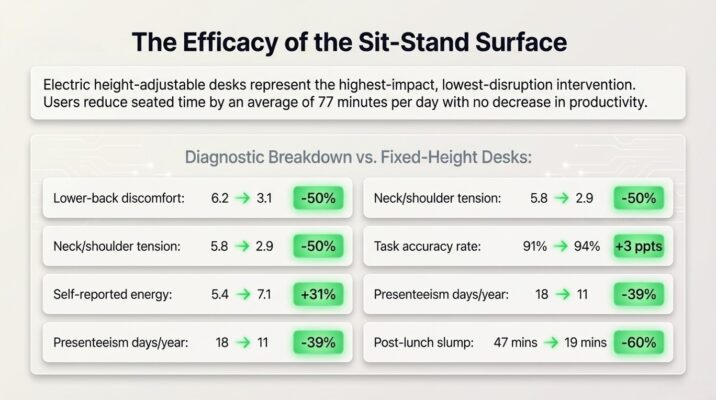
Electric height-adjustable desks represent the highest-impact, lowest-disruption intervention available to office planners. A comprehensive meta-analysis of 54 studies found that sit-stand desk users reduce seated time by an average of 77 minutes per 8-hour workday, with no measurable decrease in productivity output.
Productivity & Health Impact of Sit-Stand Desks vs. Fixed-Height Desks
| Metric | Fixed-Height Desk | Sit-Stand Desk | Change (%) |
|---|---|---|---|
| Lower-back discomfort (score /10) | 6.2 | 3.1 | −50% |
| Neck/shoulder tension (score /10) | 5.8 | 2.9 | −50% |
| Self-reported energy (score /10) | 5.4 | 7.1 | +31% |
| Task accuracy rate | 91% | 94% | +3 ppts |
| Presenteeism days/year | 18 | 11 | −39% |
| Post-lunch afternoon slump (mins) | 47 | 19 | −60% |
| Calories burned/8 hr day (extra) | — | +50 | +50 kcal |
Sources: Journal of Physical Activity and Health, British Journal of Sports Medicine, SMED Research Group meta-analysis.
 2.3 Monitor Arms, Keyboard Trays, and Peripheral Positioning
 2.3 Monitor Arms, Keyboard Trays, and Peripheral Positioning
Ergonomic seating and adjustable desks solve the macro problem of posture. Monitor arms and keyboard trays solve the micro problem of precise joint alignment. The optimal monitor position places the top-third of the screen at eye level, with the screen face tilted 10°–15° away from vertical, at a viewing distance of 50–70 cm. Incorrect monitor height is the primary driver of cervical extension strain, which adds 4–5 kg of effective loading per 15° of forward head inclination — a condition colloquially known as ‘tech neck.’

2.4 Acoustic Ergonomics — The Overlooked Dimension
Open-plan offices in the UAE commonly register ambient noise levels of 60–75 dB — sufficient to trigger sustained cortisol elevation. Acoustic panels, soft furnishings, and strategic furniture zoning can reduce ambient noise by 10–18 dB, which correlates with a 38% reduction in self-reported cognitive fatigue. This makes acoustic design a legitimate component of any comprehensive ergonomic office solution strategy, not a secondary consideration.

3. Workplace Wellness UAE: The Regional Imperative
3.1 The Cost of Inaction in a Heat-Intensive Climate
The UAE thermal environment introduces occupational health variables absent in temperate climates. Research consistently shows that thermal discomfort — even within air-conditioned interiors not precisely calibrated — reduces cognitive performance by 6–12% and accelerates fatigue onset. Effective workplace wellness UAE programmed must therefore integrate thermal zoning within furniture layout planning, ensuring that workstations are not positioned within 1.5 meters of cold-air diffuses or solar-gain window strips.
3.2 UAE Labor Well being Standards and Employer Obligations
The UAE Ministry of Human Resources and Emiratisation (MoHRE) has progressively aligned national workspace regulations with ILO ergonomic standards. While prescriptive furniture specifications remain at employer discretion, the regulatory direction is clear: organizations demonstrating measurable investment in employee health environments consistently achieve faster licensing renewals, lower employee turnover, and stronger performance in national employer-of-choice indices.
3.3 Corporate Culture Shift: Well being as Talent Strategy
In Dubai’s hyper-competitive talent market, where senior professionals increasingly factor workspace quality into employment decisions alongside compensation, productivity office design has become a talent acquisition and retention instrument. A well-designed, health-supporting office communicates organizational values, signals long-term investment in people, and reduces the psychological burden of returning to work — a factor of outsized importance in post-pandemic hybrid work models.
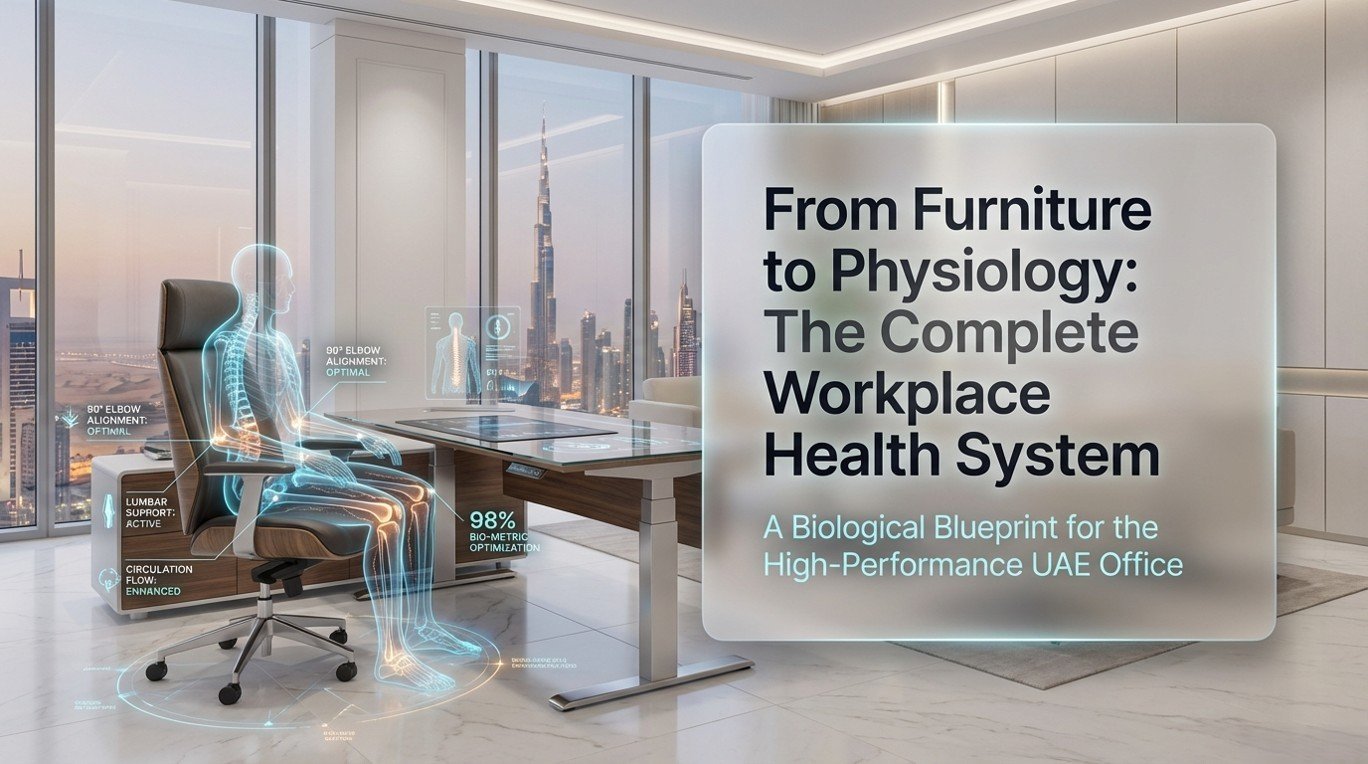
4. From Furniture to Physiology: Building the Complete Health System
4.1 The Five-Layer Workplace Health Framework
OfficeMaster approach to corporate health systems organizes the physical environment into five interdependent layers, each of which must be addressed for holistic effectiveness:
Five-Layer Workplace Health Framework
| Layer | Components | Primary Health Impact | Design Priority |
|---|---|---|---|
| 1 — Seating System | Ergonomic chairs, posture support accessories | Spinal & musculoskeletal health | Critical |
| 2 — Surface System | Adjustable desks, collaboration tables, worktops | Circulation, fatigue, engagement | Critical |
| 3 — Peripheral System | Monitor arms, lighting, keyboard trays | Vision, neck/shoulder strain | High |
| 4 — Spatial System | Layout, circulation paths, breakout zones | Movement, cognitive recovery | High |
| 5 — Environmental System | Acoustics, air quality, thermal comfort, biophilia | Stress, cognition, immunity | Moderate–High |
4.2 Circulatory Health and Furniture Design
Sedentary compression of the popliteal artery — the vessel behind the knee — reduces distal limb perfusion when seat-pan depth is incorrectly sized. Proper seat depth allows a 3-finger gap between the seat edge and the back of the calf, eliminating this pressure point. Combined with a forward seat tilt of 5°, this adjustment alone measurably improves lower-limb blood flow markers in clinical trials.
Anti-fatigue matting and floor surfaces adjacent to standing positions introduce a further circulatory benefit: micro-postural shifts during standing prevent the venous pooling that makes prolonged uninterrupted standing as detrimental as prolonged sitting. The prescription is therefore not ‘stand more’ but ‘move more’ — a goal that ergonomic workstation design should facilitate automatically.
4.3 Long-Term Musculoskeletal Health Trajectories
Longitudinal occupational health studies tracking knowledge workers over 10-year periods consistently show that those employed in ergonomically optimized environments experience 42% fewer cumulative MSDs by age 50, and report significantly higher quality-of-life scores on standardized health assessment tools. The furniture decisions made at the point of office fitout in 2025 will be biologically expressed in workforce health profiles visible by 2035.

5. The Business Case: Ergonomic Investment ROI
The business case for premium ergonomic chairs Dubai organizations invest in is increasingly quantified in financial rather than purely humanitarian terms. The following analysis draws on published health economics research to model the cost-benefit position for a representative 100-person office in Dubai.
Ergonomic Investment ROI — 100-Employee Office (Dubai, AED)
| Cost / Benefit Item | Standard Fitout | Ergonomic Fitout | Difference |
|---|---|---|---|
| Avg. chair cost per employee | AED 800 | AED 3,200 | +AED 2,400 |
| Avg. desk cost per employee | AED 1,200 | AED 4,500 | +AED 3,300 |
| Total incremental capex (100 seats) | — | — | AED 570,000 |
| Absenteeism days saved/yr (MSD) | Baseline | −6.8 days | −680 days |
| Productivity gain (17% reduction) | — | +AED 2,040/emp/yr | +AED 204,000 |
| Healthcare cost reduction/yr | Baseline | −AED 1,100/emp | −AED 110,000 |
| Turnover reduction (3% lower) | — | −3 exits/yr | +AED 90,000 |
| Total annual benefit | — | — | AED 404,000 |
| Payback period | — | — | ~17 months |
| 5-Year Net ROI | — | — | +AED 1,450,000 |
Modelled using published health economics data; actual results vary by industry, workforce age profile, and per-existing health conditions.

6. Actionable Recommendations for UAE Businesses
6.1 Phase 1: Assess — The Ergonomic Audit (Weeks 1–4)
Before purchasing a single piece of furniture, commission a structured ergonomic assessment of your current environment. A credible audit will measure:
- Percentage of workstations compliant with ISO 9241-5 standards
- Average daily sitting hours per role category
- MSD-related sick-leave patterns from the past 24 months
- Employee-reported discomfort by body region and time of day
- Thermal, acoustic, and lighting baseline measurements against ASHRAE and CIBSE benchmarks
6.2 Phase 2: Priorities — The High-Impact Intervention Sequence
Not all ergonomic investments deliver equal impact. Priorities in the following sequence for maximum health and financial return:
Intervention Priority Matrix for UAE Offices
| Priority | Intervention | Ease of Implementation | Health ROI |
|---|---|---|---|
| 1 (Highest) | Replace non-ergonomic seating | Medium | Very High |
| 2 | Install height-adjustable desks | Medium | Very High |
| 3 | Deploy monitor arms + laptop stands | Easy | High |
| 4 | Reconfigure layout for movement pathways | Medium | High |
| 5 | Add acoustic panels / soft furnishings | Easy | Medium–High |
| 6 | Introduce biophilic design elements | Easy | Medium |
| 7 (Ongoing) | Ergonomic training programme | Easy | Medium |

6.3 Phase 3: Procure — Selecting the Right Supplier
When sourcing office furniture Dubai businesses should evaluate suppliers on five criteria beyond price: warranty depth, after-sales adjustment support, certification portfolio, local inventory availability (critical for agile fitout timelines in Dubai’s project market), and demonstrable expertise in human-factors design rather than purely aesthetic trends.
6.4 Phase 4: Train — Activating the Investment
Even the most sophisticated ergonomic chair will fail to deliver its designed health benefits if the occupant does not know how to adjust it. Workstation-specific setup training either in-person or via digital guides converts hardware investment into lived physiological outcomes. OfficeMaster provides complimentary setup guides and adjustment videos for all ergonomic office solutions supplied to UAE clients.
6.5 Phase 5: Monitor — The Continuous Improvement Cycle
Establish quarterly review touch-points to reassess MSD rates, absenteeism, and employee comfort scores. As the workforce changes new hires, returning parents, ageing workforce cohorts workstation configurations require re-calibration. Workplace wellness UAE excellence is not a project with an end date; it is an ongoing management practice.

7. The Future of Workplace Health Design in Dubai
7.1 Biophilic Design and Neurological Recovery
The integration of natural materials, living plant walls, natural light simulation, and organic form language into modern office furniture design is no longer a trend — it is a scientifically grounded intervention. Biophilic environments reduce stress biomarkers (measured via salivary cortisol) by up to 37%, accelerate cognitive recovery after demanding tasks, and measurably improve air quality in sealed, air-conditioned Dubai interiors.
7.2 Activity-Based Working and Furniture Fluidity
The prescriptive 1:1 desk-to-employee ratio, long dominant in UAE corporate real estate, is being supplanted by activity-based working (ABW) models in which office furniture is designed for mobility, multi-purposing, and rapid reconfiguration. Lightweight modular seating, mobile standing-desk pods, and acoustic booths allow the same floor area to serve focused work, collaborative ideation, and video-conferencing simultaneously — a design model that improves space utilization by 20–35%.
7.3 Technology Integration: Smart Furniture and Health Data
The next frontier in corporate health systems is the integration of IoT sensors into workstation infrastructure. Smart desks that track sitting/standing ratios and prompt postural change via desk-panel nudges, connected chairs that measure pressure distribution and alert users to risk postures, and environmental sensors that adjust desk height recommendations based on ambient thermal comfort — all of these are commercially available today and increasingly specified in premium office furniture Dubai projects.

Frequently Asked Questions
What is the best ergonomic office setup in Dubai for a full working day?
The optimal setup for an 8-10 hour working day combines an ergonomic task chair with certified lumbar support and 4D armrests, an electric height-adjustable desk set to alternate between sitting (desk at elbow height while seated) and standing (elbows at 90° while standing) positions approximately every 45-60 minutes, a monitor arm positioning the screen top-third at eye level, and a discrete anti-fatigue mat. OfficeMaster stocks all components of this configuration with same-week delivery across Dubai and Abu Dhabi.
How does office furniture affect employee health?
Office furniture directly influences musculoskeletal health through spinal loading, joint alignment, and circulation restriction. Non-ergonomic furniture forces the body into sustained bio-mechanically disadvantageous positions, accelerating inter-vertebral disc wear, compressing peripheral nerves, restricting femoral vein blood flow, and triggering sustained muscle tension in the trapezius and rhomboid muscle groups. Over time, this manifests as chronic lower-back pain, neck disorders, RSI, and heightened cardiovascular risk. Ergonomically certified furniture mitigates all of these pathways simultaneously.
What are the best ergonomic chairs available in Dubai?
Dubai’s ergonomic chair market spans international brands (Herman Miller) and regional specialists. The most important criteria are: BIFMA G1 or EN 1335 certification, dynamic lumbar support, seat-depth adjustment, and a minimum 5-year warranty. OfficeMaster offers curated ergonomic chair ranges across price tiers, all independently assessed against UAE working-hour requirements.
Are height-adjustable desks worth the investment for UAE companies?
Yes. Published ROI analyses consistently demonstrate a payback period of 14-22 months for sit-stand desk investments in knowledge-worker environments, driven primarily by reductions in MSD-related absenteeism and measurable productivity gains. In Dubai’s premium talent market, sit-stand desks also contribute to employer attractiveness, reducing recruitment and on boarding costs.
What is workplace wellness and why is it important in the UAE?
Workplace wellness refers to the systematic design and management of the physical, psychological, and social dimensions of the work environment to support employee health and performance. In the UAE, where knowledge-sector employees routinely work 9-11 hour days in air-conditioned interiors with limited natural light, workplace wellness interventions deliver outsized returns because the baseline health burden of sedentary indoor work is elevated relative to temperate-climate markets.
How do I set up an ergonomic workstation correctly?
Adjust your chair so feet rest flat on the floor (or a footrest) with thighs parallel to the ground. Set seat depth so 2-3 fingers fit between the seat edge and the back of your calf. Position the monitor so the top third of the screen is at eye level and the screen is 50-70 cm from your face. Set armrests so elbows rest at approximately 90° with shoulders relaxed. Ensure the keyboard and mouse are at the same level as the elbows, with wrists in a neutral (straight) position.
What is the difference between ergonomic and standard office furniture?
Standard office furniture is designed primarily around aesthetics, dimensional standardization, and cost efficiency. Ergonomic office furniture is engineered around documented human physiological variation — adjust-ability ranges, pressure distribution, joint-angle optimization — and is validated through independent certification testing. The practical difference in a working environment is significant: ergonomically certified chairs reduce MSD incidence by 35-50% compared to non-certified alternatives in controlled occupational studies.
How much should a company spend on ergonomic office furniture in Dubai?
A credible ergonomic workstation investment in Dubai ranges from AED 3,500 to AED 9,500 per employee (chair + desk + peripherals), depending on specification level. This investment is typically recovered within 17-24 months through absenteeism reduction, productivity gains, and healthcare cost savings. Budget procurement at AED 800-1,200 per seat carries a hidden cost multiplier of 3-4x over five years when health impacts are factored in.
Does office design affect mental health as well as physical health?
Yes, significantly. Biophilic design elements, acoustic management, circadian-rhythm lighting, and spatial variety all have measurable positive effects on cortisol levels, anxiety markers, and self-reported mood. Research in environmental psychology consistently shows that employees in well-designed offices report 25-30% higher wellbeing scores than those in conventional grid-plan environments, independent of job role, compensation, or management quality.
What are the ergonomic regulations for offices in the UAE?
The UAE aligns with international ergonomic guidance through MoHRE occupational health provisions and Federal Law No. 8 of 1980 (as amended). While specific furniture prescriptions are not mandated, employers carry a duty-of-care obligation to provide a safe working environment, which in contemporary legal interpretation encompasses musculoskeletal risk assessment and mitigation. Dubai’s DEWA, ADNOC, and major financial institutions increasingly specify ergonomic standards in their internal procurement policies.
How does lighting affect productivity and is it connected to furniture layout?
Lighting and furniture are deeply connected through the concept of visual ergonomics. Task lighting should be 300-500 lux at the work surface, free from specular glare on monitor screens, and positioned to avoid casting shadows on the keyboard. Monitor placement relative to windows determines whether glare is a structural problem. Poor lighting contributes to eye strain, headaches, and postural compensations as workers unconsciously lean forward to see more clearly — demonstrating how lighting quality and posture support furniture function as an integrated system.
Can ergonomic furniture reduce employee turnover?
Research consistently links workspace quality with employee retention. A UK CIPD survey found that 47% of employees would actively consider changing employers for a better physical work environment. In Dubai’s competitive talent landscape, companies that invest demonstrably in employee health — through visible ergonomic workstation upgrades — report 8-15% lower voluntary turnover rates than industry peers with standard fitouts.
What is activity-based working and is it suitable for UAE offices?
Activity-based working (ABW) is an office design philosophy that removes assigned seating and instead provides a range of work settings — focus booths, collaborative tables, standing zones, quiet rooms — matched to different task types. ABW is well-suited to UAE professional services, media, and technology companies operating hybrid work models. It requires investment in mobile, reconfigurable office furniture and typically improves space utilization by 20-35%.
The Office as a Health System
The evidence presented throughout this guide converges on a single, unambiguous conclusion: the physical workplace is a health intervention of the first order. Every square meter of flooring, every chair, every surface, and every acoustic panel either serves or undermines the physiological potential of the people who occupy the space.
For organizations operating in Dubai and the UAE, the imperative is especially acute. In an economic environment defined by knowledge-economy competition, talent scarcity, and national well being mandates aligned with Vision 2031, the quality of office furniture and workplace design is not a facilities management question — it is a strategic boardroom question.
OfficeMaster exists at the intersection of furniture expertise, ergonomic science, and UAE market knowledge. Whether you are designing a new headquarters in DIFC, refitting a regional office in Business Bay, or optimizing a hybrid workspace in Abu Dhabi, the path from furniture specification to measurable physiological benefit is navigable with the right expertise and the right supply chain behind it.
Ready to Transform Your Workspace into a Complete Workplace Health System?
Contact OfficeMaster today for a complimentary ergonomic assessment and bespoke fitout consultation.
Visit: officemaster.ae | Email: [email protected]