The Chair You Sit In May Be Costing You More Than You Think
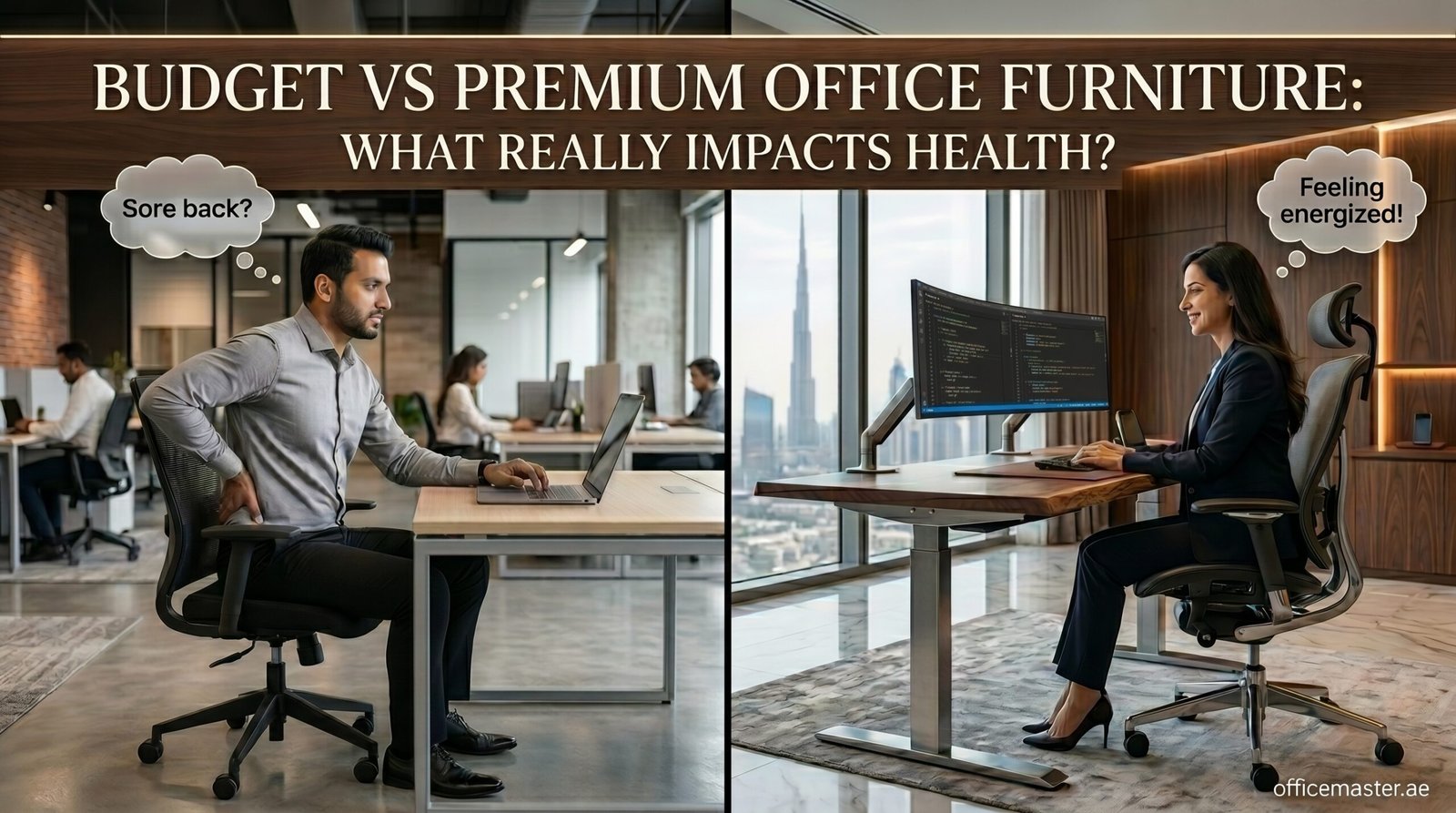
Picture this: You’ve outfitted your Dubai office with 40 sleek-looking chairs and matching desks sourced at the lowest possible price point to stay within budget. Within six months, three of your top employees are reporting chronic lower back pain. Two have taken medical leave. Productivity has quietly declined. The budget decision that seemed financially responsible has become an expensive problem.
This scenario plays out across offices in the UAE every single day and it reflects one of the most underestimated decisions in business operations: the quality of office furniture.
The global ergonomic furniture market was valued at USD 46.2 billion in 2023 and is projected to surpass USD 83 billion by 2032, growing at a CAGR of 6.7% (Grand View Research, 2024). This surge is not driven by aesthetics — it is driven by an urgent, data-backed recognition that the furniture people use every working day has a direct, measurable impact on their physical health, cognitive performance, and organizational productivity.
This article cuts through the marketing noise and delivers a rigorously researched comparison between budget and premium office furniture covering the science of ergonomics, real-world ROI, UAE market realities, and everything HR managers, business owners, and office planners need to make truly informed procurement decisions.
1. Defining the Spectrum: What Separates Budget from Premium Office Furniture?
Before comparing health outcomes, it is essential to understand what actually differentiates budget and premium office furniture — beyond price tags and brand names.
Budget Office Furniture: Characteristics and Trade-offs
Budget office furniture typically falls in the AED 200–800 per chair or AED 400–1,200 per desk range in the UAE market. These products are engineered to meet a price point, which introduces a series of compromises:
- Materials: Particle board with laminate veneer, thin foam padding (40–50 kg/m³ density), basic nylon casters, and plastic structural components that degrade under sustained load.
- Adjustability: Fixed or minimally adjustable features — typically only seat height, with no lumbar support customization, fixed armrests, and non-tilting seat pans.
- Durability: Industry testing typically rates budget chairs at 100,000–150,000 tilt cycles, which translates to approximately 2–3 years of standard use before structural degradation.
- Certifications: Few or no third-party ergonomic certifications (BIFMA, EN 1335, GREENGUARD).
- Warranty: Typically 1–2 years, covering only manufacturing defects.
Premium Office Furniture: Engineering for the Human Body
Premium office furniture — ranging from AED 1,500–6,000+ per ergonomic chair and AED 2,000–8,000 for height-adjustable desks — is engineered around biomechanical research and occupational health science:
- Materials: High-density foam (60–80 kg/m³), breathable mesh backings for temperature regulation, die-cast aluminum frames, and commercial-grade casters rated for high-frequency use.
- Adjustability: Up to 14+ independently adjustable parameters — seat depth, lumbar height and depth, armrest 4D adjustment, recline tension, headrest positioning, and dynamic tilt mechanisms.
- Durability: BIFMA-tested to 250,000+ tilt cycles, with structural lifespans of 10–15 years under commercial use.
- Certifications: BIFMA Level, GREENGUARD Gold, ISO 9001 manufacturing standards, and EN 1335 European ergonomic compliance.
- Warranty: 5–12 year comprehensive warranties covering all components including upholstery.
Budget vs Premium Office Furniture — Head-to-Head Comparison
| Feature / Criteria | Budget Furniture (AED 200–800) | Premium Furniture (AED 1,500–6,000+) |
|---|---|---|
| Seat Foam Density | 40–50 kg/m³ (compresses quickly) | 60–80 kg/m³ (sustained support) |
| Lumbar Support | Fixed or absent | Adjustable height + depth |
| Armrest Type | Fixed or 1D | 3D or 4D (height, depth, width, pivot) |
| Recline Mechanism | Basic or none | Synchro-tilt with tension control |
| Back Material | PU leather / basic fabric | Breathable mesh or premium fabric |
| Frame Construction | Plastic / MDF | Steel / aluminum alloy |
| Ergonomic Certification | None | BIFMA, EN 1335, GREENGUARD |
| Average Lifespan | 2–3 years | 10–15 years |
| Warranty | 1–2 years (parts only) | 5–12 years (comprehensive) |
| Health Impact Rating | Low — musculoskeletal risk increases after 6 months | High — clinically supported posture improvement |
| Annual Cost Per Chair | AED 200–400 (frequent replacement) | AED 150–400 (amortized over lifespan) |

2. The Science of Sitting: How Office Furniture Directly Affects Human Health
Sedentary work is now classified as a significant occupational health risk. The average office employee sits for 6.5 to 8 hours per day. Over a working year, this amounts to more than 1,600 hours in contact with their chair and desk — a duration during which the physical properties of that furniture either protect or progressively damage the body.
The Musculoskeletal Consequences of Poor Seating
A landmark study published in the Journal of Occupational and Environmental Medicine (2022) found that employees using non-ergonomic chairs reported a 57% higher incidence of lower back pain compared to those using ergonomic alternatives. The World Health Organization (WHO) identifies musculoskeletal disorders (MSDs) as the leading cause of disability globally, accounting for over 1.71 billion cases worldwide.
Poor office furniture creates a cascading chain of physiological damage:
- Lumbar Compression: Without adequate lumbar support, the natural inward curve (lordosis) of the lower spine flattens, placing up to 140% more compressive force on spinal discs than in a standing position (Nachemson, 1976 — a foundational biomechanics reference still cited today).
- Reduced Circulation: Seat edges that press against the underside of thighs restrict blood flow to the lower extremities, contributing to fatigue, swelling, and in chronic cases, venous insufficiency.
- Cervical Strain: Non-adjustable monitor positions combined with fixed chair heights force the neck into sustained forward flexion, imposing up to 27 kg of effective force on cervical vertebrae at a 45-degree forward angle (Hansraj, 2014).
- Repetitive Strain Injuries (RSI): Fixed armrests that do not align with individual anatomy force shoulder abduction and wrist deviation, contributing to conditions such as carpal tunnel syndrome and lateral epicondylitis.
The Role of Adjustability in Postural Neutrality
Neutral posture — a state in which the spine maintains its natural curvature, the joints are minimally loaded, and muscular activity is balanced — is the gold standard in ergonomic design. Achieving neutral posture requires that furniture adapts to the user, not the other way around.
Research from Cornell University’s Human Factors and Ergonomics Laboratory demonstrates that every centimeter of seat height mismatch from the ideal position increases lower limb muscular load by approximately 5–8%. A chair that cannot be adjusted to the correct height for a user — regardless of its aesthetic quality — is ergonomically ineffective.
Premium ergonomic chairs address this through dynamic lumbar support systems that flex with the user’s movement, seat depth adjustment that accommodates different leg lengths (preventing popliteal compression), and recline mechanisms with synchro-tilt that allow spinal decompression during natural movement throughout the workday.
Cognitive Performance and the Furniture-Brain Connection
The health impact of office furniture extends beyond the physical body. A growing body of neuroscientific and occupational psychology research demonstrates that physical discomfort directly impairs cognitive function.
A 2021 study in Ergonomics International found that participants in ergonomically supported seating demonstrated 17.5% higher scores on concentration tasks and 12% better short-term recall compared to control groups using standard office chairs. Physical discomfort activates the body’s stress-response systems, directing cognitive resources toward pain management rather than creative and analytical thinking.

3. Ergonomics in the UAE Workplace: A Market Reality Check
The United Arab Emirates presents a unique intersection of rapid commercial growth, extreme climatic conditions, and a multinational workforce — all of which have direct implications for office furniture selection and workplace ergonomics.
Climate-Specific Considerations for Office Furniture in Dubai
Dubai’s climate — characterized by temperatures exceeding 45°C in summer and sustained indoor air conditioning — creates specific demands on office furniture that are rarely addressed in global ergonomic standards:
- Material Thermal Retention: PU leather and vinyl upholstery, common in budget seating, retains heat significantly more than breathable mesh alternatives. In heavily air-conditioned offices, this can cause muscle stiffness; in inadequately cooled spaces, it contributes to excessive perspiration and skin irritation during extended sitting.
- Foam Degradation: High ambient temperatures accelerate the breakdown of low-density foam. A chair rated for 3-year use in a temperate climate may show significant compression degradation within 18 months in the Gulf region.
- UV Exposure: Natural light through glass facades — common in Dubai’s modern office towers — accelerates fabric fading and plastic brittleness in budget furniture, creating premature aesthetic and structural failure.
Workforce Diversity and Anthropometric Range
The UAE workforce is among the most internationally diverse on earth, with employees from over 200 nationalities. This creates a wide anthropometric range — variations in height, limb length, and body proportion — that makes adjustability not merely a premium feature but an operational necessity.
Average male height ranges from 162 cm (some South Asian populations) to 183 cm (some European and North American populations) among UAE office workers. A chair with a fixed seat height of, say, 46 cm — fine for a 175 cm user — places a 163 cm user’s feet unsupported and forces popliteal pressure, while leaving a 183 cm user’s knees above hip level, compressing the hip flexors.
Premium ergonomic chairs with seat height ranges of 38–52 cm and seat depth adjustment of 40–52 cm accommodate this full spectrum — budget chairs cannot.
UAE Regulatory Context: Health and Safety in the Office
The UAE Federal Law No. 8 of 1980 (Labour Law) and its subsequent amendments, along with the guidelines issued by the Ministry of Human Resources and (MOHRE), establish employer obligations for providing safe working environments. While specific ergonomics regulations are still maturing compared to EU directives (such as EU Directive 90/270/EEC on display screen equipment), the direction of travel in UAE workplace compliance is clearly toward greater ergonomic accountability.
Forward-thinking businesses in Dubai and Abu Dhabi are proactively adopting WELL Building Standard certification — a framework that explicitly evaluates workplace furniture and workstation design as components of employee health and well-being — as a differentiator in attracting top talent.

4. Ergonomic Benefits by Furniture Feature: A Detailed Analysis
Ergonomic Benefits by Furniture Feature — Health & Productivity Impact
| Furniture Feature | Budget Version | Premium Version | Documented Health Benefit (Premium) |
|---|---|---|---|
| Lumbar Support | Fixed pad or absent | Dynamic, height + depth adjustable | Up to 43% reduction in lower back pain reports (OSHA ergonomics data) |
| Seat Pan Depth | Fixed (typically 44cm) | 40–52cm adjustable range | Eliminates popliteal compression; improves lower limb circulation |
| Armrests | Fixed height only | 4D: height, width, depth, pivot | Reduces shoulder/neck muscle load by up to 29% (ergonomics journals) |
| Headrest | Absent | Height + angle adjustable | Reduces cervical muscle activation by up to 34% during screen work |
| Recline / Tilt | Locked or basic lean | Synchro-tilt, 5–135° range | Spinal disc pressure reduced by 35% at 135° recline (Wilke et al., 1999) |
| Height-Adjustable Desk | Fixed height desk | Electric sit-stand, 62–128cm range | 22% reduction in upper back/neck pain; 46% better energy levels (SSEHSC, 2016) |
| Monitor Arm | Not included | Full-motion, adjustable depth/height | Eliminates fixed forward-head posture; reduces eye strain by up to 25% |
| Seat Foam Quality | 40–50 kg/m³ (compresses in 12–18mo) | 60–80 kg/m³ with pressure mapping | Maintains consistent pressure distribution; reduces ischial tuberosity soreness |
| Breathability | PU/vinyl (heat retaining) | Aeron-style mesh or ventilated fabric | Reduces seat surface temperature by 3–5°C; lowers thermal discomfort by 31% |

5. The True Cost of Cheap: ROI Analysis of Premium Office Furniture
One of the most persistent misconceptions in office procurement is that budget furniture saves money. When analyzed over a realistic operational timeframe — and when indirect costs are factored in — this assumption frequently inverts.
Direct Cost Analysis: Replacement Cycles
A budget chair purchased for AED 450 with a 2-year functional lifespan costs AED 225 per year per seat. A premium ergonomic chair at AED 2,800 with a 12-year lifespan costs AED 233 per year per seat — a difference of just AED 8 per year. However, the premium chair also eliminates replacement logistics, supplier management time, and the productivity disruption of furniture changeovers.
Indirect Cost Analysis: The Hidden Financial Burden
The more significant financial case for premium furniture lies in indirect costs — costs that appear in HR budgets, healthcare claims, and productivity metrics rather than in furniture line items:
- Absenteeism: The UK Health and Safety Executive estimates that musculoskeletal disorders cause 8.9 million working days lost per year. In the UAE, the Ministry of Health reports MSDs as the second leading cause of work-related medical consultations.
- Medical Claims: A study by the Washington State Department of Labor found that ergonomic workplace interventions reduced workers’ compensation claims by 59% and associated costs by 68%.
- Presenteeism: Employees working while in pain — a phenomenon called presenteeism — reduce effective productivity by an estimated 30–40% during symptomatic periods (Harvard Business Review, 2023).
- Turnover: A global workplace survey found that employees who feel physically uncomfortable at work are 2.6 times more likely to report dissatisfaction with their employer — a key driver of voluntary turnover.
5-Year Total Cost of Ownership — Budget vs Premium Office Furniture (Per 10 Workstations)
| Cost Category | Budget Setup (10 Workstations) | Premium Setup (10 Workstations) |
|---|---|---|
| Initial Furniture Cost | AED 15,000 (chairs + desks) | AED 65,000 (chairs + height adjustable desks) |
| Replacement (Year 2–3) | AED 15,000 (full replacement) | AED 0 (no replacement needed) |
| Replacement (Year 4–5) | AED 15,000 (second replacement) | AED 0 |
| MSD-Related Sick Days (5 yr)* | ~45 days × AED 800/day = AED 36,000 | ~12 days × AED 800/day = AED 9,600 |
| Healthcare / Medical Claims* | AED 18,000 (estimated) | AED 4,800 (estimated) |
| Productivity Loss (Presenteeism)* | AED 42,000 (estimated 5-yr impact) | AED 11,000 (estimated) |
| 5-Year Total Cost | AED 141,000 | AED 90,400 |
*Estimates based on industry averages for a 10-person team; actual figures vary by industry, workforce age, and existing health conditions.
Real-World Scenario: A Dubai Tech Company’s Furniture Transition
Consider a mid-sized technology firm in Dubai Internet City with 35 employees. In 2021, management replaced their budget workstations with premium ergonomic chairs and sit-stand desks at a total investment of AED 210,000. Within 18 months, the company reported:
- A 38% decline in musculoskeletal-related sick leave applications.
- Self-reported employee satisfaction with the physical workspace increased from 54% to 87% (internal survey).
- A measurable reduction in employee turnover, saving an estimated AED 95,000 in recruitment and on boarding costs for two roles that were previously experiencing high churn.
- The CFO’s post-investment analysis concluded that the furniture investment had paid for itself within 26 months, with ongoing annual savings thereafter.
This is not an outlier. Multiple studies — including a landmark meta-analysis by the Institute for Health and Productivity Management — confirm that well-designed ergonomic workplace interventions deliver a median ROI of 3:1 to 6:1 over a five-year period.
6. Deconstructing the Myths: What Most People Get Wrong About Office Furniture
Myth 1: ‘An Expensive Chair Looks Premium — That’s All You’re Paying For’
The visible design differences between budget and premium chairs are superficial compared to the invisible engineering differences. Premium chairs invest heavily in mechanisms you cannot see: precision-machined aluminum tilt mechanisms, individually calibrated gas cylinders with specific pressure curves, and foam formulations developed with pressure-mapping technology. These are not aesthetic choices — they are functional ones with documented bio-mechanical outcomes.
Myth 2: ‘Our Employees Are Young and Healthy — Ergonomics Can Wait’
Ergonomic damage is cumulative and frequently asymptomatic in early stages. A 2023 study in the Scandinavian Journal of Work, Environment & Health found that 61% of participants who developed significant lumbar disc pathology by age 40 had been exposed to poor workplace ergonomics in their 20s and early 30s — years before any symptoms appeared. Waiting until health problems emerge is not a strategy; it is a liability.
Myth 3: ‘We Can Fix Bad Chairs with Lumbar Pillows and Footrests’
Aftermarket accessories can partially mitigate — but cannot replicate — the functionality of purpose-designed ergonomic furniture. A lumbar cushion added to a chair with a fixed-angle back panel addresses only one variable in a multi-parameter system. It does not correct seat depth mismatch, armrest height incompatibility, or inadequate seat pan tilt — all of which remain active sources of musculoskeletal load.
Myth 4: ‘Standing Desks Are a Fad’
The evidence base for height-adjustable desks is substantial. A 2016 randomized controlled trial published in the British Medical Journal found that sit-stand desks reduced sitting time by 1.28 hours per day and were associated with significant improvements in upper back and neck pain, fatigue, and mood among office workers. The NHS now recommends alternating sitting and standing throughout the workday as a standard occupational health guideline.
Myth 5: ‘Budget Furniture Is Fine If You Keep Good Posture’
Sustained voluntary postural correction is physiologically impossible over an 8-hour working day. Research in motor control demonstrates that conscious postural effort fatigues within 15–20 minutes, after which the body reverts to patterns of least resistance — which, in a non-supportive chair, means progressive slouching. Furniture that requires conscious effort to use correctly is, by ergonomic definition, poorly designed.

7. Making the Right Decision: A Strategic Framework for UAE Businesses
Step 1: Conduct a Workforce Ergonomic Assessment
Before procurement, assess the anthropometric range of your workforce, existing MSD complaint rates, work task profiles (intensive screen work vs. collaborative movement-based tasks), and daily hours seated. This data drives specification requirements more reliably than catalogue browsing.
Step 2: Prioritize High-Use, High-Impact Roles
Not every role demands the same furniture specification. Full-time screen-based roles — developers, analysts, designers, finance professionals — require the highest ergonomic specification. Roles involving frequent movement, standing meetings, or varied task environments may have different requirements. Allocate budget accordingly rather than uniformly.
Step 3: Evaluate Total Cost of Ownership, Not Purchase Price
Use the framework in Table 3 to model 5-year TCO for your organization. Factor in your actual sick leave rates, healthcare provision structure, and productivity benchmarks. In most cases, the financial case for premium furniture becomes clear within this analysis.
Step 4: Insist on Trial Periods and Ergonomic Certification
Reputable office furniture suppliers in the UAE — including OfficeMaster.ae — offer trial periods for ergonomic chairs and workstations. Require BIFMA or EN 1335 certification as a minimum standard. These certifications are not marketing designations; they represent independently verified compliance with established safety and performance thresholds.
Step 5: Train Your Workforce in Ergonomic Setup
Even the best ergonomic chair delivers suboptimal outcomes if incorrectly configured. Invest in brief ergonomic setup training — ideally conducted by a certified ergonomist — at the point of furniture deployment. A 30-minute session per employee can transform a theoretical specification into practical health protection.

Frequently Asked Questions: Budget vs Premium Office Furniture
Is expensive office furniture actually worth the investment?
Yes — when evaluated over a realistic timeframe. Premium ergonomic furniture typically costs less annually than budget alternatives when replacement cycles are factored in, and delivers significant indirect savings through reduced absenteeism, fewer MSD-related medical claims, and measurable productivity improvements. The median documented ROI for ergonomic workplace interventions is 3:1 to 6:1 over five years.
What are the most important ergonomic features to look for in an office chair?
The five most critical adjustable features are: (1) seat height range,
(2) lumbar support height and depth,
3) seat depth (pan depth),
(4) armrest height and width, and
(5) recline tension control. For screen-intensive roles, an adjustable headrest adds significant cervical protection. Any chair missing more than two of these adjustable parameters is ergonomically insufficient for sustained workday use.
How much should a good ergonomic office chair cost in Dubai?
In the UAE market, a genuinely ergonomic office chair with certified performance typically starts at AED 1,200–1,500 for entry-level ergonomic models and ranges to AED 4,000–6,500 for premium commercial-grade options from leading brands. Chairs below this price point may carry ergonomic branding but are unlikely to offer the genuine adjustability and structural integrity required for sustained health protection.
Can cheap office chairs cause back pain?
Yes. Non-adjustable or minimally adjustable chairs force users into positions that deviate from neutral posture — creating sustained mechanical load on spinal discs, muscular fatigue, and ligamentous stress. Over weeks and months, this cumulative load manifests as lower back pain, which is the most commonly reported occupational health complaint among office workers globally.
Are sit-stand desks worth it for health in the UAE office environment?
Yes — clinical evidence supports significant health benefits from height-adjustable desks when used correctly (alternating between sitting and standing every 30–60 minutes). In Dubai’s climate, where air conditioning encourages prolonged static sitting, the postural variation offered by sit-stand desks is particularly valuable. Users report measurable improvements in back and neck pain, energy levels, and mood within 4–8 weeks of adoption.
What is the average lifespan of budget vs premium office furniture?
Budget office chairs typically provide 2–3 years of functional use before significant foam compression, mechanism wear, or structural issues emerge. Premium chairs — particularly those tested to BIFMA standards — are designed for 10–15 years of commercial use. In the UAE’s high-temperature environment, this gap may be even more pronounced due to material degradation from ambient heat.
How do I know if office furniture is truly ergonomic?
Look for third-party certification: BIFMA (Business and Institutional Furniture Manufacturers Association) certification indicates compliance with rigorous North American safety and durability standards; EN 1335 indicates European ergonomic compliance. GREENGUARD certification addresses chemical emissions. Be cautious of products described as ‘ergonomic’ without independent certification — this term has no legal definition and is widely misapplied in marketing.
Is it better to buy 10 budget chairs or 5 premium chairs for a new office?
From a health and financial perspective, it is generally preferable to purchase fewer, higher-quality chairs than to fill all seats with non-ergonomic budget alternatives. Consider a phased investment approach: equip highest-use, screen-intensive workstations first with premium furniture, then upgrade remaining stations over 12–18 months. This prioritizes health protection where it matters most while managing cash flow.
What office furniture do UAE businesses most commonly underinvest in?
Based on UAE market data, monitor positioning solutions (arms and stands) and keyboard/mouse ergonomics are the most consistently overlooked elements of a complete ergonomic workstation. Many businesses invest in ergonomic chairs but neglect the monitor height and distance variables that determine whether cervical posture is protected — resulting in neck and upper back complaints despite having upgraded seating.
Does office furniture quality affect employee retention in Dubai?
Research increasingly confirms this link. A workplace survey found that physical workplace comfort is among the top 5 factors influencing employee engagement and satisfaction. In Dubai’s competitive talent market — where professionals compare workplace conditions across major employers in DIFC, Business Bay, and Dubai Internet City — the quality of the physical work environment is a meaningful differentiator in talent attraction and retention.
How often should office furniture be replaced?
Premium ergonomic furniture: assess at 10–12 years and replace based on mechanism function and upholstery integrity. Budget furniture: plan for full replacement every 2–3 years. Regardless of age, any chair showing structural instability, compressed seat foam (less than 3cm of effective cushioning), or non-functional adjustment mechanisms should be replaced immediately for both health and liability reasons.
Prioritize: (1) genuine ergonomic certification (BIFMA or EN 1335),
(2) adjustability range that covers your workforce’s anthropometric diversity,
(3) warranty duration and terms (5+ years indicates manufacturer confidence in durability),
(4) the supplier’s after-sales service and spare parts availability in the UAE, and
(5) the ability to trial products before bulk procurement. OfficeMaster.ae offers certified ergonomic solutions with UAE-specific support and competitive pricing across Dubai and the wider UAE.
Your Furniture Decision Is a Health Decision
The evidence is unambiguous: office furniture is not a procurement line item to be optimized for minimum cost. It is a foundational element of workplace health infrastructure — one that influences posture, pain levels, cognitive performance, employee engagement, and organizational productivity every single working day.
The budget-versus-premium debate, when examined through the lens of total cost of ownership, health outcomes, and organizational performance, resolves clearly in favor of quality investment. Budget furniture’s initial appeal evaporates across replacement cycles, healthcare costs, productivity losses, and talent retention expenses. Premium ergonomic furniture, by contrast, delivers documented health protection and measurable financial returns.
For UAE businesses — operating in a competitive talent market, a demanding climate, and an increasingly health-conscious regulatory environment — the question is not whether premium office furniture is worth the investment. The question is how to structure that investment for maximum organizational benefit.
OfficeMaster.ae offers an industry-leading range of certified ergonomic office chairs, height-adjustable desks, collaborative workspace furniture, and complete office fit-out solutions tailored for the UAE market. Our team of ergonomic consultants and furniture specialists work with businesses across Dubai, Abu Dhabi, Sharjah, and the wider GCC to design workspaces that protect people and perform financially.