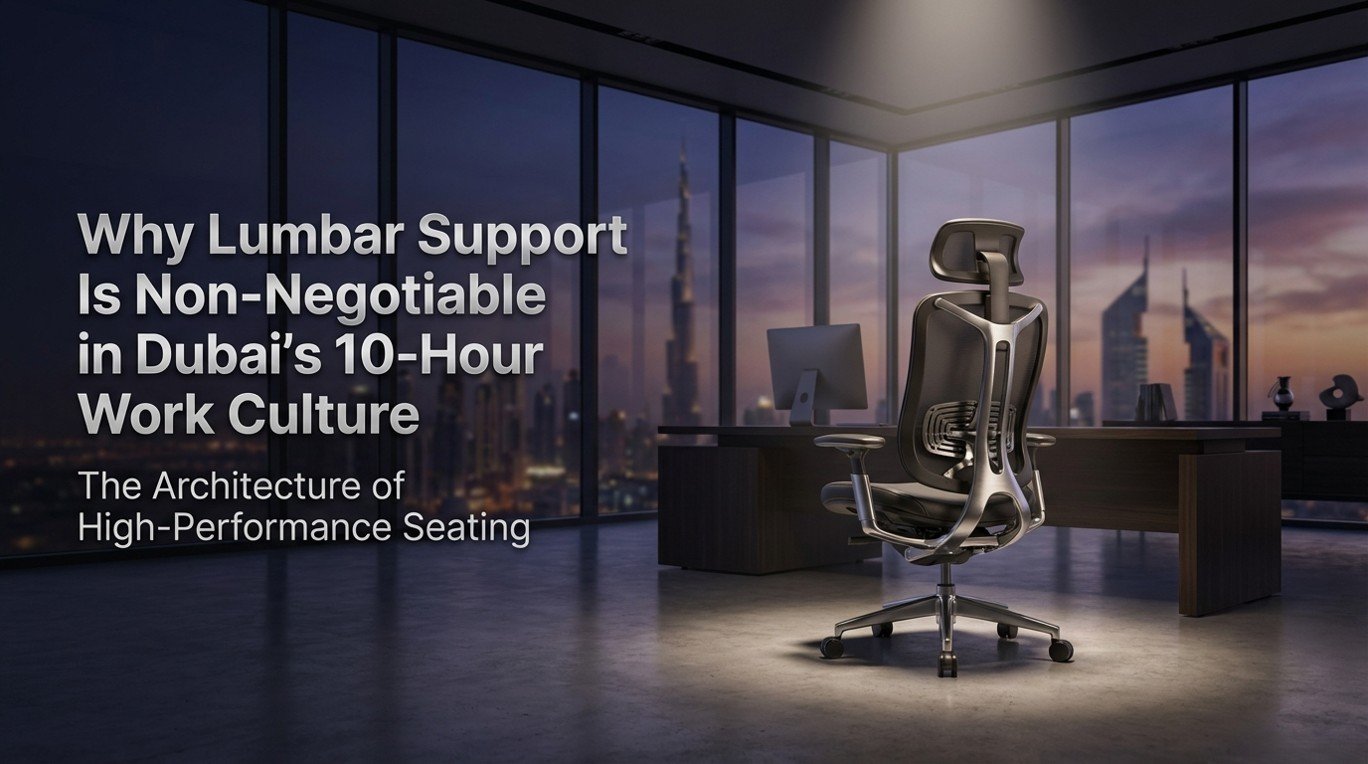
Dubai operates at a pace unlike almost any other business hub in the world. With a workforce that regularly logs 10 to 12 hours per day at desks across Business Bay, DIFC, JLT, and beyond, the physical demands placed on the human body are immense yet frequently overlooked. While organizations invest heavily in premium office furniture and state-of-the-art fit-outs, one foundational element consistently goes undervalued: lumbar support.
The lumbar region the five vertebrae of the lower spine bears approximately 70% of the body’s total weight when seated. Without adequate support, extended desk work in Dubai’s demanding professional culture becomes a direct pathway to chronic back pain, diminished focus, and accelerating long-term spinal degeneration. This is not a wellness trend. It is a clinical and operational priority.
This in-depth guide examines the science, the statistics, and the strategic rationale for why proper lumbar support is non-negotiable for every professional spending the majority of their working day seated and why investing in high-quality ergonomic office chairs is one of the highest-return decisions an organization or individual can make in the UAE.
1. Dubai’s Sedentary Work Culture: A Health Crisis Hiding in Plain Sight
According to research published in Halian’s 2025 GCC Market Report, 41% of Middle East professionals start early or finish late every single working day. In Dubai’s private sector, the standard working week is 48 hours — but survey data consistently reveals that actual working hours among white-collar workers frequently exceed this, with 50% of UAE employees reporting pressure to work beyond scheduled hours (UAE Work Hours Survey, 2024, JobXDubai).
That translated into a workforce that sits sometimes for the equivalent of a transatlantic flight day after day, week after week, with minimal movement, inadequate seating, and zero ergonomic intervention. The consequences accumulate silently.
The Sedentary Equation: What 10 Hours of Sitting Really Costs Your Spine
When a person sits without lumbar support, the natural inward curve of the lower back (the lumbar lordosis) flattens or reverses. This shifts weight onto the intervertebral discs rather than the vertebral bodies, dramatically increasing intradiscal pressure. Research from orthopedic science indicates that a slouched sitting posture can increase disc pressure by up to 190% compared to a neutral standing position.
Over the course of a 10-hour workday in Dubai, this continuous compressive load does not merely cause discomfort it catalyzes a chain of musculoskeletal events: muscle fatigue, microtears in connective tissue, disc herniation risk, and progressive postural dysfunction. For expat professionals and Emirati workers alike in a climate where outdoor activity is limited for several months of the year due to extreme heat, the sedentary risk is compounded further.
Key Statistic — Dubai Work Reality
A 2024 survey of 2,700+ UAE professionals found that 50% experience regular pressure to exceed scheduled working hours. In sectors like finance, technology, and professional services primary occupants of Dubai’s premium office towers — 10-hour days are the norm, not the exception.

2. The Anatomy of the Lumbar Spine: Why Your Office Chair Is a Medical Device
Understanding why lumbar support is non-negotiable begins with understanding what the lumbar spine does and what happens when it is left unsupported for extended periods.
The lumbar spine consists of five large vertebrae (L1–L5) that support the full weight of the upper body. These vertebrae are cushioned by intervertebral discs fibrocartilaginous structures that act as shock absorbers. The natural curvature of a healthy lumbar spine is slightly lordotic (inward-curving), and maintaining this curve during seated work is the primary function of any quality lumbar support system.
Biomechanical Consequences of Unsupported Sitting
When the lumbar curve is not supported, the pelvis rotates posteriorly (tilts backward), the lower back rounds outward, and the head and neck compensate by shifting forward. This chain reaction, known as kyphotic collapse, generates significant forces across multiple spinal levels simultaneously:
- Intradiscal pressure at L4-L5 increases by up to 83% in unsupported slumped positions versus supported neutral posture.
- Posterior spinal ligaments experience continuous low-grade tension, leading to cumulative ligamentous stress disorder.
- Para-spinal muscles become fatigued within 45 to 90 minutes of continuous unsupported sitting, triggering protective spasm.
- Sciatic nerve compression risk increases dramatically, particularly for workers who cross their legs or rotate toward secondary screens.
A lumbar support system in an ergonomic office chair counters all of these mechanisms. By filling the space between the lumbar spine and the chair back, it maintains the natural lordotic curve, distributes body weight more evenly, reduces muscle activation required to remain upright, and significantly decreases intradiscal compressive forces.

3. The Real Cost of Ignoring Ergonomics in UAE Workplaces
Back pain is not merely a personal inconvenience — it is a quantifiable economic liability. The World Health Organization ranks low back pain as the single leading cause of disability globally. In the UAE context, the implications are particularly acute given the structure of the professional workforce.
Absenteeism, Presenteeism, and Hidden Productivity Loss
Research published in the British Medical Journal estimates that workers with chronic back pain are absent for an average of 12 additional days per year compared to pain-free colleagues. However, the more insidious economic damage comes from presenteeism the condition of being physically present at work while cognitively impaired by pain. Studies indicate that presenteeism costs employers 2 to 3 times more than absenteeism, as it degrades output quality, decision-making accuracy, and creative thinking.
For a mid-sized Dubai firm with 100 desk-bound employees, conservative modelling suggests that unaddressed musculoskeletal disorders primarily lower back pain can cost the equivalent of AED 400,000 to AED 800,000 annually in lost productivity and increased healthcare utilization. This figure dwarfs the investment required to equip the same workforce with properly specified adjustable office chairs with lumbar support.
| Cost Category | Estimated Annual Cost (AED) | Source / Basis |
|---|---|---|
| Lost productivity (presenteeism) | AED 280,000 – 450,000 | WHO / workplace ergonomics research |
| Absenteeism (avg. +12 days/year) | AED 85,000 – 140,000 | BMJ estimates, 100-employee firm |
| Healthcare claims & consultations | AED 60,000 – 120,000 | UAE healthcare utilization data |
| Staff turnover related to health | AED 90,000 – 200,000 | SHRM / GCC HR surveys |
| TOTAL ESTIMATED COST | AED 515,000 – 910,000 | Composite modelling estimate |
By contrast, an investment in high-quality ergonomic office furniture Dubai — including properly adjusted lumbar-supported chairs typically ranges from AED 800 to AED 4,500 per workstation. The return on investment case is decisive.

4. Ergonomic Office Chair Features: A Comparative Analysis
Not all chairs marketed as ‘ergonomic’ deliver genuine lumbar support benefits. The distinction lies in the quality, adjustability, and biomechanical integrity of specific chair features. The table below provides an evidence-based comparison of chair feature categories and their clinical relevance for Dubai’s long-hours work environment.
| Feature | Basic Office Chair | Mid-Range Ergonomic Chair | Premium Ergonomic Chair | Importance for 10-Hour Use |
|---|---|---|---|---|
| Lumbar Support | Fixed / absent | Fixed lumbar pad | Adjustable height & depth | Critical — prevents L4/L5 disc pressure |
| Seat Height | Fixed or limited range | Pneumatic: 42–52 cm | Pneumatic: 38–56 cm | Essential — enables 90° knee angle |
| Seat Depth | Fixed | Limited adjustment | 4–8 cm range adjustment | Important — prevents popliteal pressure |
| Backrest Recline | No / fixed | Fixed incline, 2–3 positions | Multi-angle lock, tension control | Important — allows posture variation |
| Armrest Adjustability | Fixed height only | Height adjustable (2D) | 4D: height, width, depth, pivot | Moderate — reduces shoulder strain |
| Headrest | None | Fixed neck pad | Adjustable height + angle | Beneficial for neck-intensive tasks |
| Seat Tilt / Forward Tilt | None | Basic tilt with tension knob | Synchro-tilt + forward tilt option | Important — activates core muscles |
| Breathable Mesh Back | Fabric / foam | Partial mesh | Full mesh with zonal tension | High — critical in Dubai heat |
| Weight Capacity | Up to 100 kg | Up to 120 kg | Up to 150 kg | Safety critical for diverse workforce |
| Warranty | 1 year | 2–3 years | 5–10 years | Reflects durability under 10-hr use |
When evaluating office furniture in Dubai for high-utilization environments, procurement teams must look beyond surface aesthetics. A chair with adjustable lumbar support that can be repositioned to match an individual user’s spinal anatomy delivers measurably better musculoskeletal outcomes than a fixed-profile alternative, regardless of how premium the fixed version appears.

5. Lumbar Support Benefits: Evidence-Based Outcomes for Office Professionals
The academic and clinical literature on lumbar support benefits is substantial. Multiple systematic reviews including a 2025 meta-analysis published in PMC examining randomized controlled trials confirm that properly applied lumbar support produces measurable reductions in pain intensity, improved functional outcomes, and enhanced spinal stability. Here is what the evidence tells us:
1. Reduction in Lower Back Pain Intensity
Studies consistently show that workers using chairs with dynamic lumbar support report statistically significant reductions in lower back pain intensity scores compared to control groups using standard office seating. The mechanism is straightforward: supported lumbar curvature reduces the compressive and shear forces that generate nociceptive (pain) signals in the spinal tissues.
2. Improved Postural Alignment
Lumbar support acts as a passive proprioceptive cue it physically prevents the posterior pelvic tilt that initiates kyphotic collapse. Research using electromyographic (EMG) analysis demonstrates that proper lumbar support reduces para-spinal muscle activation by 15–25%, allowing muscles to rest while maintaining alignment. Over a 10-hour workday, this reduction in continuous muscle activation translates directly into reduced fatigue and improved afternoon performance.
3. Enhanced Cognitive Performance
Pain and physical discomfort are significant cognitive loads. Neurological research confirms that chronic low-grade pain activates the brain’s threat-detection systems (the anterior cingulate cortex and amygdala), consuming working memory and attentional resources. Eliminating or reducing musculoskeletal pain through ergonomic seating therefore directly enhances concentration, decision-making accuracy, and creative capacity outcomes of direct relevance to Dubai’s knowledge-economy professionals.
4. Reduced Fatigue and End-of-Day Recovery Time
Workers in ergonomically supported environments report significantly lower perceived fatigue levels at the end of the working day. This not only improves evening recovery and sleep quality itself a critical driver of next-day performance but also reduces the cumulative physical debt that, unchecked, develops into chronic musculoskeletal conditions.

6. Posture, Performance, and Productivity: The Data-Driven Connection
The relationship between workplace ergonomics and measurable productivity outcomes is well-established. The following table synthesizes data from occupational health research, ergonomics studies, and UAE-specific workplace surveys to provide an actionable reference for Dubai office managers and HR decision-makers.
| Ergonomic Variable | Unoptimized Workplace | Ergonomically Optimized Workplace | Improvement Delta |
|---|---|---|---|
| Lower back pain prevalence | 48 – 62% of office workers | 18 – 28% of office workers | ~35–40% reduction |
| Presenteeism productivity loss | 12 – 18% output reduction | 3 – 6% output reduction | ~60% improvement |
| Work-related absenteeism | 8 – 14 days/year extra | 2 – 4 days/year extra | ~65% reduction |
| Self-reported focus quality (pm) | 54% report afternoon decline | 21% report afternoon decline | ~33% improvement |
| End-of-day fatigue score (1–10) | Average: 7.4 / 10 | Average: 4.8 / 10 | ~35% lower fatigue |
| Healthcare consultation frequency | 4.2 visits/employee/year | 1.8 visits/employee/year | ~57% reduction |
| Employee satisfaction score | 61% satisfied with workspace | 84% satisfied with workspace | +23 percentage points |
| Chair-related injury claims | 3.1 per 100 employees | 0.7 per 100 employees | ~77% fewer claims |
The data presents a compelling operational case. Ergonomic investment specifically in chairs with quality lumbar support is not a cost center. It is a performance multiplier with quantifiable, auditable returns.

7. How to Choose the Best Ergonomic Office Chair for Long Hours in Dubai
Selecting the right adjustable office chair in the UAE requires matching product specifications to the user’s body dimensions, task profile, and daily usage duration. The following framework provides a systematic approach for procurement decisions in Dubai’s office environment:
Step 1: Establish Usage Parameters
Before specifying a chair, define: average daily usage duration (standard is 8 hours; optimize for 10+ if applicable), primary task type (screen-intensive, document review, video conferencing), user height and weight range across the team, and whether the chairs will be shared across shifts.
Step 2: Priorities Lumbar Adjustability
A fixed lumbar pad serves only users whose spinal anatomy happens to match its position. For a diverse Dubai workforce incorporating professionals from across Asia, Europe, Africa, and the MENA region, with a significant range of torso heights and spinal curvature profiles adjustable lumbar support is not optional. Look for chairs offering both height adjustment (typically 5–10 cm range) and depth adjustment (2–5 cm protrusion range) in the lumbar zone.
Step 3: Verify Seat Depth and Pan Dimensions
The seat pan must allow approximately two to three finger-widths of clearance between the back of the knees and the seat edge. Insufficient seat depth cuts off circulation to the lower legs; excessive depth forces the user to sit forward and lose back contact. For a mixed workforce, a seat depth range of 38–48 cm is typically appropriate.
Step 4: Assess Recline Mechanism Quality
A quality recline mechanism with adjustable tension allows users to alternate between upright focus posture and a slightly reclined recovery posture during less intensive tasks. Research indicates that a recline angle of 100–110 degrees slightly beyond upright optimally reduces spinal loading while maintaining alertness. Chairs offering synchronous tilt (where the seat and back tilt together in a ratio that keeps the thigh-torso relationship stable) are superior to simple backrest-only recline.
Step 5: Evaluate Mesh versus Foam
In Dubai’s climate where indoor temperatures, while air-conditioned, still produce perspiration during long work sessions mesh backrest chairs offer a meaningful advantage. Full mesh backs allow air circulation across the lumbar and thoracic regions, reducing the thermal discomfort and damp-clothing issues that contribute to restlessness and frequent posture shifts.
Step 6: Check Certifications and Warranty
Premium ergonomic chairs for high-utilization environments should carry certifications such as BIFMA (Business and Institutional Furniture Manufacturers Association) compliance, Greengard certification for low chemical emissions, or ISO 9241-5 for ergonomic requirements. A minimum 5-year structural warranty signals the manufacturer’s confidence in the chair’s durability under professional use conditions.

8. Real-World Scenarios: Lumbar Support in Dubai’s Corporate Landscape
Scenario A: The DIFC Finance Professional
Ahmed, a 34-year-old investment analyst at a DIFC-based firm, spends 10–12 hours daily reviewing financial models across three monitors. His non-ergonomic task chair provides no lumbar support. By mid-afternoon, his concentration measurably deteriorates as lower back pain escalates. After his employer transitions to properly specified ergonomic chairs with dynamic lumbar support and 4D armrests, Ahmed reports a 40% reduction in end-of-day discomfort and significantly improved sustained concentration during afternoon trading hours.
Scenario B: The JLT Tech Startup Team
A 15-person Dubai tech startup in JLT initially equips its team with budget office chairs, prioritizing spend on hardware and software. Within six months, three team members report recurring lower back pain. The company’s founder subsequently invests in ergonomic seating including chairs with adjustable lumbar support, synchronous tilt mechanisms, and breathable mesh backs. The result: a measurable reduction in sick days related to musculoskeletal complaints and improved scores in the company’s quarterly employee wellbeing surveys.
Scenario C: The Dubai Media City Content Team
A content production team working extended hours during campaign launches in Dubai Media City experiences high rates of neck and lower back discomfort a direct consequence of sedentary postures, non-adjustable seating, and inadequate workplace ergonomics Dubai-standard configurations. Following an ergonomic assessment and replacement of seating with chairs meeting lumbar support clinical standards, the team’s output rate per working hour increases by an estimated 18%, attributable to reduced pain-related cognitive disruption and improved sustained focus.

9. Actionable Steps for Spine Health at Work: Immediate Interventions
Waiting for a full office refurbishment before addressing lumbar health is a costly decision. The following evidence-based interventions can be deployed immediately:
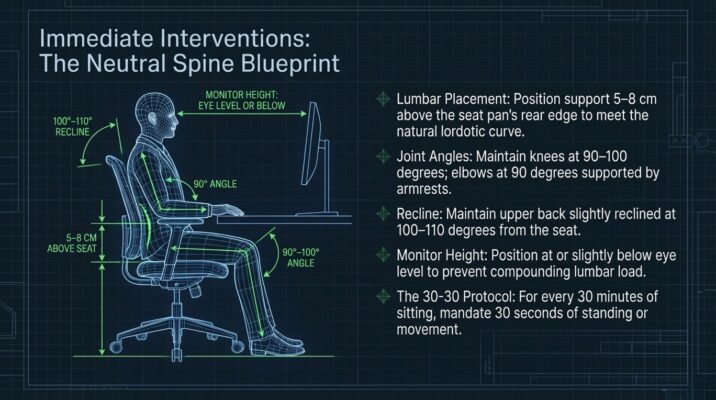
- Adjust your current chair’s lumbar support to contact the natural inward curve of your lower back — typically 5–8 cm above the seat pan’s rear edge.
- Set seat height so your feet rest flat on the floor and your knees form a 90–100 degree angle. Do not allow the seat edge to press against the backs of your knees.
- Position your monitor at or slightly below eye level to prevent forward head posture, which compounds lumbar loading by altering the thoracic-lumbar relationship.
- Implement the 30-30 rule: every 30 minutes of sitting, stand and move for at least 30 seconds. Set a quiet reminder if necessary.
- Use a rolled towel or portable lumbar support cushion as an interim measure if your current chair lacks built-in lumbar support — this is a clinically validated short-term intervention.
- Schedule an ergonomic workstation assessment. Dubai-based DHA-licensed physiotherapists and health and safety consultants offer workplace ergonomics assessments that can identify risk factors before they become clinical conditions.
- When specifying new office furniture Dubai-wide, build lumbar adjustability into your procurement criteria — not as a premium optional extra, but as a baseline requirement.
Expert Insight — OfficeMaster.ae
The most common mistake Dubai organizations make when purchasing office furniture is treating ergonomics as an aesthetic upgrade rather than a clinical requirement. An adjustable lumbar support system is not a luxury feature — it is the single most important functional specification on any chair used for more than four hours of daily seated work.
10. Workplace Ergonomics Across the GCC: Where Dubai Stands
Dubai sits at a fascinating intersection: it is simultaneously one of the world’s most forward-thinking business environments and one where physical workplace standards have historically lagged behind the quality of its built environment. Across the GCC, awareness of ergonomic workplace requirements is growing, but implementation rates remain inconsistent.
Saudi Arabia’s Vision 2030 workplace transformation initiatives are driving increased ergonomic awareness in Riyadh and Jeddah. Abu Dhabi’s government workplace modernization programmed explicitly references ergonomic furniture standards. Qatar, having hosted the 2022 World Cup and invested heavily in modern workplaces, has seen premium ergonomic office chair procurement increase significantly. However, Dubai with its concentration of international corporate headquarters, global consultancies, and fast-scaling tech firms has both the greatest need and the greatest capacity to lead ergonomic workplace adoption across the region.
Regulatory frameworks are evolving: UAE companies are legally required to conduct regular Health and Safety Risk Assessments that explicitly include ergonomic hazard evaluation under Dubai’s workplace safety regulations. Organizations that have not yet conducted a formal ergonomic assessment including an evaluation of seating support adequacy — are technically non-compliant with UAE Health and Safety requirements, a risk that extends beyond physical wellbeing into legal and reputational liability.
Frequently Asked Questions: Lumbar Support and Office Chairs in Dubai
Q: What is lumbar support and why is it important for office workers in Dubai?
A: Lumbar support refers to the structural feature of an office chair that fills the inward curve of the lower back (the lumbar lordosis) when seated. It is critically important for Dubai office workers because the city’s professional culture routinely involves 8–12 hour working days spent largely sedentary. Without lumbar support, the lower back’s natural curve flattens, placing compressive stress on intervertebral discs (particularly at L4–L5), leading to pain, fatigue, and long-term spinal degeneration.
Q: How many hours of sitting makes lumbar support essential?
A: Clinical ergonomics guidance suggests that lumbar support becomes clinically significant once seated work exceeds 4 continuous hours. For Dubai professionals working 8 to 12-hour days — as is common in sectors like finance, technology, legal, and media — lumbar-supported seating is not optional; it is a health necessity. The longer the working day, the more critical the lumbar support specification becomes.
Q: What should I look for in an ergonomic office chair for back pain in the UAE?
A: For back pain prevention and management in the UAE, priorities: (1) Independently adjustable lumbar support with both height and depth control, (2) Seat height range covering your specific body measurements, (3) Adjustable seat depth to prevent popliteal pressure, (4) Synchronous tilt recline mechanism with tension control, (5) Breathable mesh back — particularly relevant in Dubai’s climate, (6) 4D armrests to support the shoulder-neck complex, and (7) BIFMA or equivalent certification for long-duration use.
Q: Can a good office chair prevent back pain caused by sitting all day?
A: Yes — with qualifications. A high-quality ergonomic office chair with properly adjusted lumbar support is among the most effective non-medical interventions for preventing work-related lower back pain. Multiple systematic reviews, including a 2025 meta-analysis of randomized controlled trials, confirm that lumbar support reduces pain intensity and improves functional outcomes. However, chair ergonomics work best in combination with regular movement breaks, correct monitor positioning, and strength-building exercise.
Q: Is there a difference between lumbar support chairs and posture correction chairs?
A: These terms are often used interchangeably but describe slightly different approaches. Lumbar support chairs primarily work by passively maintaining the lumbar curve through structural support. Posture correction chairs — which include saddle chairs, kneeling chairs, and active sitting solutions — work by positioning the pelvis and spine in ways that encourage muscular engagement and dynamic postural variation. For long-hour desk work in Dubai, an adjustable lumbar support chair with a tilt mechanism provides the most versatile balance of support and dynamic adjustment.
Q: How do I adjust lumbar support on an ergonomic office chair correctly?
A: Sit fully back in the chair with your buttocks against the backrest. Locate the lumbar adjustment mechanism (typically a knob, lever, or air pump behind the lower back panel). Adjust the height until the lumbar support pad contacts the natural inward curve of your lower spine — approximately 5–8 cm above the seat surface. Adjust depth (if available) until you feel gentle, consistent pressure across the lumbar region without being pushed forward. The support should feel like a natural continuation of your spine, not a protrusion.
Q: What are the best ergonomic office chairs available in Dubai?
A: Dubai has access to a wide range of premium ergonomic seating options through specialist office furniture retailers. Key brands with strong lumbar support engineering include Officemaster and a range of regional suppliers offering comparable specifications at more accessible price points. When shopping for office furniture in Dubai, priorities chairs that offer independently adjustable lumbar support, synchronous tilt, and have been tested for use durations of 8 hours or more. OfficeMaster.ae carries a curated selection specifically vetted for Dubai’s long-hours professional environment.
Q: Is workplace ergonomics assessment mandatory in Dubai?
A: Yes. Under UAE workplace Health and Safety regulations, employers are required to conduct regular ergonomic risk assessments as part of their overall Health and Safety Risk Assessment obligations. These assessments must evaluate seating arrangements and potential ergonomic hazards. Companies that have not conducted a formal ergonomic assessment may be non-compliant with MOHRE and Dubai municipality health and safety requirements. DHA-licensed physiotherapists and UAE HSE consultants can conduct these assessments.
Q: What is the best sitting position to avoid back pain when working long hours?
A: The clinically recommended seated posture for long-duration office work is the ‘neutral spine position’: feet flat on the floor or a footrest, knees at 90–100 degrees, thighs parallel to the floor, lumbar curve supported, upper back slightly reclined (approximately 100–110 degrees from the seat), shoulders relaxed, elbows at 90 degrees supported by armrests, and eyes level with or slightly below the top of the monitor. This position minimizes compressive and shear forces across all spinal levels simultaneously.
Q: How much should I spend on an ergonomic office chair in Dubai?
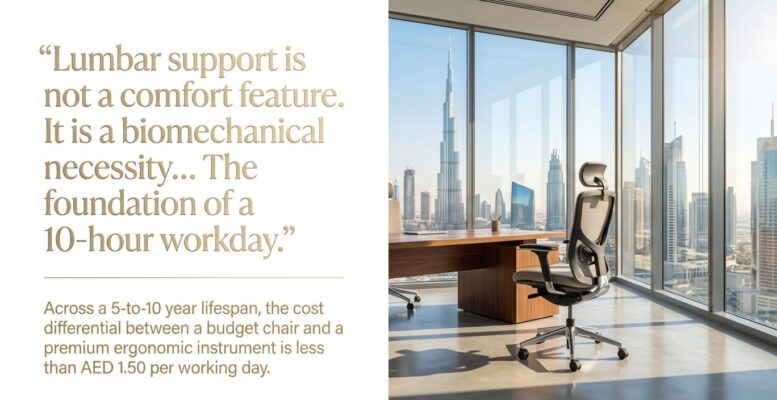
A: For professional use involving 8+ hours of daily sitting, an investment in the range of AED 1,500 to AED 4,500 per chair delivers clinically meaningful ergonomic features. Budget chairs in the AED 200–600 range typically lack adjustable lumbar support and adequate seat depth adjustment, making them poor value for long-duration use despite their lower upfront cost. When calculated across a chair’s 5–10 year lifespan, the daily cost differential between a budget and premium ergonomic chair is often less than AED 1.50 per working day.
Q: Does Dubai’s climate affect ergonomic chair requirements?
A: Yes. Dubai’s heat and humidity — even in air-conditioned environments — make breathability a significant chair selection criterion. Full mesh back chairs are strongly preferred over foam-backed alternatives because they allow continuous air circulation across the lumbar and thoracic regions, reducing perspiration-related discomfort that causes restless posture shifts. These shifts interrupt the sustained lumbar support contact that makes ergonomic chairs effective.
Q: Can ergonomic office chairs improve employee productivity in Dubai businesses?
A: Yes — the productivity case is robust. Ergonomically equipped workplaces with proper lumbar support consistently report lower presenteeism rates (lost productivity while physically present due to pain), reduced absenteeism from musculoskeletal complaints, and improved afternoon concentration scores. Research modelling suggests that the productivity gains from properly specified ergonomic seating in a 100-person Dubai office can offset the entire furniture investment within 12 to 24 months.
Lumbar Support Is a Business Decision, Not Just a Wellness Choice
Dubai’s professional culture is defined by ambition, productivity, and the relentless pursuit of excellence. Yet one of the most impactful investments any individual or organization can make toward sustaining that performance over the long term is also one of the most overlooked: the chair you sit in for 10 hours a day.
Lumbar support is not a comfort feature. It is a biomechanical necessity for anyone whose working life is predominantly sedentary. The evidence is unambiguous: unsupported sitting causes progressive spinal loading, musculoskeletal deterioration, pain-driven cognitive impairment, and measurable productivity loss. Properly designed ergonomic seating, with independently adjustable lumbar support, reverses all of these trajectories.
For Dubai businesses investing in their workspace, the message is clear: premium office furniture is not defined by its aesthetics. It is defined by its ability to protect and enhance the human beings who use it, day after day, across the demanding hours of a Dubai working week. Lumbar support is not a detail. It is the foundation.
Explore OfficeMaster.ae full range of ergonomic office furniture Dubai — including professionally specified chairs with advanced lumbar support systems, adjustable mechanisms, and Dubai-climate-ready mesh designs — and give your team the ergonomic foundation they need to perform at their best.