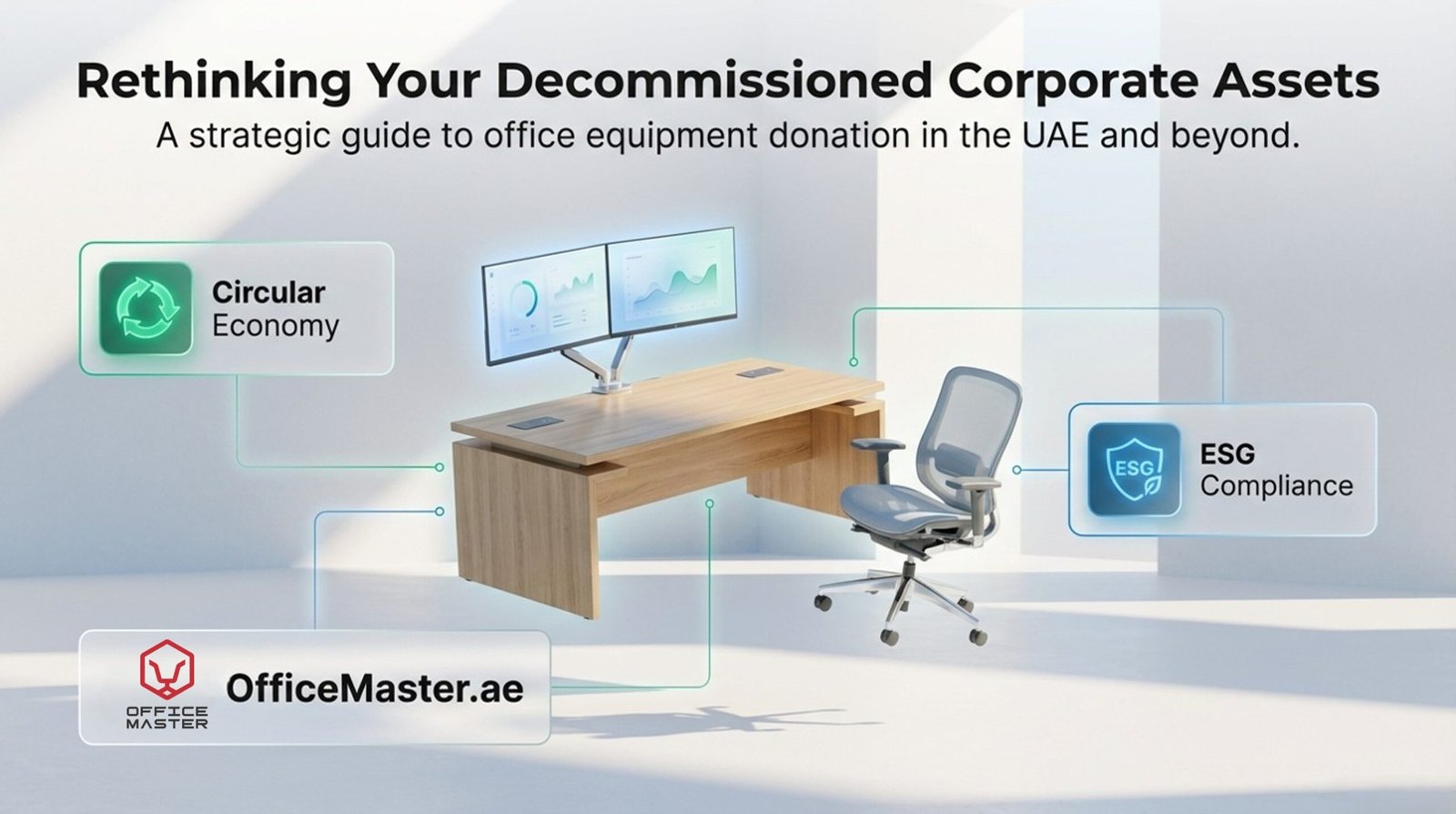
A Complete Guide for Businesses in Dubai, the UAE, and Beyond
Rethinking What Happens to Your Old Office Assets
Every year, millions of desks, chairs, filing cabinets, monitors, printers, and copiers are decommissioned by businesses around the world. In the UAE alone, rapid commercial expansion, office relocations, and corporate reconfigurations generate enormous volumes of surplus office assets annually. The critical question facing facility managers, operations directors, and sustainability officers is simple but consequential: what do you do with office equipment you no longer need?
Landfill disposal is no longer acceptable. Regulatory pressure, shareholder expectations, and genuine environmental conscience are pushing companies toward more responsible alternatives. Donation giving used office equipment a second life through nonprofit organizations, schools, community groups, or charities is emerging as the gold-standard solution. It aligns corporate social responsibility (CSR) objectives, reduces waste management costs, supports communities, and often carries tangible tax and reputational benefits.
This comprehensive guide from OfficeMaster.ae walks businesses through everything they need to know about donating office furniture and equipment: where to donate, how to donate, what organizations accept, the legal framework in the UAE, environmental impact, and step-by-step processes to implement a corporate donation program. Whether you are managing a full office clearance in Dubai or simply upgrading your workspace assets, this guide equips you to act responsibly and strategically.
Why Businesses Donate Office Equipment: The Strategic and Ethical Case
The True Cost of Waste
When a company discards office furniture and equipment, it absorbs multiple hidden costs: removal fees, landfill charges, transportation logistics, and potential regulatory penalties for improper electronic waste disposal. In Dubai and across the UAE, regulations under the Federal Law on Waste Management (Federal Law No. 12 of 2018) increasingly hold businesses accountable for responsible asset disposal. Donation eliminates many of these burdens while generating goodwill and measurable social impact.
Corporate Social Responsibility and ESG Performance
ESG (Environmental, Social, and Governance) frameworks now govern how institutional investors, multinational clients, and government partners evaluate companies. Donating office equipment directly feeds into the ‘S’ (Social) and ‘E’ (Environmental) pillars of ESG reporting. Companies that document donation activities can include them in annual sustainability reports, improving their ESG scores and attracting conscious investors and customers.
The Circular Economy Imperative
The circular economy model rejects the traditional ‘take, make, dispose’ approach. Instead, it advocates for extending product lifecycles through reuse, refurbishment, and redistribution. Office furniture and electronics are ideal candidates for circular economy strategies. A well-maintained executive desk or ergonomic chair donated to a local school or NGO can serve another decade of productive use, dramatically reducing the embedded carbon footprint of that asset.
Expert Insight: According to the Ellen MacArthur Foundation, the circular economy could reduce global CO2 emissions by 45% by 2030. Office furniture and commercial equipment represent a significant portion of this potential, particularly in fast-growing economies like the UAE.
Environmental Impact of Office Equipment Donation vs. Disposal
The numbers paint a compelling picture. The table below compares the environmental outcomes of donating versus disposing of common office assets.
| Asset Type | CO2 Saved (Donation vs Landfill) | Years of Extended Use | Landfill Weight Diverted |
|---|---|---|---|
| Office Desk (wooden) | Approx. 120 kg CO2 | 5–15 years | 30–70 kg |
| Ergonomic Chair | Approx. 45 kg CO2 | 5–10 years | 15–25 kg |
| Desktop Computer | Approx. 300 kg CO2 | 3–5 years | 5–10 kg |
| Laptop | Approx. 200 kg CO2 | 3–5 years | 2–4 kg |
| Printer / Copier | Approx. 500 kg CO2 | 4–8 years | 50–150 kg |
| Filing Cabinet (metal) | Approx. 80 kg CO2 | 10–20 years | 30–60 kg |
| Monitor (LCD) | Approx. 180 kg CO2 | 4–7 years | 4–8 kg |
Sources: Estimates aligned with data from the World Economic Forum, Ellen MacArthur Foundation, and EPA lifecycle analysis reports.

What Types of Office Equipment Can Be Donated?
Not all office assets are equally suitable for donation. Condition, functionality, safety standards, and recipient organization requirements all play a role. The following categories represent the most widely accepted types of donated office equipment.
Office Furniture
- Desks: Executive desks, standing desks, reception desks, workstations, corner desks
- Seating: Ergonomic task chairs, executive chairs, visitor chairs, conference seating, stools
- Storage: Filing cabinets, pedestals, bookshelves, lockers, credenzas, hutches
- Tables: Conference tables, training tables, canteen tables, breakroom furniture
- Reception & Lobby: Reception counters, waiting area sofas, feature cabinets
Office Electronics and Technology
- Computers: Desktop PCs and all-in-one units in working condition
- Laptops: Especially models less than 7 years old with working batteries
- Monitors: LCD and LED screens in good visual condition
- Printers and Copiers: Multifunction devices with recent servicing records
- Telephones: Desk phones, VOIP handsets, conference call units
- Networking Equipment: Routers, switches, access points (with data wiped)
Office Supplies and Stationery
- Unopened stationery stock: pens, notebooks, folders, staplers
- Paper and printing supplies: reams of paper, toner cartridges (unused)
- Whiteboards, pinboards, and notice boards
- Presentation equipment: projectors, screens, flip charts
Breakroom and Facilities Equipment
- Refrigerators, microwaves, coffee machines, water dispensers
- Cleaning equipment and storage solutions
- First aid supplies and safety equipment (non-expired)
Important: Always verify that donated electronics have been professionally data-wiped or reset to factory settings before handover. This protects your company from data breach liability and is a legal requirement under UAE Federal Decree-Law No. 45 of 2021 on the Protection of Personal Data.

Organizations That Accept Office Equipment Donations in the UAE and Globally
The landscape of organizations accepting office equipment donations spans NGOs, international charities, government social programs, schools, and community groups. The table below provides a structured overview of the types of organizations you can approach.
| Organization Type | Examples (UAE/Global) | Equipment Accepted | Best For |
|---|---|---|---|
| Local NGOs & Charities | Emirates Red Crescent, Dubai Cares, Beit Al Khair | Furniture, electronics, stationery | Community support, refugee aid |
| International Aid Organizations | Habitat for Humanity, UNHCR, Goodwill | All types | Global humanitarian causes |
| Schools & Universities | Public schools, community colleges, vocational institutes | Desks, chairs, computers, AV equipment | Educational enrichment |
| Mosques & Community Centers | Local masjids, cultural halls | Chairs, tables, storage, whiteboards | Community gathering spaces |
| Social Enterprises | Reuse/refurbishment social businesses | All types of furniture and electronics | Employment creation, circular economy |
| Government Programs | Dubai Social Agenda programs, UAE Ministry of Community | Furniture, appliances, supplies | Low-income family support |
| Startup Incubators & Co-Working Hubs | Nonprofit incubators, youth entrepreneurship hubs | Office furniture, computers, peripherals | Emerging entrepreneurs |
| Healthcare Clinics & Shelters | Migrant worker shelters, women’s refuges | Furniture, appliances, medical furniture | Vulnerable population support |
Dubai and UAE-Specific Donation Channels
The UAE has a well-developed social sector with numerous channels for corporate donations. Here are key organizations and platforms operating in Dubai and the wider UAE:
Emirates Red Crescent (ERC)
One of the UAE’s largest humanitarian organizations, the Emirates Red Crescent accepts in-kind donations including furniture and household equipment. They operate collection centers across Dubai, Abu Dhabi, and Sharjah, and can coordinate pickups for large volumes of corporate surplus assets.
Beit Al Khair Society
Established in Dubai, Beit Al Khair provides social support to low-income families, widows, orphans, and people with disabilities. They regularly receive office furniture and equipment donations and redistribute items to families in need.
Dubai Cares
Focused on educational access in developing countries, Dubai Cares can facilitate the redirection of usable educational equipment, computers, and stationery to schools in underserved global communities, making it ideal for companies wanting international impact from their donations.
Goodwill and Global Reuse Networks
While Goodwill has limited direct presence in the UAE, several third-party logistics and reuse organizations in Dubai work with international refurbishment networks to channel usable office equipment to beneficiaries across Africa, South Asia, and Southeast Asia regions where demand for second-hand office assets is substantial.
UAE Ministry of Community Development Partner Programs
The Ministry of Community Development periodically runs in-kind donation programs for social housing families and community institutions. Companies can register as corporate donors and coordinate large-scale furniture and equipment handovers through official government channels.

Recycling vs. Donation: Choosing the Right Strategy
Corporate asset disposal does not present a binary choice between donation and recycling. In practice, an intelligent strategy combines both, routing assets through the most appropriate channel based on their condition, type, and age.
| Criteria | Donation | Recycling/Refurbishment | Disposal (Last Resort) |
|---|---|---|---|
| Asset Condition | Good to excellent | Fair to good | Poor / non-repairable |
| Social Impact | High — direct community benefit | Medium — material recovery | None |
| Environmental Benefit | High — avoids new production | Medium — material recovery | Low — energy from waste only |
| Cost to Company | Low to zero (often free pickup) | Low to medium | Medium to high |
| CSR/ESG Credit | High | Medium | Low |
| Data Risk | Managed with proper wiping | Managed with proper wiping | Requires certified destruction |
| Timeline | Variable — depends on recipient | Typically faster | Fastest |
| Regulatory Alignment (UAE) | Strongly encouraged | Compliant | Increasingly restricted |
When Recycling Makes More Sense
Some assets are genuinely beyond useful life or carry data risks that cannot be mitigated through standard wiping procedures. For these items, certified electronic waste recyclers operating under UAE environmental regulations provide the responsible path. In Dubai, companies like Green Gulf Contracting and other licensed e-waste handlers provide compliant destruction and material recovery services.
The Refurbishment Middle Ground
Between pure donation and recycling lies refurbishment a growing sector in the UAE where specialists restore used office furniture and electronics for resale or donation. Companies like OfficeMaster.ae understand the full lifecycle of office furniture and can advise businesses on whether assets are worth refurbishing before donation, maximizing both environmental and social impact.

Legal Framework and Compliance Considerations in the UAE
Businesses operating in Dubai and the broader UAE must navigate several regulatory frameworks when disposing of or donating office equipment. Understanding these is essential to ensuring compliance and avoiding unintended liability.
Federal Law No. 12 of 2018 on Integrated Waste Management
This foundational law establishes the framework for waste classification, recycling mandates, and responsible disposal across the UAE. It encourages companies to adopt waste hierarchies that prioritize reuse and donation before recycling or disposal. Corporate facilities managers should ensure their asset disposal policies align with this framework.
Federal Decree-Law No. 45 of 2021 on Personal Data Protection
Before donating any electronic equipment computers, laptops, phones, servers, or networked devices companies must ensure that all personal and corporate data has been completely and verifiably erased. The PDPL mandates data controllers to take reasonable steps to protect personal data throughout its lifecycle, including at the point of disposal. Professional data-wiping services using certified standards (such as NIST 800-88 or DoD 5220.22-M) should be used, and certificates of data destruction should be retained.
Dubai Municipality Waste Regulations
Dubai Municipality enforces local regulations on commercial waste generation and disposal. Businesses generating significant volumes of waste office furniture or electronics may be required to use licensed contractors for removal. Donation through registered charitable organizations is generally viewed favorably by regulators and may reduce your formal waste disposal reporting obligations.
Customs and Import Considerations for Cross-Border Donations
If your company wishes to donate office equipment to organizations outside the UAE for example, to schools in South Asia or Africa you will need to navigate UAE export regulations and the import rules of the destination country. Working with experienced international logistics partners who specialize in in-kind humanitarian cargo is strongly recommended to avoid delays and customs complications.
Pro Tip: Request a formal Deed of Gift or Donation Receipt from the receiving organization. This creates a documented audit trail that supports your CSR reporting, satisfies corporate governance requirements, and in some free zone jurisdictions may qualify for recognition in tax filings with your home country’s tax authority.

CSR and Business Benefits of Donating Office Equipment
Building Community Relationships in Dubai
Dubai’s business culture places significant value on community engagement and corporate giving. Companies that actively donate office equipment to local schools, community organizations, and charities often see tangible returns in the form of enhanced brand reputation, improved government relations, and stronger community goodwill. In a market as relationship-driven as the UAE, these soft benefits frequently translate into commercial opportunities.
Employee Engagement and Retention
Modern employees particularly Millennial and Gen Z professionals actively prefer to work for companies that demonstrate social and environmental responsibility. A structured office equipment donation program creates powerful internal storytelling opportunities. Employees who participate in sorting, preparing, and coordinating donations report higher levels of engagement and organizational pride, contributing to reduced attrition.
Supplier and Client Differentiation
In competitive B2B environments, sustainability credentials are increasingly becoming a procurement criterion. Clients in sectors like banking, real estate, and government increasingly require suppliers to demonstrate ESG compliance as part of vendor qualification. A documented office equipment donation program provides a concrete, communicable example of your company’s commitment to responsible operations.
Media and Public Relations Opportunities
Donation initiatives, particularly those involving schools or vulnerable communities, are highly newsworthy. A well-executed corporate furniture donation event can generate positive coverage in Dubai business media, sustainability publications, and social media channels, extending the marketing value of the activity well beyond its immediate social impact.
Step-by-Step Guide: How to Donate Office Equipment as a Business
Implementing a successful office equipment donation program requires planning, coordination, and documentation. The following process provides a repeatable framework that businesses in Dubai and across the UAE can adapt to their specific circumstances.
Step 1: Conduct a Full Asset Audit
Before anything else, generate a complete inventory of the assets you intend to donate. Document each item with:
- Asset description and model number
- Approximate age and condition (Excellent / Good / Fair / Poor)
- Whether it contains data storage (for electronics)
- Estimated replacement value or current market value
- Physical dimensions and weight (relevant for logistics planning)
Step 2: Assess and Grade Assets
Sort your audited inventory into categories: items suitable for direct donation, items requiring minor refurbishment before donation, items to be sent for recycling, and items that require certified destruction. This triage process ensures that only appropriate assets reach donation channels, protecting your company’s reputation and the recipient organization’s expectations.
Step 3: Data Sanitization for Electronics
All electronic devices must be professionally wiped before donation. Engage a certified data destruction or IT asset disposal (ITAD) company to perform and certify the wiping process. Retain certificates of data destruction for each device. This is a legal requirement under UAE data protection law and an ethical obligation to the recipient organization.
Step 4: Identify Suitable Recipient Organizations
Research and shortlist organizations that can genuinely use your specific assets. A primary school needs desks and chairs differently than a startup co-working hub needs computers and tables. Match your asset profile to recipient needs. Reach out to multiple organizations simultaneously and be transparent about what you have, its condition, and your timeline.
Step 5: Coordinate Logistics
Determine who is responsible for transportation. Some larger charities in Dubai can arrange collection, particularly for bulk donations. For smaller organizations, you may need to arrange and fund delivery. Companies like OfficeMaster.ae, with deep expertise in office furniture logistics across Dubai and the UAE, can provide guidance or referrals for efficient, insured transportation of donated assets.
Step 6: Execute the Transfer and Document Everything
On the day of transfer, ensure you receive a signed Deed of Gift, delivery note, or formal acknowledgment letter from the recipient organization. Photograph the handover. Capture names, organizations, asset lists, and dates. This documentation is essential for CSR reporting, audits, and any future regulatory review.
Step 7: Report and Communicate Internally and Externally
Prepare a donation summary report for internal stakeholders and incorporate the activity into your quarterly and annual CSR reporting. Consider sharing the story on LinkedIn, your company website, and through press releases to maximize the reputational value of your initiative. Employee newsletters and town halls are also highly effective channels for communicating donation milestones.
Corporate Office Equipment Donation Planning Checklist
| Phase | Action Item | Responsible Party | Status |
|---|---|---|---|
| Planning | Conduct full asset inventory | Facilities Manager | To Do |
| Planning | Define donation vs. recycle vs. dispose criteria | CSR / Operations Lead | To Do |
| Compliance | Engage certified data wiping service | IT Department | To Do |
| Compliance | Review UAE data protection and waste regulations | Legal / Compliance | To Do |
| Outreach | Identify and contact 3–5 recipient organizations | CSR Manager | To Do |
| Outreach | Confirm asset suitability with recipients | Facilities / CSR Manager | To Do |
| Logistics | Arrange transportation (company or charity-organized) | Operations Manager | To Do |
| Execution | Execute handover and collect signed documentation | Facilities Manager | To Do |
| Reporting | Photograph and document the donation event | Marketing / CSR Lead | To Do |
| Reporting | Prepare CSR report entry and press materials | Marketing Manager | To Do |
| Review | Conduct post-donation review and update asset disposal policy | Operations Director | To Do |


How Schools and Community Programs Benefit from Office Equipment Donations
Educational institutions and community organizations across the UAE and developing world face persistent resource shortages. Corporate office equipment donations can transform these environments in practical, lasting ways.
Schools and Educational Institutions
Many public and charity-funded schools in the UAE and abroad operate with outdated or insufficient furniture and technology. A donation of 30 ergonomic chairs and 15 desks can equip a new classroom. A batch of refurbished computers can launch a coding program. Filing cabinets and storage furniture help schools organize records efficiently. The educational impact of well-donated corporate assets is measurable and significant.
Vocational Training Centers
In Dubai, vocational training centers serving migrant workers, youth at risk, and career changers benefit enormously from functional office furniture and equipment. Reception desks, training tables, computers, and projectors donated by corporations directly enable more effective skills training, improving employment outcomes for vulnerable populations.
Community and Cultural Centers
Community centers, mosques, cultural halls, and neighborhood hubs regularly seek chairs, tables, storage solutions, and electronic equipment to support their programs. These donations improve service capacity for community events, educational programs, health outreach, and social support activities.
Refugee and Migrant Support Organizations
The UAE hosts millions of expatriate workers, some of whom rely on social support organizations during periods of vulnerability. Organizations supporting migrant workers, domestic staff, and others in precarious situations genuinely benefit from donated office furniture to establish functional service delivery environments waiting areas, counselling rooms, administrative offices.
Dubai-Specific Guidance: Navigating the Local Donation Landscape
Dubai’s rapid commercial growth creates both the supply and demand for office equipment donations. The city’s ongoing construction of new commercial districts, periodic relocation of businesses, and aggressive growth targets across sectors like technology, finance, and logistics mean that large volumes of office furniture and electronics regularly become surplus to requirements.
Free Zone Considerations
Businesses operating in Dubai’s many free zones including DIFC, JAFZA, DMCC, Dubai Internet City, and Dubai Media City should understand that donation activities may require coordination with free zone authorities for customs and logistics purposes. Most free zone authorities actively encourage CSR activities and will support properly documented donation programs.
Working with Licensed Removal and Logistics Partners
When planning a significant office furniture donation in Dubai, it is highly advisable to work with a licensed commercial moving and logistics company. Professional teams ensure that furniture is disassembled, transported, and reassembled safely at the recipient location, protecting both the donor company from liability and the recipient from receiving damaged goods.
Seasonal Donation Patterns and Timing
In Dubai, the period around Ramadan sees heightened charitable activity, and many organizations actively seek corporate in-kind donations during this time. The summer months, when businesses often undertake office redesigns and relocations before the September return to full operational activity, also represent a peak supply moment for surplus office assets. Planning donations around these seasonal patterns can maximize logistical efficiency and social impact.
Office furniture Dubai suppliers like OfficeMaster.ae often support clients through office transitions, including advising on responsible disposal channels for outgoing furniture when new assets are being installed. This end-to-end service approach means businesses can seamlessly replace old office furniture while ensuring outgoing assets reach communities in need rather than landfill.

Comparison of Office Equipment Donation Options
| Donation Channel | Ease of Process | Impact Level | Logistics Support | Documentation Provided | Best Asset Types |
|---|---|---|---|---|---|
| Local NGO (e.g. Emirates Red Crescent) | Easy | High | Often available | Yes — receipt provided | All types |
| Schools (direct outreach) | Moderate | Very High | Self-arranged | Letter of acknowledgement | Desks, chairs, computers |
| Government social programs | Moderate | High | Coordinated | Official documentation | Furniture, appliances |
| International charities | Moderate–Complex | Global impact | Variable | Yes | Electronics, supplies |
| Refurbishment social enterprises | Easy–Moderate | Medium–High | Typically available | Varies | Electronics, furniture |
| Startup incubators / hubs | Easy | Medium | Self-arranged | Informal to formal | Chairs, desks, monitors |
| Community centers / mosques | Easy | Medium–High | Self-arranged | Informal | Chairs, tables, storage |
Integrating Donation into Your Office Furniture Upgrade Strategy
One of the most efficient ways to implement a donation program is to integrate it into the natural lifecycle of your office furniture and equipment investment cycle. When a business decides to upgrade its office furniture in Dubai or any other market, the outgoing assets represent an immediate donation opportunity.
Partnering with Your Office Furniture Supplier
Forward-thinking office furniture suppliers, including OfficeMaster.ae, understand the full lifecycle of the products they provide. When companies upgrade their workspaces with new office furniture, the outgoing chairs, desks, and storage units can be systematically redirected to charitable channels. A proactive supplier will have established relationships with donation partners and logistics providers, making the process seamless for their corporate clients.
Planning Donation Capacity from Day One
When planning a new office fit-out or a workplace reconfiguration project, build the donation strategy into the project management timeline from the outset. Identify recipient organizations, confirm acceptance of specific asset types, and schedule collection logistics to coincide with the fit-out delivery date. This prevents assets from being stored unnecessarily or, worse, disposed of improperly due to time pressure.
Documenting Asset Condition from Procurement
Companies that maintain detailed asset registers from the point of procurement recording purchase dates, values, usage history, and condition assessments are better positioned to make rapid and well-evidenced donation decisions when assets reach end-of-use. A structured asset management approach is a pre-requisite for an efficient and compliant corporate donation program.

Top Frequently Asked Questions: Where to Donate Office Equipment
Where can I donate office furniture in Dubai?
In Dubai, you can donate office furniture to organizations including Emirates Red Crescent, Beit Al Khair Society, Dubai Cares, and various community centers and mosques across the city. Government-linked social programs operated by the Ministry of Community Development also accept corporate furniture donations. For large-volume donations, some organizations can arrange collection, while others require the donor to arrange delivery. Working with a licensed office furniture and logistics partner in Dubai can simplify the process significantly.
Can companies donate used office chairs and desks?
Yes, absolutely. Used office chairs and desks in good condition are among the most sought-after donated assets. Schools, training centers, community organizations, and NGOs consistently seek functional seating and workstation furniture. The key requirements are that items must be structurally sound, reasonably clean, and free from significant damage that would render them unsafe or unusable. Ergonomic executive chairs, meeting chairs, and standard desks are all highly valued.
Are there tax benefits for donating office equipment in the UAE?
The UAE’s corporate tax framework, introduced in 2023, provides deductions for qualifying charitable donations made to organizations approved by the Federal Tax Authority. While the specifics depend on your corporate tax registration status and the qualifying criteria of the recipient organization, companies should consult with a UAE-registered tax advisor or accountant to assess the deductibility of in-kind donations. Additionally, for companies filing taxes in their home jurisdiction, charitable in-kind donations may qualify for deductions under their home country’s tax laws.
Do charities in the UAE accept electronic office equipment?
Yes, many charities and NGOs in the UAE accept electronic office equipment, particularly computers, laptops, and monitors. Most organizations require that electronics are in working condition and have been professionally data-wiped before acceptance. Some organizations have established refurbishment programs that accept non-working devices for repair before redistribution. Always contact the specific organization in advance to confirm their current acceptance criteria for electronic equipment.
What should I do with confidential data before donating computers?
Before donating any computer, laptop, server, or network device, all data must be completely and irrecoverably erased using certified data wiping software or physical destruction methods. Standards such as NIST 800-88 or DoD 5220.22-M should be applied. A certificate of data destruction should be obtained and retained for each device. This is both a legal obligation under UAE data protection law and an ethical responsibility to the recipient organization and the individuals whose data may reside on the device.
Can I donate office furniture internationally from Dubai?
Yes, it is possible to donate office furniture and equipment internationally from Dubai, though the process involves additional complexity around export regulations, customs documentation, and import requirements at the destination. Several international humanitarian organizations operating in the UAE facilitate cross-border in-kind donations. Working with a freight forwarder experienced in humanitarian cargo is essential for smooth execution.
How do I value donated office equipment for CSR reporting?
For CSR reporting purposes, donated assets are typically valued at their fair market value at the time of donation essentially, what a willing buyer would pay in the open market for an asset in that condition. For furniture, depreciated replacement cost is commonly used. For electronics, current resale market values provide a reliable benchmark. Some organizations request a professional valuation letter from an accredited appraiser for high-value donations.
How much notice should I give before a large office equipment donation?
For large-volume donations for example, furnishing an entire office worth of assets it is advisable to give recipient organizations at least four to eight weeks of advance notice. This allows them to confirm their acceptance capacity, prepare receiving logistics, and in some cases, make arrangements for redistribution to multiple beneficiary locations. Shorter notice is generally possible for smaller donations.
Can I donate office furniture if some items need minor repairs?
In many cases, yes. Some recipient organizations particularly those with refurbishment programs or access to basic maintenance capabilities will accept furniture with minor repairs needed, such as wobbly castors, worn upholstery, or superficial scratches. However, you should always disclose the condition honestly and confirm acceptance before arranging delivery. Donating items with concealed damage or safety issues is counterproductive and damages the trust relationship with recipient organizations.
Is donating office equipment better than selling it?
It depends on your priorities. Selling surplus office assets can recover some residual value, but typically requires significantly more effort: listing, negotiating, arranging viewings, and managing multiple transactions. Donation is generally faster, simpler, and generates non-financial returns in the form of CSR value, community goodwill, ESG improvement, and potential tax benefits. For companies where these factors matter and in Dubai’s relationship-driven business culture, they often matter considerably donation is frequently the superior strategic choice.

Responsible Office Asset Management Starts Here
The decision about where to donate office equipment is no longer just a logistical afterthought. It is a strategic business decision with implications for your company’s environmental performance, social impact, regulatory compliance, and brand reputation. As Dubai and the UAE continue to develop as global hubs for responsible business, companies that demonstrate thoughtful stewardship of their assets from procurement through to end-of-life are building the kind of credentials that matter increasingly to clients, investors, employees, and communities.
Whether you are clearing an entire office floor after a relocation, replacing ergonomic chairs as part of a wellness initiative, or upgrading technology infrastructure across your workforce, donating your surplus assets is the most impactful responsible disposal option available. It keeps materials in productive use, reduces environmental burden, supports communities in need, and creates a documented story of corporate responsibility that communicates your company values.
OfficeMaster.ae Dubai’s trusted authority in office furniture and workspace solutions is uniquely positioned to support businesses through every stage of their office furniture lifecycle. From selecting new, high-quality pieces that will serve your team for years, to advising on responsible end-of-life strategies for outgoing assets, the team at OfficeMaster.ae brings deep expertise, UAE market knowledge, and genuine commitment to sustainable workplace practices.
Start your office equipment donation journey today. Audit your assets, identify your recipients, and reach out to the OfficeMaster.ae team for guidance on integrating responsible disposal into your next office project.