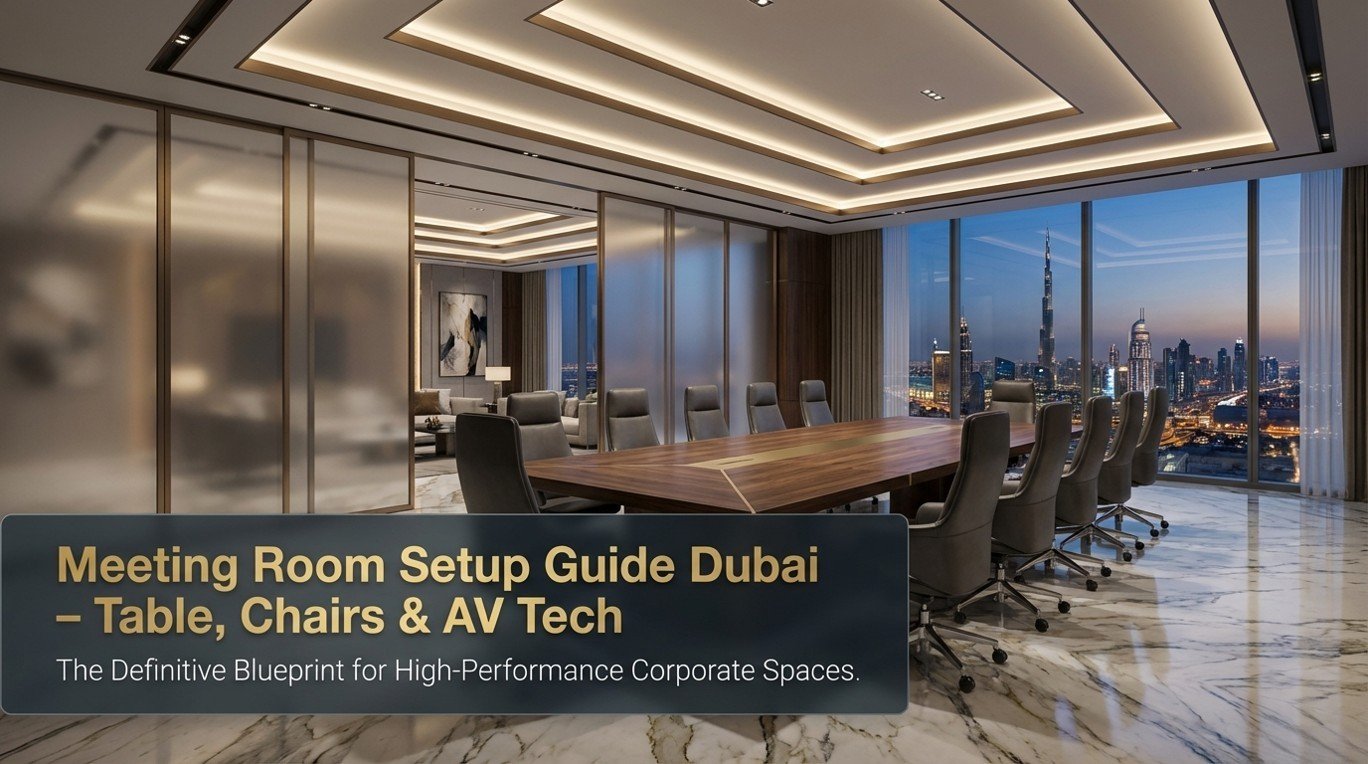
In Dubai’s relentlessly competitive business landscape, the quality of your meeting room speaks before anyone in the room does. From boardroom negotiations with international clients to daily agile standups with distributed teams, the physical and technological environment of a meeting space directly shapes how decisions are made, deals are closed, and talent is retained. Yet, despite the enormous commercial stakes, many organizations in the UAE continue to invest heavily in public-facing spaces while under-equipping their conference rooms with mismatched furniture, outdated AV systems, and poor acoustic planning.
This comprehensive guide was developed specifically for business owners, office managers, facility planners, interior designers, and corporate procurement teams operating in Dubai and the wider UAE. It covers every dimension of building a world-class meeting room from initial space planning and the selection of the right office furniture, to deploying enterprise-grade AV technology, managing cables invisibly, and futureproofing your conference environment for hybrid work. Whether you are fitting out a single boardroom or an entire multi-room corporate floor, the principles, data, and recommendations in this guide will save you time, money, and costly redesign cycles.
1. Why Meeting Room Design Matters in Dubai’s Modern Workplace
Dubai has earned its position as a global business hub, hosting the regional headquarters of multinational corporations, a thriving SME sector, and one of the world’s most active free-zone ecosystems. With the UAE’s business culture placing significant weight on face-to-face relationship building, formal presentations, and collaborative problem-solving sessions, the meeting room has evolved from a functional necessity into a strategic asset.
Research consistently shows that poorly designed meeting environments contribute to reduced concentration, meeting fatigue, and lower decision quality. Conversely, thoughtfully planned meeting spaces with appropriate furniture, optimized acoustics, and seamless technology improve attendee engagement, shorten meeting durations, and enhance overall productivity outcomes. In a city where office rents are among the highest globally, maximizing the functional output of every square meter is not merely an aesthetic preference; it is a business imperative.
The shift towards hybrid work models, accelerated by global workplace transformation trends, has made this challenge more complex. Today, a meeting room in Dubai Business Bay or DIFC must simultaneously serve a group of executives physically present in the room and remote colleagues joining from London, New York, or Singapore all while maintaining consistent audio quality, clear visual connection, and zero technical friction.
2. Meeting Room Planning: Starting with the Right Framework
2.1 Define the Room’s Primary Purpose
Before specifying a single piece of furniture or a single AV component, the planning process must begin with a clear understanding of how the room will be used. Meeting rooms in Dubai corporate environments generally fall into one of several functional categories:
- Boardrooms: High-stakes executive meetings, client presentations, and board-level governance
- Conference rooms: Team meetings, cross-departmental reviews, and project workshops
- Training rooms: Structured learning sessions, onboarding programmes, and skills workshops
- Huddle rooms: Quick team syncs, 1-to-1 conversations, and informal brainstorming
- Video conferencing suites: Purpose-built for high-quality remote and hybrid meetings
Each category carries different furniture, technology, and spatial requirements. Conflating these categories in a single room without adaptive furniture and technology creates spaces that serve no single purpose particularly well.
2.2 Room Capacity and Size Planning
One of the most common and expensive mistakes in meeting room setup is the mismatch between room capacity and physical area. Dubai office developers often publish meeting room capacity figures based on code compliance rather than practical usability. The following guide provides realistic capacity estimates that account for furniture, movement space, and AV equipment clearance:
| Room Size (sqm) | Practical Capacity | Recommended Layout | AV Setup Tier |
|---|---|---|---|
| 8 – 12 sqm | 2 – 4 people | Huddle / Roundtable | Single display, webcam |
| 12 – 20 sqm | 4 – 8 people | Boardroom / U-Shape | Dual display, ceiling mic |
| 20 – 35 sqm | 8 – 14 people | Boardroom / Hollow Square | Dual display, video bar |
| 35 – 55 sqm | 14 – 20 people | Classroom / Theatre | Dual large display, PTZ camera |
| 55 – 80 sqm | 20 – 30 people | Theatre / Chevron | Projection + display wall, multi-mic |
| 80 sqm+ | 30+ people | Auditorium / Multi-zone | Full AV integration, distributed audio |
Meeting Room Size vs Capacity vs Layout vs AV Tier
2.3 Traffic Flow and Accessibility
Room layout planning in Dubai must also account for accessibility requirements under UAE disability standards, as well as the practical circulation needs of larger meeting groups. A minimum 90 cm clear pathway must be maintained around all furniture. For rooms serving more than 12 participants, two egress points are strongly advisable. Where possible, furniture positioning should allow presenters to move freely along the primary display wall without obstructing views from any seated position.

3. Meeting Room Layout Styles: Choosing the Right Configuration
The physical arrangement of a meeting room fundamentally determines the dynamics of the interactions that take place within it. Different layouts create different power structures, communication patterns, and productivity outcomes. Understanding these configurations is essential when selecting office furniture and planning AV placement.
| Layout Style | Best For | Collaboration Level | AV Complexity | Flexibility |
|---|---|---|---|---|
| Boardroom (fixed table) | Executive meetings, client presentations | Moderate | Medium | Low |
| U-Shape | Training, interactive presentations | High | Medium | Medium |
| Hollow Square | Working groups, consensus building | High | Medium | Medium |
| Classroom / Theatre | Seminars, training, announcements | Low | High | Medium |
| Cluster / Pod | Collaborative workshops, design sprints | Very High | Low | High |
| Chevron | Large presentations with sightlines | Low-Medium | High | Low |
| Roundtable | Small teams, equal-voice discussions | Very High | Low | Low |
| Hybrid Flex | Multi-mode use, daily changing needs | Variable | High | Very High |
Meeting Room Layout Style Comparison Guide
Dubai organizations adopting Activity-Based Working (ABW) models are increasingly designing meeting floors with multiple small-to-medium rooms across different configurations rather than one or two large boardrooms. This approach distributes meeting demand more efficiently and reduces the incidence of over-specified large rooms being used for small, informal team conversations.

4. Meeting Room Tables: Selection, Sizing, and Materials
4.1 The Strategic Role of the Conference Table
The conference table is the centerpiece of any meeting room. It determines how people orient themselves to each other and to presentation surfaces, where technology is integrated, and how the overall aesthetic of the space is perceived. In Dubai’s corporate culture, boardroom tables in particular signal organizational identity a poorly chosen table in a client-facing meeting room undermines confidence before a word is spoken.
When selecting office furniture for meeting rooms, the table specification must balance aesthetics, functionality, durability, and technology integration. UAE office environments are exposed to heavy use, frequent cleaning with industrial products, and the visual expectations of multinational business culture.
4.2 Table Shape Selection Guide
- Rectangular: Classic boardroom choice; ideal for presentations; clear hierarchy of seating; best for 6–20 people
- Boat-shaped (convex sides): Improves sightlines for all participants; widely used in corporate boardrooms; excellent for 8–16 people
- Oval: Encourages equality of contribution; no head-of-table dynamic; suits consensus-building meetings
- Round: Best for small groups of 4–8; maximizes collaborative energy; works well in huddle rooms
- Modular/Folding: Offers maximum flexibility; can reconfigure between boardroom and classroom layouts; ideal for training rooms and multipurpose spaces
- Racetrack: A rectangular table with curved ends; combines the functionality of rectangular with improved sightlines; popular in DIFC and Dubai Marina corporate offices
4.3 Table Size vs Seating Capacity Reference
| Table Length (cm) | Table Width (cm) | Seating Capacity | Room Min Length (cm) | Room Min Width (cm) |
|---|---|---|---|---|
| 180 | 90 | 4 – 6 people | 440 | 310 |
| 240 | 100 | 6 – 8 people | 500 | 320 |
| 300 | 110 | 8 – 10 people | 560 | 330 |
| 360 | 120 | 10 – 12 people | 620 | 340 |
| 420 | 130 | 12 – 16 people | 680 | 350 |
| 480 | 130 | 16 – 20 people | 740 | 350 |
| 540+ | 130 – 150 | 20 – 24 people | 800+ | 370+ |
Conference Table Dimensions vs Seating Capacity vs Room Minimum Size
4.4 Material and Finish Recommendations for Dubai Climate
Dubai’s climate characterized by high ambient temperatures, intensive air conditioning use, and occasional humidity fluctuations places specific demands on furniture materials. The following summarizes recommended materials for conference tables in UAE office environments:
| Material | Durability | Aesthetic | Heat/Humidity Resistance | Recommended Use |
|---|---|---|---|---|
| High-pressure laminate (HPL) | Excellent | Modern/Neutral | Excellent | All room types |
| Veneer over MDF | Good | Premium/Classic | Moderate | Boardrooms, executive suites |
| Solid hardwood | Excellent | Prestigious | Moderate (with treatment) | High-end boardrooms |
| Tempered glass top | Good | Contemporary | Good | Design-forward offices |
| Powder-coated steel frame | Excellent | Industrial/Modern | Excellent | All frame components |
| Quartz / stone inlay | Excellent | Luxury | Excellent | Premium executive boardrooms |
Conference Table Material Comparison for UAE Environments
Technology Integration in Modern Conference Tables
Leading office furniture providers in Dubai now offer conference tables with integrated cable management channels, in-surface power modules (standard UAE 13A plug, USB-A, USB-C, HDMI), and wireless charging pads. These integrations are not cosmetic; they are directly tied to AV system performance, cable management quality, and the overall impression of a well-organized, modern meeting environment. When specifying tables, confirm in-built connectivity options with your furniture supplier before order placement.

5. Ergonomic Conference Chairs: Comfort, Productivity, and Brand
5.1 Why Ergonomics Matter in Meeting Rooms
The assumption that ergonomic seating is only relevant at fixed workstations is a significant misconception that persists across many UAE organizations. Research published by workplace health authorities consistently demonstrates that discomfort experienced during meetings manifesting as fidgeting, posture shifting, and reduced focus directly correlates with meeting length and chair quality. Executive meetings in Dubai frequently run 60–120 minutes, and sometimes considerably longer; at these durations, seating quality has a measurable impact on cognitive performance and decision quality.
5.2 Conference Chair Selection Criteria
- Seat depth and width: Accommodate a wide range of body types common in Dubai’s multicultural workforce (seat depth 42–52 cm; width 48–56 cm)
- Lumbar support: Adjustable lumbar for meetings lasting 45 minutes or more
- Armrests: Height-adjustable armrests reduce shoulder tension during extended discussions
- Swivel and casters: Lockable casters protect premium flooring common in Dubai corporate offices
- Upholstery: High-grade mesh for ventilation (important given air conditioning cycles) or premium leather for boardrooms
- Weight capacity: Minimum 120 kg to accommodate the full range of users
- Stack/nest capability: For flexible multi-layout rooms, stackable or nesting conference chairs offer significant operational advantages
5.3 Conference Chair Type Comparison
| Chair Type | Ergonomic Level | Best Environment | Durability | Price Range (AED) |
|---|---|---|---|---|
| Executive leather boardroom | Medium-High | Boardroom, client rooms | Excellent | 800 – 3,500 |
| Mesh conference chair | High | All conference rooms | Very Good | 450 – 2,200 |
| Visitor/stacking chair | Low-Medium | Training, overflow seating | Good | 150 – 600 |
| Task chair (meeting-adapted) | Very High | Long-session workshop rooms | Excellent | 900 – 4,500 |
| Collaborative stool (sit-stand) | Medium | Huddle rooms, standing-height tables | Good | 350 – 1,200 |
| Soft seating lounge chair | Medium | Informal breakout, creative rooms | Good | 500 – 2,500 |
Conference Chair Types, Ergonomics & Price Ranges in Dubai
For corporate offices specifying office furniture Dubai-wide, it is advisable to establish a consistent chair specification across all meeting rooms, with a premium variant reserved for boardrooms and client-facing suites. Inconsistent chair quality across a meeting floor signals disorganization and creates maintenance complexity for facility teams.

6. AV Technology Setup: Building a World-Class Conference Experience
6.1 AV System Planning Fundamentals
Audio-visual technology is the most technically complex and frequently problematic element of any meeting room setup. Poor AV planning is responsible for more lost meeting productivity than any other single factor. A survey of enterprise workplace managers consistently ranks ‘AV issues’ as the primary source of meeting frustration, accounting for as much as 15–20 minutes of wasted time per meeting in organizations without standardized AV environments.
For Dubai businesses operating across multiple time zones and maintaining regular video communication with partners in Europe, Asia, and North America, AV quality is not a secondary concern — it is a direct operational capability. The following framework provides a tiered approach to AV specification that scales appropriately across different room sizes and use cases
6.2 AV Equipment Tiers by Room Type
| AV Component | Huddle Room (≤12sqm) | Conference Room (12–35sqm) | Boardroom (35–55sqm) | Training Room (55sqm+) |
|---|---|---|---|---|
| Display | 55″ 4K TV | 75″ 4K or dual 65″ | 86″ or dual 75″ | 98″ or projection |
| Video Camera | USB PTZ bar (e.g. Logitech Rally) | PTZ camera (e.g. Poly Studio E70) | Dual PTZ (e.g. Cisco Quad Cam) | Multi-cam PTZ system |
| Microphone | All-in-one bar mic | Ceiling array mic | Tabletop + ceiling array | Distributed ceiling array |
| Speaker | Built-in bar speaker | Ceiling speakers (2–4) | Ceiling + subwoofer | Multi-zone ceiling array |
| Conferencing Platform | Zoom/Teams room bar | Teams Rooms / Poly | Cisco Webex Room | Extron/Crestron integration |
| Wireless Sharing | Barco ClickShare CX-20 | ClickShare CX-30 | ClickShare CX-50 / Mersive | Crestron AirMedia 3 |
| Control System | Touch display (on bar) | 10″ touch panel | 10–15″ touch + automation | Full Crestron/AMX control |
| Cable Management | Surface channel | Under-table + floor box | In-table + floor trunking | Raised floor / full conduit |
AV Equipment Recommendations by Meeting Room Type
6.3 Display Selection and Placement
The selection and placement of meeting room displays is governed by two primary considerations: viewing distance and content type. For standard meeting room video calls and presentation content, the following viewing distance guidelines apply:
- Minimum viewing distance: 1.5× the screen diagonal (e.g., a 75″ screen has a minimum distance of ~2.85 m)
- Maximum comfortable viewing distance: 6× the screen diagonal for standard HD content
- For 4K content: Maximum viewing distance can be extended by approximately 30%
- Display height: Bottom edge of screen should be no lower than 90 cm from finished floor level in seated rooms
- Viewing angle: All seated participants must have an unobstructed sightline within 45° horizontal of screen center
In Dubai boardrooms where client-facing presentations are routine, dual-display configurations are strongly recommended. One display is dedicated to presentation content, while the second carries the video call view of remote participants eliminating the disorienting switching between content and participants that disrupts meeting flow.
6.4 Audio: The Most Underrated AV Investment
Organizations consistently underinvest in meeting room audio relative to visual technology, yet audio quality has a more direct impact on communication effectiveness than almost any other technical variable. Unintelligible audio forces participants to ask for repetitions, causes cognitive fatigue, and creates barriers for non-native English speakers a significant proportion of Dubai’s diverse workforce.
Modern ceiling-array microphone systems, such as those manufactured by Shure, Biamp, QSC, and Sennheiser, use beamforming technology to isolate speaker voices dynamically, suppress HVAC noise from Dubai buildings’ powerful air conditioning systems, and eliminate echo without relying on physical acoustics. These systems represent one of the highest-value technology investments available for corporate meeting rooms and should be specified as standard for rooms serving more than eight participants.

7. Hybrid Meeting Technology: Designing for the Distributed Workforce
7.1 What Makes a Truly Hybrid-Ready Meeting Room
The term ‘hybrid meeting’ is used widely but understood inconsistently. A genuinely hybrid-ready meeting room is one where remote participants experience equal presence, audio clarity, and content access to those physically in the room — not merely a room from which a video call can be made. The distinction is critical, and it has significant implications for furniture layout, camera placement, and AV system design.
Key characteristics of a hybrid-ready meeting room include a camera that captures all room participants simultaneously and maintains intelligible image size at distances up to 6 meters; a microphone system that picks up natural speech from any seat without requiring participants to lean towards a central unit; a display configuration that gives in-room participants a clear view of remote faces at a scale comparable to their physical counterparts; and a room control system that enables any participant local or remote to share content without friction.
7.2 Recommended Hybrid Meeting Technology Stack
| Function | Entry-Level Solution | Mid-Range Solution | Enterprise Solution |
|---|---|---|---|
| Video conferencing OS | Zoom Rooms | Microsoft Teams Rooms | Cisco Webex Room OS |
| Camera system | Logitech Rally Bar | Poly Studio E70 | Cisco Quad Camera |
| Microphone | Shure MXA310 | Shure MXA910 | Biamp TesiraFORTE |
| Wireless content sharing | Barco ClickShare CX-20 | Barco ClickShare CX-50 | Crestron AirMedia 3200 |
| Room booking display | Joan 6 Pro | Crestron TSS-770 | Extron TLP Pro 1025T |
| Network switch (PoE) | Cisco SG250 | Cisco CBS350 | Cisco Catalyst 9200 |
| UPS/power protection | APC BR1500G | Eaton 5PX 1500i | Vertiv Liebert GXT5 |
Hybrid Meeting Room Technology Stack Comparison
7.3 Network Infrastructure Requirements
All enterprise-grade video conferencing systems require dedicated, high-quality network infrastructure. For Dubai offices, the following minimum specifications are recommended for meeting rooms:
- Dedicated VLAN for AV and conferencing devices, isolated from general office traffic
- Minimum 25 Mbps symmetric bandwidth per active video call (50 Mbps recommended for 4K)
- Network latency below 150 ms for real-time video conferencing quality
- QoS (Quality of Service) policies configured to priorities conferencing traffic
- Wi-Fi 6 (802.11ax) access point within or adjacent to the meeting room for wireless content sharing
- Wired Ethernet drops for all fixed AV equipment (cameras, codecs, room control panels)

8. Lighting Design for High-Performance Meeting Spaces
8.1 The Impact of Lighting on Meeting Effectiveness
Lighting is among the most influential and most neglected aspects of meeting room design in Dubai’s corporate sector. A meeting room that is well-furnished and technologically equipped but poorly lit will still produce suboptimal outcomes. Lighting affects circadian rhythms, alertness levels, and the quality of video conferencing imagery in equal measure.
The specific challenge in Dubai offices is the tension between natural light often abundant due to the region’s solar intensity and the demands of video conferencing, which requires controlled, diffuse illumination without glare or shadowing. Blackout blinds or motorized solar shading should be considered essential, not optional, in any room with exterior glazing that is used regularly for video calls.

8.2 Lighting Specifications for Meeting Rooms
- Horizontal illuminance at desk level: 300–500 lux for standard meeting rooms; 500–750 lux for training rooms
- Color temperature: 3,500–4,500K (neutral white) for daytime use; tunable white recommended for rooms used across full business day
- Color Rendering Index (CRI): Minimum 80; 90+ recommended for client-facing boardrooms where accurate color representation of materials matters
- Glare control: Recessed luminaires with anti-glare louvers or micro prismatic diffusers; UGR (Unified Glare Rating) below 19
- Vertical illuminance for video: Minimum 150 lux at face level to ensure adequate camera exposure for video conferencing; ideally 200–300 lux
- Emergency lighting: Comply with UAE Fire and Life Safety Code with battery backup
Dimmable lighting controls with preset scene capability ‘Presentation Mode’, ‘Video Call Mode’, ‘Full Bright’, ‘Whiteboard Mode’ substantially improve the usability of meeting rooms and can be integrated into the room control automation system.

9. Acoustic Design: Creating a Professional Sound Environment
9.1 Acoustic Challenges in Dubai Meeting Rooms
Dubai’s contemporary commercial architecture characterized by glass facades, hard flooring, high ceilings, and open-plan adjacencies creates significant acoustic challenges for enclosed meeting rooms. Sound transmission between spaces, echo within rooms, and background noise from HVAC systems are the three most common acoustic complaints in UAE corporate offices.
A meeting room’s acoustic performance is measured by two primary metrics: Reverberation Time (RT60) the time for sound energy to decay by 60 dB after a source stops and Sound Transmission Class (STC) the degree of sound isolation between the room and adjacent spaces. For conference rooms, an RT60 of 0.4–0.6 seconds is optimal. An STC of 45–50 provides adequate speech privacy from adjacent open-plan areas.
9.2 Practical Acoustic Treatment Solutions
- Acoustic ceiling tiles: Replace standard ceiling tiles with absorptive panels (NRC 0.7 or above) in the ceiling grid
- Wall panels: Fabric-wrapped acoustic panels on 40–60% of wall surface area; can be integrated with branding and artwork
- Flooring: Carpet or large-area rugs significantly reduce RT60; for rooms requiring hard flooring, compensate with additional ceiling and wall absorption
- Acoustic glazing: For glass partition walls, use double-glazed acoustic glass with laminated interlayer (STC 40+)
- Acoustic door seals: Fitted door sweeps and perimeter seals for rooms with STC requirements; automatic drop seals for premium boardrooms
- Furniture as absorber: Upholstered conference chairs and soft seating contribute measurably to room absorption
- HVAC noise control: Specify NC (Noise Criteria) 30 or below for meeting rooms; use lined ductwork and low-velocity terminal units

10. Cable Management: The Foundation of a Professional AV Installation
Visible, tangled cables are the single most visible indicator of a poorly planned meeting room. In Dubai’s client-intensive business environment, where offices are frequently visited by senior executives, investors, and government counterparts, cable disorder creates an immediate and lasting negative impression. Beyond aesthetics, poor cable management creates trip hazards, signal integrity issues, and maintenance difficulties that accumulate costs over time.
10.1 Cable Management Strategy by Room Tier
- Huddle rooms: Surface-mounted cable channels in matching finish; single floor box for laptop connectivity; wireless presentation system eliminates HDMI cable needs
- Standard conference rooms: Under-table cable tray integrated into table specification; floor boxes with UAE 13A and USB-C charging; display cables routed through wall conduit to AV rack
- Boardrooms: Full in-table cable management with motorized pop-up modules; all cabling in-wall or under raised access floor; AV rack housed in purpose-built credenza or wall-mounted rack enclosure
- Training rooms: Floor box grid at regular spacing matching table arrangement; cable tiles or raised access floor for maximum layout flexibility
The adoption of USB-C and wireless connectivity standards (HDMI over Wi-Fi, Miracast, AirPlay, Barco ClickShare) significantly reduces cable requirements for laptop connectivity. Specifying these technologies in conjunction with a robust wireless network infrastructure is the most effective long-term cable management strategy for multi-purpose meeting spaces.

11. Modern Office Collaboration Trends in Dubai (2025–2026)
11.1 Activity-Based Working and Meeting Room Ecosystems
The most progressive organizations in Dubai’s commercial districts are moving away from fixed-allocation meeting rooms towards dynamic meeting ecosystems that offer a range of space types, each optimized for a specific interaction pattern. This approach, derived from Activity-Based Working (ABW) methodology, creates a portfolio of spaces from phone booths and two-person focus pods to eight-person collaborative suites and 20-person boardrooms that employees select based on the specific task at hand rather than booking a generic ‘meeting room’.
11.2 Smart Room Technology and IoT Integration
Occupancy sensors, connected to room booking platforms such as Microsoft Places, Cisco DNA Spaces, or Condeco, are being deployed across major Dubai commercial developments to provide real-time and historical data on meeting room utilization. This data enables facilities teams to right-size their meeting room portfolio, identify over-specified spaces, and plan furniture reconfigurations based on actual use patterns rather than assumptions. Integration with smart building systems allows lighting and HVAC to respond automatically to room occupancy, contributing to Dubai’s sustainability objectives under the UAE Net Zero 2050 strategy.
11.3 Biophilic Design in Dubai Meeting Rooms
The integration of natural elements living plant walls, natural material surfaces, views of greenery into meeting room design has gained significant momentum in Dubai’s premium office market. Biophilic design elements have been shown in multiple workplace studies to reduce stress hormone levels, improve creative problem-solving performance, and increase the subjective sense of meeting room quality. In a market where talent attraction and retention are primary concerns for Dubai employers, biophilic meeting environments represent a meaningful competitive differentiator.
11.4 Inclusive and Accessible Meeting Room Design
Dubai’s commitment to becoming one of the world’s most inclusive cities, reflected in federal disability legislation and the Dubai Universal Design Code, is driving increased attention to accessibility in meeting room design. Accessible meeting rooms require a clear floor path of minimum 90 cm, a lowered section of conference table for wheelchair users (74–76 cm clearance), hearing loop systems for participants with hearing impairment, and captioning capability on video conferencing displays. These features are increasingly specified as standard rather than as adaptations.

12. Step-by-Step Meeting Room Setup Guide
The following sequential framework provides a practical pathway for planning and executing a full meeting room fitout, from initial briefing to post-installation commissioning.
- Define the room’s primary function, secondary uses, and user personas
- Establish target capacity, frequency of use, and booking model
- Conduct a site survey: measure room dimensions, identify power/data locations, HVAC registers, window positions
- Develop a 2D layout plan confirming furniture arrangement, AV placement, and circulation paths
- Select the conference table based on shape, size, material, and technology integration requirements
- Specify conference chairs aligned with ergonomic standards and aesthetic brief
- Design the AV system: specify display, camera, microphone, speaker, control, and wireless sharing
- Plan cable infrastructure: conduit routes, floor boxes, data ports, power connections
- Specify acoustic treatment: ceiling, walls, floor, glazing, door seals
- Design the lighting scheme: general illuminance, video call lighting, scene controls
- Integrate room booking: select platform, deploy door panel, configure to calendar system
- Execute installation with certified AV integrator and furniture delivery team
- Conduct commissioning: test all AV systems end-to-end, calibrate audio, configure display settings
- Train end users: 30-minute session on room controls, wireless sharing, booking system
- Establish maintenance schedule: firmware updates, cable inspections, chair adjustment checks

13. Best Practices for Productivity-Focused Meeting Spaces
13.1 Design Principles That Improve Meeting Outcomes
- Visual clarity: Every participant must see the primary display without neck rotation exceeding 30 degrees
- Audio coverage: Every seat must be within effective range of the microphone system; avoid layouts where distant seats are poorly served
- Temperature control: Dubai meeting rooms should be maintained at 22–24°C with independent zone control where possible; overcooling is a persistent comfort complaint
- Technology reliability: Single-touch room activation; no user interaction required beyond pressing ‘join meeting’
- Whiteboard provision: Digital or physical whiteboards visible from all seats; for rooms without AV integration, physical whiteboards of minimum 120×240 cm
- Signage and wayfinding: Clear room naming, capacity signage, and technology instruction cards reduce booking confusion and setup delays
- Storage: Built-in credenza or side storage for AV rack, stationery, and extension cables reduces desktop clutter
13.2 Common Meeting Room Setup Mistakes to Avoid
- Placing displays too high: Neck strain from looking upward at screens above 15 degrees from eye level
- Under-specifying microphones: A single omnidirectional microphone cannot serve a 12-person conference table effectively
- Ignoring HVAC noise: Air conditioning noise in the 40–55 dB range makes intelligible audio capture impossible without noise-cancellation technology
- Mismatched furniture heights: Conference chairs and tables must be coordinated; a 75 cm table with chairs designed for a 72 cm surface creates immediate ergonomic problems
- Insufficient power provision: Meeting rooms consistently generate more device charging demand than initially planned; install more power outlets than the initial specification requires
- Single-codec dependency: Relying on a single conferencing platform without fallback creates meeting failures when that platform experiences outages
Frequently Asked Questions (FAQ): Meeting Room Setup in Dubai
What is the minimum room size for a meeting room in a Dubai office?
A functional 4–6 person meeting room requires a minimum floor area of approximately 12–15 square meters, including furniture clearance. Smaller rooms of 8–10 sqm can function as 2–3 person huddle spaces. UAE building regulations and DEWA-compliant commercial fitouts allow flexibility, but practical usability should guide specification.
What conference table size do I need for 10 people?
A 10-person conference table typically requires 280–320 cm length and 110–120 cm width. Allow at least 60 cm per person along each side, and 90–120 cm of clear space behind each chair for movement and egress.
What AV equipment does a basic meeting room in Dubai need?
Minimum entry-level setup includes a 55–65 inch 4K display, a video bar (camera, microphone, speaker combined), a single HDMI cable to desk, and a wireless presentation device. Client-facing rooms may require ceiling microphones and separate speakers.
How do I choose between a fixed boardroom table and a modular table system?
Choose a fixed table for a single primary use, stable capacity, and premium aesthetics. Choose modular systems for multi-configuration needs, varying team sizes, or flexible space use. Modular systems offer long-term operational flexibility.
What is the best video conferencing system for a Dubai boardroom?
Top-tier systems in 2026: Cisco Webex Room Kit Pro, Poly Studio G7500, Logitech Rally Plus. Align with your platform (Teams, Zoom, Webex). All support 4K video, intelligent framing, and enterprise audio, common in DIFC and Downtown Dubai offices.
How important is acoustic treatment in a Dubai office meeting room?
Critically important. Without it, RT60 values often exceed optimal 0.4–0.6 seconds, causing echo, poor speech intelligibility, and acoustic fatigue. Invest 5–10% of fitout budget in acoustic treatment for disproportionate meeting quality improvements.
What ergonomic conference chairs are recommended for long meetings?
For 60+ minute meetings, specify chairs with adjustable lumbar support, armrests, 44–50 cm seat depth, and breathable mesh back. Recommended models: Herman Miller Aeron (Conference), Humanscale Different World, Steelcase Leap V2, or certified local equivalents.
How do I manage cables in a conference room effectively?
Use tables with integrated cable channels, route display and AV cables in-wall, deploy floor boxes for mid-room connections, and use wireless presentation devices. Retrofit surface-mounted raceways are available for existing rooms.
What lighting specification is best for video conferencing in Dubai?
Provide 200–300 lux of diffuse, glare-free light at face level. Neutral white (3,500–4,000K) for accurate skin tones. Ceiling panels with micro prismatic diffusers are preferred. Use motorized blackout blinds to manage Dubai sunlight.
How much should a meeting room fitout cost in Dubai?
Basic 8–12 person room: AED 35,000–75,000. Mid-range: AED 75,000–180,000. Premium boardroom with full AV and acoustic treatment: AED 180,000–500,000+, depending on size and finishes.
What meeting room furniture brands are popular in Dubai?
Premium: Herman Miller, Steelcase, Haworth, Knoll, OfficeMaster, Vitra. Mid-market: Actiu, Narbutas, Martex. OfficeMaster.ae offers a full range tailored to UAE office needs across all specification tiers.
How can I make my meeting room hybrid-ready?
Four core elements: wide-angle camera capturing all participants, microphone system with full coverage, display showing remote participants at natural scale, and content-sharing system supporting in-room and remote users. Upgrading these improves hybrid meeting equity.
What is the standard conference table height in UAE offices?
Standard height: 75–76 cm. Works with chairs 44–50 cm seat height for 25–30 cm arm clearance. Height-adjustable tables (72–120 cm) are available for flexible seated/standing use.
Do I need a room booking system for meeting rooms in Dubai?
For 3+ meeting rooms, digital booking systems are recommended. Popular platforms: Microsoft Bookings, Condeco, Robin Powered, Envoy. Door-mounted displays provide real-time room status and reduce conflicts.
What sustainability considerations apply to meeting room fitout in Dubai?
Follow GBRS and Estidama guidelines. Use FSC/Greenguard-certified furniture, energy-efficient displays, occupancy-sensor lighting/HVAC, low-VOC finishes, and local suppliers. Contributes to LEED and Estidama certifications.
Building Meeting Rooms That Work as Hard as You Do
A world-class meeting room in Dubai is not the product of a single decision it is the outcome of a series of coordinated, informed choices about space, furniture, technology, acoustics, and light. Each element reinforces the others, and the failure of any single component whether a poorly specified microphone, an undersized table, or an inadequate network connection is sufficient to undermine the effectiveness of the whole.
As Dubai continues to attract global business investment and position itself as a premier hub for knowledge industries, the quality of workplace collaboration environments has become a genuine competitive differentiator. Organizations that invest in meeting environments that are comfortable, technologically seamless, acoustically clear, and aesthetically considered will attract talent, impress clients, and generate measurably better decision-making outcomes.
OfficeMaster.ae provides a comprehensive portfolio of conference room furniture, ergonomic seating, and workspace solutions engineered for Dubai’s demanding commercial environment. From sourcing the right table dimensions to specifying ergonomic seating for extended meetings, our team of workplace consultants brings the depth of experience needed to create meeting rooms that perform at every level.
Contact OfficeMaster.ae today to discuss your meeting room requirements and receive a tailored consultation for your Dubai or UAE office project.