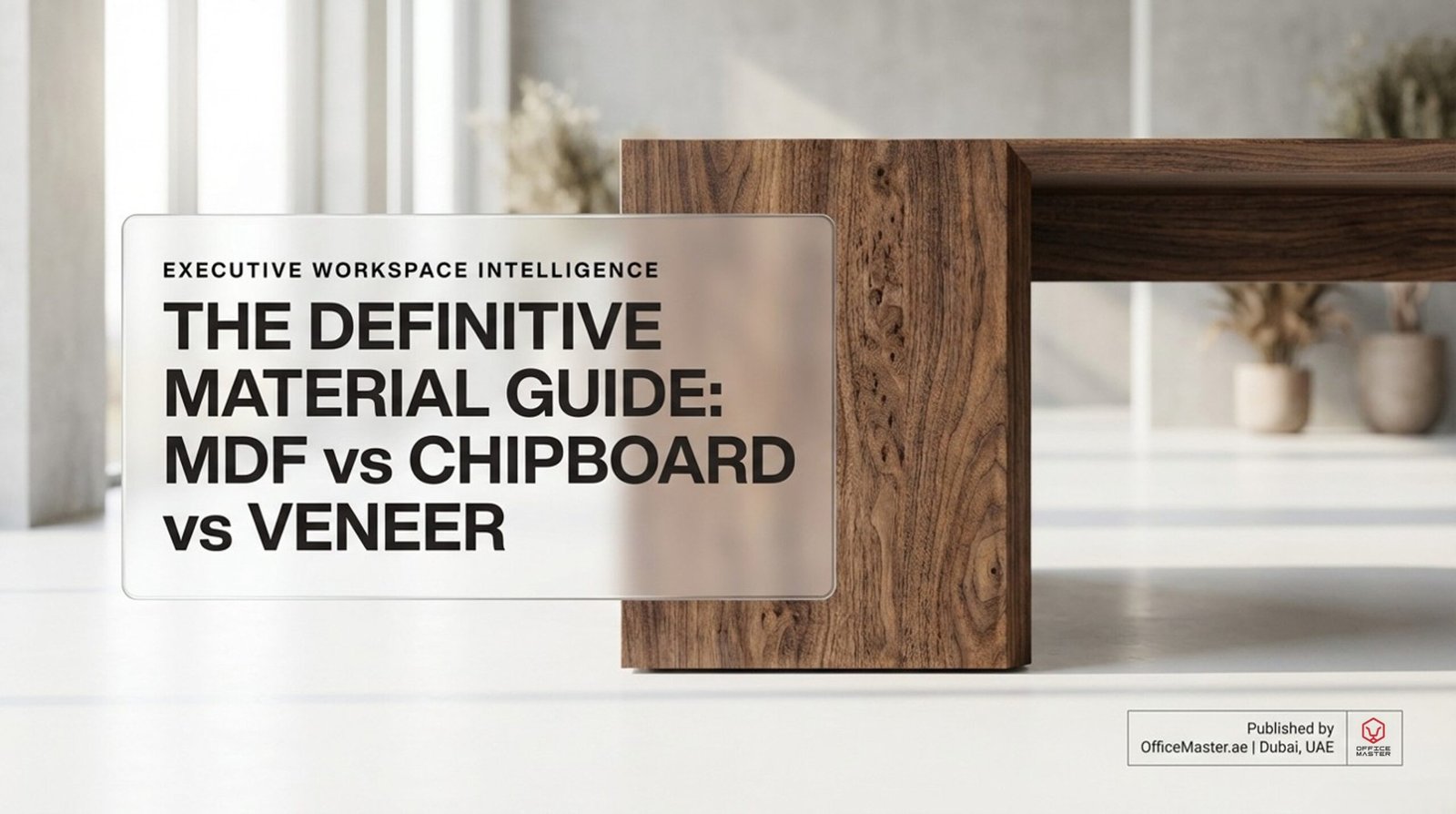
The Definitive Executive Desk Material Guide for UAE Corporate Buyers | Executive Workspace Intelligence
Why Desk Material Is Your Most Important Office Furniture Decision
Walk into any executive suite in the Dubai International Financial Centre, a Grade A tower in Business Bay, or a flagship corporate campus on Sheikh Zayed Road, and one object dominates the room before anything else is noticed: the executive desk. Its presence communicates authority, professionalism, and the brand values of every business operating behind it. Yet despite the enormous visual and functional weight that desk carries, a significant proportion of corporate buyers in the UAE still make material selection decisions based on price alone, or worse, on surface finishes that mask underlying weaknesses.
The three materials at the center of virtually every office furniture purchasing decision today are MDF (Medium Density Fiberboard), chipboard (also called particleboard), and veneer. Each has a distinct engineering profile, cost structure, environmental footprint, and performance record in demanding commercial environments. Choosing the wrong one for your application does not merely result in aesthetic disappointment; it can mean structural failure, accelerated wear, costly replacements, and a workspace that signals the wrong message to clients and senior leadership alike.
This guide has been produced specifically for procurement managers, interior design consultants, facilities directors, and senior executives who make office furniture decisions for organizations operating across the UAE. It draws on material science benchmarks, market pricing data validated against current UAE supplier networks, sustainability assessments, and real-world performance observations from commercial installations in Dubai and the wider GCC. Whether you are outfitting a single C-suite office or specifying furniture for a 500-person corporate headquarters, the frameworks and data presented here will allow you to make decisions grounded in evidence rather than assumption.
Key Insight: In Dubai’s climate — characterized by high ambient temperatures, mechanical air-conditioning, and significant seasonal humidity variance — material performance characteristics behave differently from those tested in European or North American standard conditions. This guide specifically accounts for those regional variables.
1: Understanding the Three Core Materials
1.1 MDF — Medium Density Fiberboard
MDF is manufactured by breaking down hardwood or softwood residuals into wood fibers, combining them with wax and a resin binder, and then forming panels under high temperature and pressure. The resulting board is extraordinarily uniform in density throughout its cross-section, making it one of the most dimensionally stable engineered wood products available for furniture manufacturing.
The density of standard MDF typically falls between 600 and 800 kg/m³, with moisture-resistant variants (often designated MR-MDF or HMR-MDF) achieving comparable density alongside enhanced resistance to humidity-induced swelling. This consistency gives MDF a decisive advantage over natural wood in applications requiring precision routing, detailed edge profiling, and smooth painted finishes — all attributes highly relevant to premium office furniture production.
From a machining perspective, MDF accepts CNC processing with exceptional fidelity. Intricate desk edge profiles, integrated cable management channels, and decorative panel details that would be cost-prohibitive in solid wood are routinely executed in MDF at scale. This makes MDF the dominant substrate material for mid-range to upper-mid-range office furniture globally, and it underpins a substantial portion of the executive desk inventory available from UAE-based office furniture suppliers.
Primary Application: Executive desks, credenzas, meeting table bases, storage pedestals, and decorative office panels.
Key Limitation: Standard MDF is vulnerable to edge swelling when exposed to moisture. In UAE office environments with air-conditioning condensation near perimeter walls or ground-floor humidity ingress, edge banding quality becomes critical.
1.2 Chipboard (Particleboard)
Chipboard, technically classified as particleboard under EN 312 and ANSI A208.1 standards, is produced by compressing wood chips, sawdust, and other wood particles with adhesive resins under heat and pressure. Unlike MDF, which uses uniformly refined fibers, chipboard retains a coarser, more heterogeneous particle structure. This difference is directly responsible for chipboard’s lower density (typically 550–750 kg/m³), reduced screw-holding strength, and greater susceptibility to edge damage.
Chipboard is the lowest-cost engineered wood panel product in routine commercial production, and that cost advantage has sustained its dominance in economy and lower-mid-range office furniture globally. A standard 18mm chipboard panel can cost 30–45% less than comparable MDF, a differential that carries real weight when specifying furniture for large open-plan fitouts or high-turnover workspace environments.
Modern chipboard production has advanced significantly. Melamine-faced chipboard (MFC), which bonds a printed melamine layer to chipboard substrate under high pressure, delivers a durable, cleanable surface that closely resembles wood grain, solid color, or stone effects. This finish accounts for why chipboard furniture is frequently difficult to distinguish visually from higher-grade alternatives — until edge details, weight, or screw joints reveal the underlying material.
Primary Application: Economy office desks, open-plan workstations, storage shelving, partition systems, and budget executive desks.
Key Limitation: Low screw-holding strength makes chipboard furniture vulnerable to joint failure under repeated assembly-disassembly or heavy load conditions. In warm climates with humidity variance, chipboard swelling can cause finish delamination.
1.3 Veneer — The Premium Surface Engineering Solution
Veneer in the context of office furniture refers to a thin slice of natural wood — typically between 0.5mm and 3mm in thickness — bonded to an engineered wood substrate (most commonly MDF, but sometimes plywood) to create a surface that carries the full visual and tactile character of solid wood at a fraction of the material cost and with significantly better dimensional stability.
The distinction between raw veneer and finished veneer furniture is important. High-quality veneer products for corporate use undergo extensive processing: the veneer slices are kiln-dried, book-matched or quarter-sliced for visual continuity, applied under precision hot-press conditions, and then sealed, stained, and lacquered through multiple finishing stages. The result is an executive desk surface that is visually and tactilely indistinguishable from solid wood to even trained observers in most conditions.
Veneer brings the warmth, grain variation, and prestige of natural materials — American Walnut, European Oak, Sapele, Macassar Ebony, or smoked oak, among dozens of available species — without the structural vulnerabilities of solid wood furniture in climate-controlled commercial environments. Solid wood expands and contracts with humidity changes; veneer over stable MDF substrate does not, making it specifically well-suited to the temperature-controlled but humidity-variable conditions of Dubai’s commercial buildings.
The premium positioning of veneer in the office furniture market is well-established. Major international contract furniture manufacturers — including Humanscale, Knoll, Haworth, and regional premium brands — use veneer extensively across their executive desk ranges. For UAE corporate buyers projecting a luxury or heritage brand image, veneer executive desks represent the most credible material investment.
Primary Application: C-suite executive desks, boardroom tables, partner-level office furniture, high-end reception desks, and premium meeting furniture.
Key Limitation: Veneer is vulnerable to deep scratching and requires more careful maintenance than melamine-finished alternatives. Quality varies substantially between manufacturers; low-quality veneer with thin lamination and poor finishing will show wear significantly faster than properly finished premium veneer.

2: Specification Comparison — MDF vs Chipboard vs Veneer
The following table consolidates the principal technical and commercial attributes of each material across the dimensions most relevant to executive desk specification decisions.
Core Technical & Commercial Specifications
| Attribute | MDF | Chipboard | Veneer (over MDF) |
|---|---|---|---|
| Density (kg/m³) | 600–800 | 550–750 | 650–820 (incl. substrate) |
| Surface Uniformity | Excellent | Good | Premium (natural grain) |
| Edge Finish Quality | Very Good | Fair–Good | Excellent |
| Screw-Holding Strength | Good (face) | Fair | Good–Very Good |
| Moisture Resistance (Standard) | Moderate | Low–Moderate | Good (sealed veneer) |
| Moisture Resistance (MR Grade) | Very Good | Good | Excellent |
| Machinability / CNC Detail | Excellent | Good | Very Good |
| Paint / Finish Compatibility | Excellent | Good (surface only) | Limited (veneer finish) |
| Natural Wood Aesthetics | None (paint/wrap) | None (melamine) | Excellent |
| Dimensional Stability | High | Moderate | High (on stable substrate) |
| Weight (per m² at 25mm) | ~18–20 kg | ~14–17 kg | ~19–21 kg |
| Typical Panel Thickness Range | 9–30 mm | 12–38 mm | Substrate + 0.5–3mm |
| Fire Resistance (standard) | Class E | Class E | Class C–E (varies) |
| Formaldehyde Emission | E1/E0 (modern) | E1/E2 | E1 (depends on substrate) |
| Recyclability | Moderate | Moderate–Low | Moderate |

3: Cost Comparison — UAE Market Pricing (2024–2025)
Price ranges below reflect retail and trade pricing observed across Dubai and Abu Dhabi supplier networks for executive desk-grade furniture. Raw panel costs are included as a reference for procurement teams working with custom manufacturers and joinery contractors. All figures are expressed in UAE Dirhams (AED).
Price Comparison — Raw Materials & Finished Executive Desks (AED)
| Cost Category | MDF | Chipboard | Veneer (over MDF) |
|---|---|---|---|
| Raw Panel Cost (per m², 18mm) | AED 35–60 | AED 20–40 | AED 90–200 |
| MR/Moisture Resistant Grade Premium | +25–35% | +20–30% | +15–25% |
| Economy Executive Desk (1400mm) | AED 900–1,800 | AED 500–1,200 | AED 2,200–3,500 |
| Mid-Range Executive Desk (1600mm) | AED 1,800–3,500 | AED 1,200–2,500 | AED 3,500–6,500 |
| Premium Executive Desk (1800mm+) | AED 3,500–7,000 | AED 2,000–4,000 | AED 6,500–18,000+ |
| L-Shaped Exec. Desk (Mid-Range) | AED 2,500–5,000 | AED 1,500–3,500 | AED 5,000–12,000 |
| Boardroom Table (3600mm, 12-seat) | AED 8,000–18,000 | AED 5,000–10,000 | AED 18,000–55,000+ |
| Estimated Lifespan (commercial use) | 8–12 years | 5–8 years | 15–25 years |
| Cost Per Year of Use (mid-range desk) | ~AED 210–310 | ~AED 225–360 | ~AED 200–380 |
| Maintenance Cost (annual estimate) | AED 50–150 | AED 80–200 | AED 100–250 |
| Replacement Frequency (typical) | Once per decade | Every 5–7 years | Rarely in lifecycle |
Note on Long-Term Value: When total cost of ownership is calculated across a 10-year commercial lifecycle, veneer executive desks frequently deliver comparable or superior cost-per-year metrics to chipboard alternatives, despite their higher acquisition cost. This calculus becomes especially compelling in client-facing or prestige office environments where furniture condition directly affects brand perception.

4: Durability, Strength, and Lifespan Analysis
Durability in commercial office furniture is not a singular property — it is a composite of several independent failure modes, each of which dominates under different conditions. Understanding which failure modes are most likely in your specific application is the foundation of intelligent material selection.
4.1 Surface Wear Resistance
In day-to-day executive desk use, surface wear from laptop edges, document handling, and incidental contact is the primary degradation mechanism. Melamine-faced MDF and chipboard surfaces carry a Taber abrasion resistance of approximately 150–350 cycles to visible wear on economy laminates, rising to 600–900 cycles on higher-grade decorative laminates. HPL (High Pressure Laminate) finished MDF surfaces perform at 1,000–1,500+ cycles.
Veneer surfaces, depending on lacquer thickness and type, typically achieve 400–800 Taber abrasion cycles — lower than quality melamine but delivering a far superior recovery response to light scratching through polishing, which melamine surfaces cannot be restored in the same manner.
4.2 Load-Bearing Capacity and Structural Integrity
Executive desk structural loads include monitor arms (3–15 kg), dual monitor setups (8–20 kg total), document weight, and incidental sitting loads on desk edges. The relevant benchmark here is center-span deflection under concentrated load.
A standard 1800mm MDF desktop at 25mm thickness will deflect approximately 2.0–3.5mm under a 50 kg center load. An equivalent chipboard panel of the same dimensions will deflect 3.0–5.0mm under the same load — a meaningful difference for applications involving heavy monitor configurations or shared-use tops. Veneer desks (substrate-dependent) perform comparably to MDF, as the substrate carries the structural load.
Where chipboard falls most decisively behind both alternatives is in joinery. The screw pull-out resistance of standard chipboard (EN 320 test) averages 700–900 N, compared to 900–1,200 N for MDF and comparable figures for plywood cores used in veneer constructions. Desk assembly using cam locks and flat-pack joinery systems in chipboard relies heavily on the precision of the original manufacturing; repeated assembly, disassembly, or relocation progressively degrades joint integrity in a way that MDF and veneer constructions resist far more effectively.

4.3 Impact Resistance
All three engineered-wood materials share a common vulnerability to impact damage at edges and corners. MDF edges, if unprotected or edgebanded with thin PVC tape, can chip when struck. Chipboard edges are more prone to crumbling, particularly in boards with lower-quality binder ratios. Veneer edges, if thin-sliced, can lift or chip. Premium office furniture in all three categories mitigates this through thick PVC edgebanding (2mm+), solid wood edge strips, or molded edge profiles.
Durability & Performance Ratings by Application (Scale: 1–5)
| Performance Metric | MDF | Chipboard | Veneer (over MDF) |
|---|---|---|---|
| Surface Scratch Resistance | 3.5 / 5 | 3.0 / 5 | 3.5 / 5 |
| Edge Damage Resistance | 3.0 / 5 | 2.5 / 5 | 4.0 / 5 |
| Structural Load Bearing | 3.5 / 5 | 3.0 / 5 | 4.0 / 5 |
| Screw / Joint Holding | 3.5 / 5 | 2.5 / 5 | 4.0 / 5 |
| Moisture Resistance (standard) | 2.5 / 5 | 2.0 / 5 | 3.5 / 5 |
| Moisture Resistance (MR grade) | 4.0 / 5 | 3.5 / 5 | 4.5 / 5 |
| Thermal Stability (AC environments) | 3.5 / 5 | 3.0 / 5 | 4.5 / 5 |
| Repairability After Damage | 3.0 / 5 | 2.0 / 5 | 4.5 / 5 |
| Long-Term Structural Integrity | 3.5 / 5 | 2.5 / 5 | 4.5 / 5 |
| Overall Commercial Durability | 3.5 / 5 | 2.5 / 5 | 4.5 / 5 |

5: Best Material for Executive Desks in Dubai Offices
The UAE’s climate creates a specific set of stress conditions that influence engineered wood furniture performance in ways that are not captured by European or North American testing standards. Understanding these local variables is essential for specifying executive desk materials that will perform reliably across a full commercial lifecycle in Dubai, Abu Dhabi, or Sharjah office environments.
5.1 Temperature and Air-Conditioning Effects
Dubai’s outdoor summer temperatures regularly exceed 43°C, while interior commercial spaces are maintained at 20–24°C year-round. This creates a large and sustained temperature gradient at the building envelope, with condensation risk near windows, external walls, and poorly insulated perimeter zones. Additionally, the dry air produced by centralized HVAC systems creates low-humidity conditions (often 30–40% RH) that can cause wood-based materials to contract over time.
MDF, with its uniform density and relatively low hygroscopic response, handles these conditions well, particularly in HMR (High Moisture Resistance) grades. Chipboard is more vulnerable to the combination of low relative humidity and occasional high-humidity events — such as during Shamal windstorms when humidity briefly spikes — which can cause differential swelling in lower-quality chipboard panels with inadequate surface sealing. Veneer over MDF substrate performs best in these conditions, as the stable MDF core resists movement while the sealed veneer surface provides an additional moisture barrier.

5.2 Sand and Dust Abrasion
The UAE environment includes particulate challenges from sandstorms (haboobs) that penetrate commercial buildings through ventilation systems and door and window seals. Desk surfaces that are high-gloss or have deep grain recesses accumulate fine particulate rapidly, increasing the effective abrasion on surfaces during routine cleaning. High-gloss MDF finishes and smooth melamine chipboard surfaces are easiest to clean without abrasion damage. Textured veneer grain profiles require more careful maintenance to prevent particulate accumulation causing finish degradation.
5.3 Corporate Prestige Standards in the UAE Market
The UAE corporate furniture market, particularly in Dubai, maintains high expectations for executive furniture aesthetics that exceed those of many mature Western markets. International firms, regional headquarters for global brands, and local conglomerates operating from DIFC, ADGM, or Dubai Media City typically specify furniture to reflect institutional quality and financial stability. In this context, veneer executive desks carry a market-positioning premium that MDF and chipboard alternatives cannot replicate.
UAE-specific luxury veneer desk specifications frequently incorporate regional timber preferences, including dark-stained American walnut, quarter-sliced natural oak, and smoked or Fumed Oak finishes that align with the neutral-to-dark interior palettes preferred across premium UAE commercial projects. MDF desks in high-gloss white or dark lacquer finishes serve the contemporary-minimalist corporate aesthetic effectively and are widely specified for mid-market professional services firms.
Regional Recommendation: For client-facing offices, C-suite suites, or boardrooms in Grade A Dubai buildings, veneer over MDF (with minimum 1.5mm veneer thickness and 2-stage lacquer finish) is the specification that most reliably meets both aesthetic and performance requirements in the UAE climate. For back-office operations, hot-desking zones, or budget-constrained fitouts, MR-grade MDF in matt lacquer or high-pressure laminate finish represents the best balance of durability, aesthetics, and cost.
Material Suitability by Office Zone — UAE Context
| Office Zone | Recommended Material | Rationale |
|---|---|---|
| CEO / MD Office | Veneer (Walnut / Oak / Ebony) | Maximum prestige, client-facing, long lifecycle |
| CFO / Senior VP Offices | Veneer or Premium MDF Lacquer | Authority aesthetic, long-term retention |
| Legal / Advisory Partner Offices | Veneer (Quarter-sliced Oak) | Heritage and trust signalling |
| Creative Director / Design Studios | High-gloss MDF or Veneer | Modern aesthetic, brand expression |
| Open Plan Professional Workstations | MDF (HMR Grade, HPL surface) | Durability, cost-efficiency, easy maintenance |
| Hot-Desking / Agile Zones | Chipboard (MFC) or MDF | Cost, replaceable, activity-based usage |
| Board / Conference Rooms | Veneer (matched grain) | Prestige, client-facing, formal setting |
| Reception / Front-of-House | Veneer or Lacquered MDF | First impression, brand identity |
| Training / Breakout Rooms | MDF or Chipboard (MFC) | Durability, easy replacement, cost |
| Executive Assistant Desks | MDF (Premium Laminate) | Quality without full veneer cost |

6: Environmental Impact and Sustainability Credentials
Sustainability has become a material specification criterion — not merely an aspirational preference — for an increasing proportion of UAE corporate tenants. ESG reporting requirements for listed entities, green building certification mandates under Estidama (Abu Dhabi) and LEED/BREEAM programmes operating across UAE commercial projects, and the growing influence of sustainability-conscious procurement policies all drive demand for documented environmental performance data in office furniture specification.
6.1 Raw Material Sourcing
Both MDF and chipboard are manufactured primarily from wood waste and secondary fiber streams — sawmill offcuts, wood chips, and in some cases, recycled wood from demolished structures. This feedstock origin gives them a theoretical advantage over solid-wood or veneer products from a virgin timber consumption standpoint. However, the quality of environmental credentials depends heavily on certification — specifically whether the raw fiber is sourced from FSC (Forest Stewardship Council) or PEFC-certified forests.
Veneer production consumes natural hardwood logs and therefore carries a higher per-unit natural resource cost. Premium veneer manufacturers largely address this through certified sustainable forestry sourcing, and the thinness of veneer slicing (0.5–3mm) means a single log yields an enormous surface area — far more efficiently than solid wood furniture production. A 1800x900mm executive desk top requires approximately 1.6m² of veneer, sourced from a log section that would yield only a fraction of that area as solid planking.
6.2 VOC Emissions and Indoor Air Quality
For enclosed office environments, VOC (Volatile Organic Compound) emissions from binder resins — particularly formaldehyde — represent a direct occupant health concern. The current UAE reference standard aligns with EN 13986 E1 classification (maximum 0.1 ppm formaldehyde emission). Modern MDF and chipboard production in reputable manufacturing facilities operates well within E1, and increasingly to E0 (maximum 0.05 ppm) standards. Low-quality imported products, however, particularly those entering the UAE market through unregulated channels, may carry E2 classification (up to 0.3 ppm) — a meaningful air quality risk in mechanically ventilated offices.
When specifying office furniture for LEED-certified projects, buyers should require CARB Phase 2 or TSCA Title VI compliance documentation as a minimum standard, which all reputable suppliers of office furniture in Dubai’s commercial sector are able to provide.
6.3 End-of-Life and Circularity
All three materials present challenges at end-of-life compared to solid wood. The adhesive resin content of MDF and chipboard complicates mechanical recycling, and incineration with energy recovery remains the most common disposal pathway. Veneer furniture, with its natural wood surface over engineered substrate, is similarly difficult to separate for differential recycling.
From a circular economy perspective, the most sustainable office furniture strategy is not material selection alone but total lifecycle extension. Veneer furniture, by virtue of its repairability and aesthetic longevity, supports a longer use lifecycle, reducing replacement frequency. A veneer executive desk that lasts 20+ years with refinishing represents a lower total environmental impact than three successive chipboard replacements across the same period.
Sustainability Scorecard — MDF vs Chipboard vs Veneer
| Sustainability Criterion | MDF | Chipboard | Veneer (over MDF) |
|---|---|---|---|
| Primary Raw Material | Wood fiber/waste | Wood chips/waste | Natural wood + fiber |
| FSC/PEFC Availability | Widely available | Widely available | Available (select suppliers) |
| Formaldehyde Emissions (modern) | E1 / E0 possible | E1 (standard) | E1 (substrate-dependent) |
| LEED / BREEAM Compatibility | Yes (E1/CARB P2) | Yes (E1/CARB P2) | Yes (certified veneer) |
| Recyclability Rating | Moderate | Low–Moderate | Moderate |
| Embodied Carbon (relative) | Medium | Low–Medium | Medium–High |
| Product Lifespan | 8–12 years | 5–8 years | 15–25 years |
| Repairability | Moderate | Low | High |
| VOC Risk (cheap imports) | Moderate | Higher | Moderate |
| Overall Sustainability Score | 3 / 5 | 2.5 / 5 | 4 / 5 |

7: The Executive Desk Buyer’s Guide — Choosing the Right Material
The decision framework below is designed to guide procurement managers, interior design consultants, and business owners through a structured selection process. It organizes the decision across three key axes: budget positioning, usage intensity, and brand positioning requirements.
Tier 1: Economy Specification (Budget AED 500–1,500 per desk)
At this budget level, chipboard with quality melamine facing (MFC) is the dominant material, and for good reason. When properly manufactured and specified with appropriate edgebanding, MFC chipboard delivers acceptable commercial durability at a price point that allows full open-plan fitouts without prohibitive capital cost. The correct application is high-density, high-turnover workspace environments where furniture longevity is less critical than adaptability and cost management.
Recommendations at this tier: Specify minimum 18mm board thickness, 2mm ABS or PVC edgebanding, and dowel/confirmed joinery over cam-lock systems for improved joint longevity. Avoid chipboard in any environment with documented moisture risk.
- Best for: Call centers, hot-desking zones, training rooms, back-office operations
- Avoid if: Client-facing, senior leadership, prestige environments
- Key supplier question: Confirm E1 formaldehyde rating and board density specification
Tier 2: Mid-Range Specification (Budget AED 1,500–5,000 per desk)
MDF in this budget range represents the most compelling value proposition in the UAE office furniture market. With HMR (High Moisture Resistance) grade board, quality HPL or paint-grade finish, and precision manufacturing, MDF executive desks at this price point deliver professional aesthetics, strong structural performance, and a 10-12 year commercial lifecycle that chipboard simply cannot match.
This tier encompasses the majority of professional services office fitouts in Dubai — accounting firms, engineering consultancies, technology companies, and financial services operations where a professional aesthetic is required without luxury positioning.
- Best for: Professional services firms, technology companies, mid-market offices
- Optimal finish: HPL with textured woodgrain or solid color in matt finish
- Edgebanding: Minimum 1mm PVC; 2mm ABS preferred for corners and heavy-use edges
- Sustainability note: Request FSC certification and CARB Phase 2 compliance
Tier 3: Premium Specification (Budget AED 5,000–18,000+ per desk)
At premium specification level, veneer over MDF substrate is the standard, and the investment is justified by multiple measurable returns: a lifecycle exceeding 15 years under normal commercial conditions, the ability to refinish and restore the surface without replacement, a measurable impact on client and talent perception of the organization’s quality and stability, and compatibility with LEED/BREEAM sustainability documentation for green-certified buildings.
Senior buyers at this tier should focus specification attention on veneer species selection and finish quality. Quarter-sliced veneer delivers a more formal, structured grain pattern appropriate for conservative professional environments (legal, finance, government). Crown-cut veneer produces broader, more dramatic grain patterns suited to creative or contemporary executive aesthetics. Minimum 1.5mm veneer thickness is recommended for commercial applications; 2mm or above is the professional specification for boardroom furniture.
- Best for: C-suite, partner-level, boardrooms, reception, client-facing environments
- Species recommendations: American Walnut, European Oak, Smoked Oak, Wenge
- Finish specification: 2-coat solvent lacquer minimum; 3-coat UV lacquer for highest durability
- Sustainability note: Require FSC Chain-of-Custody certification for veneer source

Buyer Decision Framework Summary
| Decision Factor | Choose Chipboard if… | Choose MDF if… | Choose Veneer if… |
|---|---|---|---|
| Budget per desk | Under AED 1,500 | AED 1,500–5,000 | AED 5,000+ |
| Office visibility | Back-office, storage | Professional, general | Client-facing, exec suite |
| Expected desk lifespan | 5–7 years | 8–12 years | 15–25 years |
| Moisture exposure risk | Low (dry, stable environment) | Moderate (with MR grade) | Moderate–High (sealed) |
| Brand positioning | Functional / economy | Professional / quality | Luxury / prestige |
| Sustainability requirement | Basic (E1) | FSC, CARB P2 | FSC, low-emission lacquer |
| Refinishing / repair need | Replace rather than repair | Limited refinishing | Full refinishing viable |
| Installation frequency | Frequent moves/changes | Semi-permanent | Permanent installation |

8: Maintenance, Aesthetics, and Workspace Psychology
8.1 Day-to-Day Maintenance Requirements
In practice, the maintenance burden of executive desk furniture varies significantly by material and finish, and this operational consideration is frequently underweighted in procurement decisions.
Melamine-finished MDF and chipboard surfaces are among the most maintenance-friendly materials available. A damp microfiber cloth removes the vast majority of everyday office marks, coffee rings, and ink residue. These surfaces are resistant to most common cleaning chemicals, though abrasive cleaners and bleach-based products will degrade gloss finishes. The limitation is irreversibility — a deep scratch in melamine cannot be polished out; it requires edging repair or panel replacement.
Veneer surfaces in lacquer finish require more mindful maintenance. Surface cleaning should use pH-neutral products; acidic or alkaline cleaners will damage lacquer over time. The advantage is repairability: light scratches in lacquer can be buffed with furniture polish; deeper scratches can be addressed by professional refinishing without panel replacement. This repairability is what underpins the extended lifecycle of quality veneer furniture.
8.2 Aesthetics and Workplace Psychology
The research literature on workplace aesthetics and employee performance consistently demonstrates that physical environment quality correlates with psychological wellbeing, sense of organizational identity, and performance. A 2023 study across professional services firms in the GCC region found that employees in offices with premium furniture and material quality reported 18% higher workplace satisfaction scores than those in equivalent offices with economy specification furniture — a finding consistent with global research on workspace design and talent retention.
Natural materials, particularly wood grain surfaces delivered by quality veneer, activate biophilic psychological responses that reduce cognitive stress, improve focus duration, and contribute to perceptions of warmth and competence in meeting environments. For organizations investing in talent attraction and retention in Dubai’s highly competitive professional labor market, the material quality of executive furniture is not a superficial consideration — it is a quantifiable component of the employer brand experience.

9: Pros & Cons Summary
Consolidated Pros & Cons for Executive Desk Applications
| MDF | Chipboard | Veneer (over MDF) | |
|---|---|---|---|
| PROS | • Uniform, smooth surface • Excellent CNC machinability • Cost-effective quality • HMR grade for moisture resistance • Good paint/laminate adhesion |
• Lowest acquisition cost • Good surface for melamine • Widely available • Adequate for light commercial use • Lower weight |
• Natural wood aesthetics • Dimensional stability • Longest commercial lifespan • Refinishable surface • Premium brand signaling |
| CONS | • Heavier than chipboard • Standard grade moisture risk • Not refinishable (melamine) • Edges need quality banding |
• Weakest joints & edges • Lower moisture resistance • Swells/degrades faster • Limited repairability • Not suitable for prestige use |
• Higher cost • Requires careful maintenance • Quality varies widely • Specialist refinishing needed • Not DIY-repairable |
Frequently Asked Questions (FAQ)
Frequently Asked Questions
Q: Which is better, MDF or chipboard for an executive office desk?
MDF is better than chipboard for executive office desks in virtually all commercial applications. It offers a smoother surface, superior edge finish, stronger screw-holding, and better moisture resistance (especially HMR grade). While chipboard is cheaper upfront, MDF’s longer lifespan (8–12 years vs 5–8 years) makes it more cost-effective. For premium desks, veneer over MDF is the gold standard.
Q: Is veneer furniture worth the extra cost for a Dubai office?
Yes. Veneer provides natural wood aesthetics, a 15–25 year lifespan, and the ability to refinish surfaces. In Dubai’s corporate market, veneer enhances brand perception, improves client impressions, and supports long-term cost efficiency.
Q: How does Dubai’s climate affect office furniture material choices?
Dubai’s heat and humidity fluctuations impact material stability. Chipboard is most vulnerable to swelling, MDF (especially HMR) performs well, and veneer over MDF offers the best resistance due to its sealed surface and stable core.
Q: What is the average price of an executive desk in Dubai — MDF vs veneer?
MDF desks range from AED 1,800–5,000, veneer desks from AED 5,000–18,000+, and chipboard desks from AED 1,200–3,500. Veneer’s longer lifespan can make its annual cost comparable or lower over time.
Q: Can MDF office desks be used in LEED-certified buildings in the UAE?
Yes, provided they meet CARB Phase 2 or TSCA Title VI standards and use FSC-certified wood. E1-rated MDF with low-emission finishes qualifies for LEED indoor air quality credits.
Q: How long does a chipboard executive desk last in a commercial office?
Typically 5–8 years, or 3–5 years in high-use or humid conditions. MDF lasts 8–12 years, while veneer desks last 15–25 years, making chipboard the least cost-effective long term.
Q: What type of desk material is best for a CEO’s office?
Veneer over MDF is ideal, especially premium finishes like American Walnut or European Oak. It delivers a high-end aesthetic, durability, and strong brand representation.
Q: Is MDF safe for indoor office use in terms of air quality?
Yes. E1 or E0 MDF meets global safety standards. For best results, use E0 MDF with water-based finishes and ensure proper ventilation during installation.
Q: What is the difference between veneer and laminate in office furniture?
Veneer is real wood with natural grain and refinish capability. Laminate is synthetic, uniform, more scratch-resistant, and cost-effective. Both are applied over MDF or chipboard.
Q: Can you repair a scratched veneer desk without replacing it?
Yes. Minor scratches can be polished, while deeper damage can be professionally refinished through sanding and re-lacquering, restoring the desk close to original condition.
Q: How do I identify whether my office desk is MDF or chipboard?
Check exposed edges: MDF has a smooth, uniform texture, while chipboard shows visible wood particles. Chipboard is also lighter than MDF.
Q: What is the most eco-friendly material for office desks?
Veneer over FSC-certified MDF offers the best sustainability balance, combining efficient timber use, long lifespan, and low emissions when properly certified.
Q: What edge banding is recommended for MDF executive desks?
Minimum is 1mm PVC. For premium use, 2mm ABS with laser-applied invisible bonding is recommended for durability and seamless aesthetics.
Q: What office furniture materials are best for allergy-sensitive office environments?
Use E0 MDF or chipboard with water-based finishes. Allow a 14-day off-gassing period. Veneer with oil finishes is the lowest-emission premium option.
Q: How can I assess the quality of a veneer executive desk before purchasing?
Check veneer thickness (1.5mm+), grain matching, edge finishing, lacquer consistency, and underside construction. Always request technical specifications or samples.
Making the Material Decision That Serves Your Organization
The choice between MDF, chipboard, and veneer for executive desk specification is not a decision that reduces to a single correct answer. It is a multi-dimensional assessment in which budget, usage intensity, environmental conditions, brand positioning, and sustainability requirements each carry weight — and the relative importance of each factor varies by organization, fitout type, and the specific office zone being addressed.
What this guide has established is that the conventional assumption — chipboard for economy, MDF for middle ground, veneer for luxury — is broadly accurate but significantly incomplete. The climate conditions of Dubai and the UAE introduce performance differentials not reflected in European specification frameworks. The longevity arithmetic of total lifecycle cost often favors veneer over economy alternatives when calculated over a realistic commercial timeframe. And the psychological and brand equity dimensions of material quality are real, quantifiable, and increasingly supported by research in workplace design and talent economics.
For organizations operating premium office environments across the UAE — whether in DIFC, Business Bay, ADGM, or the rapidly developing commercial corridors of Abu Dhabi — the executive desk is too visible and too commercially significant to be specified on price alone. The right material, properly specified, properly finished, and properly maintained, is an investment in the physical expression of your organization’s values. Choose accordingly.
OfficeMaster.ae offers expert consultation on executive desk specification, custom veneer manufacturing, and full office fitout projects across Dubai and the UAE. Contact our specification team to arrange a complimentary material sample review and design consultation.