Definition, Uses, and Workspace Design Guide
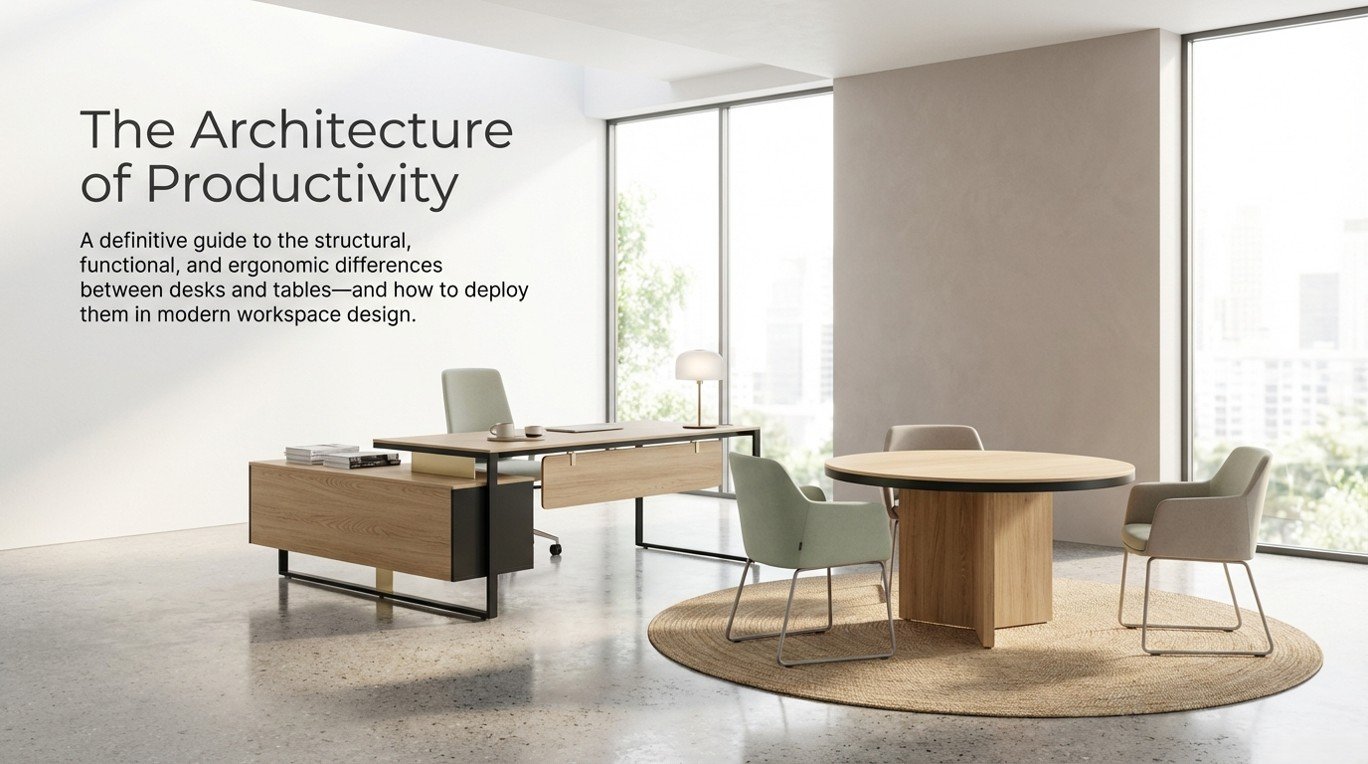
When designing a productive workspace whether a corporate office in Dubai, a home study in Abu Dhabi, or a collaborative hub across the UAE one question surfaces more often than most professionals expect: what is the actual difference between a desk and a table? The terms are used interchangeably in everyday conversation, but in furniture design, ergonomics, and professional workspace planning, they represent distinctly different categories of furniture, each engineered for specific functions, environments, and user needs.
This comprehensive guide by OfficeMaster.ae explores the definition of each piece, their historical evolution, structural and functional differences, ergonomic considerations, material choices, and how businesses and individuals should approach the desk vs table decision when planning or upgrading their workspaces. Whether you are a facility manager sourcing office furniture in Dubai, an interior designer specifying commercial fit-outs, or an entrepreneur setting up your first office, this guide provides the authoritative knowledge you need.
1. Defining a Desk: The Purpose-Built Workstation
A desk is a purpose-designed furniture piece primarily intended to support focused individual work. By definition, a desk provides a stable, elevated horizontal surface typically between 70 cm and 80 cm in height specifically engineered to facilitate tasks such as writing, computing, reading, drawing, and administrative work. What distinguishes a desk from a general table is intentionality: every structural and ergonomic feature of a desk is oriented toward the performance needs of the person working at it.
Key Defining Characteristics of a Desk
- Designed for individual, task-focused use
- Standard height between 70–80 cm (27.5–31.5 inches)
- Often includes storage: drawers, pedestals, cable management
- Cable management channels built into the structure
- Modular or adjustable features for ergonomic positioning
- Leg clearance of at least 60–65 cm for seated comfort
- Available in L-shape, U-shape, straight, standing, and corner configurations
Historical Origins of the Desk
The word ‘desk’ is derived from the Medieval Latin ‘desca’, meaning a table for writing. Early desks appeared in European monasteries during the 12th and 13th centuries, where monks needed elevated surfaces for manuscript illumination. The writing slope, a precursor to the modern desk, allowed scribes to maintain proper posture and viewing angles during long hours of copying texts.
By the 17th century, desks had evolved into elaborate cabinetry pieces the ‘bureau plat’ in French design introduced a flat top with drawers beneath, becoming the template for the executive desk still common in formal offices today. The Industrial Revolution in the 19th century drove mass production of standardized office desks, and by the early 20th century, the roll-top desk, the clerk’s desk, and the typewriter desk had become staples of commercial offices worldwide.
In the late 20th century, the personal computing revolution fundamentally redesigned the office desk: surfaces widened to accommodate monitors, keyboards, and peripheral devices, cable management became a priority, and ergonomic research began informing every dimension. Today, the standing desk, motorized height-adjustable desk, and smart workstation desk represent the frontier of desk design globally and across the UAE office furniture market.
2. Defining a Table: The Versatile Multi-Use Surface
A table, in its broadest furniture definition, is a flat horizontal surface supported by legs or a base structure, designed for a wide variety of uses dining, conferencing, gathering, displaying objects, or serving as a general-purpose work surface. Unlike a desk, a table is not inherently designed for individual focused work; its design philosophy centers on flexibility, social interaction, shared use, and multi-functionality.
Tables used in office environments particularly conference tables, meeting tables, collaborative workspace tables, and training tables are engineered for group interaction rather than individual task focus. They tend to have cleaner profiles, fewer integrated storage features, and wider surfaces to accommodate multiple users simultaneously.
Key Defining Characteristics of a Table
- Designed for shared or multi-purpose use
- Height varies: dining (75 cm), counter (90 cm), bar (105–110 cm)
- Minimal or no integrated storage
- Wider surface area for group use or multi-functional purposes
- Available in rectangular, round, oval, and modular configurations
- Used in dining, conferencing, training, hospitality, and reception contexts
- Surfaces optimized for aesthetics and shared interaction
Historical Origins of the Table
The table’s history predates the desk by thousands of years. Ancient Egyptian and Roman civilizations used low-lying stone and wooden tables primarily for dining and displaying objects. The word ‘table’ traces to the Latin ‘tabula’, meaning a flat board or plank. Medieval European great halls featured trestle tables temporary structures set up for communal meals and then dismantled to free floor space, a design philosophy that echoes in today’s folding and modular office tables.
The table became a symbol of authority and negotiation during the Renaissance. The ’round table’ of Arthurian legend represented equality among peers a concept directly reflected in modern collaborative workspace design, where circular or organic conference table forms signal egalitarian team environments. By the 20th century, the conference table had become a centerpiece of corporate design, and today’s modern office tables range from sleek boardroom surfaces to agile hot-desking platforms and biophilic collaborative workstations.
3. Desk vs Table: Comprehensive Side-by-Side Comparison
The following comparison table provides a detailed, data-driven overview of the key differences between desks and tables across the most important design, functional, and ergonomic dimensions:
| Feature | Desk | Table |
|---|---|---|
| Primary Purpose | Individual focused work (writing, computing, administrative tasks) | Shared, multi-purpose use (dining, meetings, collaboration, display) |
| Standard Height | 70–80 cm (ergonomic seated work) | 75 cm (dining), 90 cm (counter), 105–110 cm (bar) |
| User Configuration | Designed for 1 user at a time | Designed for 2+ users simultaneously |
| Storage Integration | Common (drawers, pedestals, shelves, cable trays) | Rare (clean profile, no integrated storage) |
| Cable Management | Built-in cable channels, grommets, and trays | Generally absent |
| Ergonomic Features | Adjustable height, monitor arms, keyboard trays | Minimal ergonomic features |
| Surface Size | 120–200 cm wide, 60–80 cm deep | 120–300+ cm wide, 80–120 cm deep |
| Leg Clearance | At least 60–65 cm for seated comfort | Varies; not always prioritized |
| Primary Environments | Private offices, home offices, workstations | Boardrooms, canteens, meeting rooms, homes |
| Finish Options | Functional and aesthetic (laminate, wood veneer, metal) | Aesthetic emphasis (glass, solid wood, stone, laminate) |
| Modularity | High (L-shape, U-shape, corner, sit-stand) | Moderate (folding, stackable, extendable) |
| Price Range (AED) | AED 800–25,000+ depending on type and spec | AED 500–50,000+ for premium conference tables |
| Typical Lifespan | 7–15 years (commercial grade) | 10–20 years (solid material conference tables) |

4. Structural and Design Differences in Detail
4.1 Frame and Construction
Desks are structurally engineered to bear concentrated loads a computer setup with dual monitors, a docking station, peripherals, and documentation can easily weigh 30–60 kg concentrated in the center of the work surface. Commercial-grade desks are typically built with 25 mm or thicker MDF or particleboard surfaces with high-pressure laminate (HPL) finishes, steel-reinforced leg frames rated for 80–120 kg of static load, and modular panel systems that allow for reconfiguration.
Tables, while also requiring structural integrity, distribute load more evenly across their wider surfaces and among multiple users. Conference tables, for instance, are engineered for occasional placement of laptops, documents, and beverages rather than continuous concentrated mechanical loads. The design emphasis in tables shifts toward visual harmony, surface elegance, and social functionality rather than ergonomic engineering.
4.2 Height and Ergonomics
One of the most critical ergonomic distinctions lies in height specification. The standard ergonomic desk height for seated work is 72–75 cm for users of average height (165–175 cm), allowing the forearms to rest horizontally and the feet to rest flat on the floor. ISO 9241 and EN 527-1 (European furniture standards) define these parameters for office desks, and reputable office furniture suppliers in Dubai and the UAE reference these standards.
Height-adjustable or sit-stand desks allow users to alternate between seated and standing positions, with a standing height range of 95–125 cm. Research consistently demonstrates that sit-stand desks reduce musculoskeletal discomfort by up to 54% and improve energy levels and focus when used with structured movement patterns throughout the workday.
Standard dining or meeting tables sit at approximately 75–77 cm similar to desk height but without the ergonomic refinements of keyboard tray positioning, monitor distance optimization, or lumbar support alignment that desk design incorporates holistically.
4.3 Ergonomic Dimensions Reference Table
| Measurement | Office Desk Standard | Dining / Meeting Table | Standing Desk |
|---|---|---|---|
| Surface Height | 72–75 cm | 75–77 cm | 95–125 cm (adjustable) |
| Surface Depth | 60–80 cm | 80–100 cm | 60–80 cm |
| Surface Width | 120–200 cm | 160–400 cm | 120–160 cm |
| Leg Clearance Height | 65–70 cm | 70–75 cm | N/A (standing) |
| Leg Clearance Width | 58–65 cm | Variable | 58–65 cm |
| Monitor Distance | 50–70 cm (eye-to-screen) | Not specified | 50–70 cm |
| Weight Capacity | 80–120 kg (static) | 100–200 kg (distributed) | 80–120 kg (static) |
| Keyboard Tray Depth | Optional: 25–35 cm | Not applicable | Optional: 25–35 cm |


5. Workplace Applications: Choosing Between Desks and Tables
5.1 When to Choose a Desk
A dedicated office desk is the right choice in any scenario where an individual requires sustained, focused, task-intensive work. In commercial office environments across Dubai and the broader UAE, desks remain the foundation of individual workstations in open-plan offices, private offices, executive suites, and home-based work setups. Key scenarios include:
- Individual workstations in open-plan offices requiring daily computer use
- Home offices where adults work remotely for 4+ hours daily
- Trading floors, design studios, and technical environments with multiple monitors
- Reception areas where staff need a dedicated surface with storage
- Executive offices requiring a commanding aesthetic combined with functionality
- Educational environments: study desks in universities, libraries, and schools
5.2 When to Choose a Table
A table becomes the optimal choice when the furniture needs to serve multiple users, host collaborative activity, or perform in a non-task-focused context. In UAE corporate environments, tables dominate in:
- Boardrooms and executive meeting rooms (conference tables)
- Training rooms and seminar spaces (folding and stackable tables)
- Cafeterias and breakout zones in corporate offices
- Collaborative open zones and agile workspace hubs
- Reception and lobby areas requiring a prestige surface statement
- Co-working spaces where surfaces need to serve varying user numbers
5.3 Can a Table Be Used as a Desk?
Yes, a table can function as a desk in many situations, particularly for light or occasional work. Many remote workers and home-based professionals successfully use dining tables, kitchen tables, or purpose-purchased modern office tables as primary work surfaces. However, there are important caveats to consider when making this substitution:
Storage: Tables lack integrated drawers and cable management, which creates clutter and reduces efficiency for full-time computer work.
Ergonomics: Standard tables may sit at 75–77 cm rather than the ergonomically optimal 72–75 cm desk height, which compounds strain over long work sessions.
Durability: Tables designed for dining or hospitality may not withstand the concentrated daily loads of a full workstation setup.
Professional environment: In commercial settings, a dedicated ergonomic office desk projects professionalism and supports wellbeing in ways a repurposed table cannot.

6. Materials and Manufacturing: Desks vs Tables
Material selection is a defining differentiator between desk and table construction. The following overview covers the most common materials used in each category and their performance characteristics in commercial and residential UAE environments:
Material Considerations for UAE Environments
In Dubai and across the UAE, climate control in commercial buildings mitigates the humidity challenges that affect wood furniture in tropical climates. However, interior designers and facility managers sourcing office furniture in Dubai should still priorities materials with stable cores (MDF or particleboard with veneer) over solid wood for desks in air-conditioned environments, as rapid temperature fluctuations between hot exteriors and cool interiors can cause dimensional changes in unprotected solid wood surfaces over time.
High-pressure laminate desks remain the most practical choice for high-turnover environments like co-working spaces, call centers, and open-plan offices. For executive boardrooms and C-suite offices, solid wood veneer or stone-topped conference tables make a powerful authority statement aligned with the premium corporate aesthetic prevalent in Dubai’s business culture.

7. Types of Desks: A Complete Classification Guide
| Desk Type | Configuration | Best For | Typical Dimensions (cm) |
|---|---|---|---|
| Straight / Single Desk | Linear flat surface | General office workstations | 120–180W x 60–80D x 72–75H |
| L-Shaped Desk | Two perpendicular surfaces | Dual-monitor setups, corner use | 160–200W x 160–200D x 72–75H |
| U-Shaped Desk | Three-surface wrap-around | Executive offices, intensive multitasking | 200–300W x 200–250D x 72–75H |
| Standing / Sit-Stand Desk | Motorized or manual height adjustment | Health-conscious workers, long hours | 120–160W x 60–80D x 65–125H |
| Corner Desk | Angled to fit corners | Space optimization | 120–150W x 120–150D x 72–75H |
| Compact / Mini Desk | Small footprint design | Home offices, limited space | 80–100W x 50–60D x 72–75H |
| Writing Desk | Simple flat top, minimal storage | Home offices, light writing tasks | 100–130W x 50–60D x 72–75H |
| Reception Desk | Elevated counter + lower work surface | Front-of-house reception areas | 150–300W x 70–90D x 110–120H (front) |
| Computer Desk / Workstation | Monitor shelf, CPU holder, cable management | IT-intensive roles, gaming setups | 120–180W x 60–80D x 72–75H |
| Collaborative Desk / Bench | Multi-person linear benching | Open-plan agile offices | 160–240W per person x 70–80D |

8. Types of Office Tables: A Complete Classification Guide
| Table Type | Configuration | Best For | Typical Dimensions (cm) |
|---|---|---|---|
| Conference / Boardroom Table | Large rectangular or boat-shaped | Formal meetings, 8–24 people | 240–600L x 100–140W x 75H |
| Meeting Table | Smaller rectangular or round | Team meetings, 4–10 people | 120–240L x 90–120W x 75H |
| Round Meeting Table | Circular top | Collaborative, equal discussion | 90–180 diameter x 75H |
| Training Table | Foldable and stackable | Training rooms, seminar spaces | 120–180L x 60W x 75H (foldable) |
| Cafeteria / Canteen Table | Durable laminate, high traffic | Staff dining areas | 120–180L x 70–80W x 75H |
| Collaborative / Agile Table | Organic, modular, reconfigurable | Innovation labs, huddle zones | Variable, modular |
| Poseur / Bar-Height Table | Tall legs, bar-height | Standing meetings, breakout areas | 60–90 diameter x 105–110H |
| Coffee / Lounge Table | Low surface, casual aesthetic | Reception, lounge, waiting areas | 80–120L x 50–70W x 40–50H |

9. Workspace Design Guide: Desks and Tables in Modern Office Planning
9.1 The Activity-Based Working (ABW) Model
Modern office design particularly in progressive organizations across Dubai’s financial, technology, and media sectors is moving toward Activity-Based Working (ABW) environments. In ABW offices, no single employee is assigned a permanent desk. Instead, a variety of furniture zones cater to different work modes: focused individual work, collaborative team interaction, informal conversation, and rejuvenation.
In ABW environments, the desk vs table distinction becomes an explicit design decision. Focused work zones are equipped with individual task desks featuring privacy screens, acoustic panels, and ergonomic chairs. Collaboration zones feature shared tables round, oval, or modular without dedicated storage, encouraging movement and team interaction. The ratio of desk-to-table space typically ranges from 60:40 to 40:60 depending on the organization’s work style profile.

9.2 Desk and Table Allocation by Office Type
| Office Type | Recommended Desk:Table Ratio | Primary Desk Type | Primary Table Type |
|---|---|---|---|
| Traditional Corporate Office | 80:20 | Executive desk, workstation desk | Conference table, boardroom table |
| Open-Plan / Hot-Desking Office | 70:30 | Straight desk benching, sit-stand | Collaborative tables, meeting tables |
| Activity-Based Working Office | 50:50 | Compact desks, focus booths | Modular tables, poseur tables |
| Creative / Studio Office | 60:40 | Large writing desks, design desks | Collaborative tables, brainstorm tables |
| Co-working Space | 65:35 | Shared workstation desks | Meeting pods, café tables |
| Home Office | 90:10 | L-shape or straight desk | Meeting / video call table (optional) |
| Trading / Financial Floor | 95:5 | Multi-monitor workstation desks | Minimal; small meeting tables |
9.3 Space Planning Standards for Desks and Tables
International workspace planning standards provide clear benchmarks for furniture allocation per employee. The British Council for Offices (BCO) recommends a minimum of 8–10 sq m per workstation in standard open-plan offices. BIFMA (Business and Institutional Furniture Manufacturers Association) ergonomic standards guide desk dimension specifications in North America, while EN 527-1 governs European and increasingly UAE commercial offices adopting international standards.
- Minimum aisle clearance between desks: 90 cm (primary) / 60 cm (secondary)
- Conference table clearance from walls: 90–120 cm for comfortable chair movement
- Collaborative table zones: minimum 1.5 sq m per person for informal seating
- Sit-stand desk requires additional 20 cm rear clearance when raised fully
- Reception desk counter height: 105–115 cm for standing interaction

10. Expert Insights: Selecting the Right Furniture for Productivity
10.1 Design Perspective
Leading workplace designers consistently emphasize that the desk and table should not be viewed as competing choices but as complementary elements within a holistic workspace ecosystem. The right combination of focused-work desks and collaborative tables defines an office’s functional culture. Organizations that invest in high-quality ergonomic desks for individual work report measurable improvements in productivity, reduced absenteeism, and lower long-term healthcare costs.
10.2 The Ergonomic Business Case
Investing in purpose-designed ergonomic desks rather than repurposing general-purpose tables for individual workstations has a compelling ROI. Studies by the Health and Safety Executive (HSE) and the American Journal of Health Promotion indicate that ergonomic workstation investments reduce musculoskeletal disorder (MSD) incidence by 25–60%, lower worker absenteeism by up to 20%, and improve individual productivity by 3–10%. For a 50-person office, this translates to meaningful operational savings over a 5–7-year furniture lifecycle.
10.3 Sustainability and Lifecycle Considerations in UAE
Sustainable furniture procurement is an emerging priority for UAE organizations aligned with the UAE Net Zero 2050 Strategic Initiative and green building standards such as LEED and Estidama. Choosing desks and tables manufactured from recycled materials, certified sustainable wood (FSC-certified), or modular systems that can be reconfigured rather than replaced reduces both environmental footprint and long-term total cost of ownership.
11. How Businesses Should Choose Between Desks and Tables
The decision-making framework for selecting desks versus tables in any commercial office project should be structured around five core questions:
- Who will use the furniture and how? Individual, task-focused users require a desk. Groups of users meeting, collaborating, or dining require a table.
- How long will they use it daily? Any user spending 4+ hours at a surface daily requires an ergonomic desk with proper height, storage, and cable management.
- What activities will take place? Computing, writing, and administrative work = desk. Meetings, training, dining, and collaboration = table.
- What is the space configuration? Small spaces benefit from compact corner or L-shaped desks. Large boardrooms require imposing conference tables that command authority.
- What is the investment horizon? Commercial-grade desks and premium conference tables deliver superior lifecycle value over consumer-grade alternatives purchased at lower upfront cost.


Frequently Asked Questions – Desks vs Tables
What is the difference between a desk and a table?
A desk is purpose-designed for individual, task-focused work and often includes ergonomic dimensions, cable management, and storage. A table is a general-purpose surface used for shared activities such as dining, meetings, collaboration, or hospitality. The key difference is design intent: desks optimize productivity for individual work, while tables priorities versatility and group interaction.
Can a table be used as a desk?
Yes, a table can be used as a desk for occasional or light work. However, for full-time professional work—especially computer-based work for more than four hours daily—a purpose-built desk is recommended. Tables usually lack ergonomic height design, cable management, and storage features needed for sustained productivity and comfort.
What defines a desk in furniture design?
A desk is defined by three key criteria: an ergonomically appropriate work height, structural features supporting individual use (such as leg clearance and cable management), and design intent focused on sustained task-based work rather than general-purpose surface use.
What is the difference between a workstation desk and a regular desk?
A workstation desk integrates additional functional elements such as monitor arms, CPU storage, keyboard trays, cable management systems, and sometimes acoustic screens. A regular desk typically provides a simple work surface with optional drawers but fewer integrated technology or ergonomic components.
What type of desk is best for an office environment?
Height-adjustable (sit-stand) desks are widely considered the best option for modern offices because they support ergonomic posture changes during the day. Traditional offices often use straight or L-shaped desks with a height of 72–75 cm and sufficient depth for monitors and equipment. Open-plan offices frequently use benching desk systems to maximize space efficiency.
How do I choose between desks and tables for a modern collaborative office?
Desks and tables should be treated as complementary elements rather than direct alternatives. Most offices allocate around 60–70% of furniture to individual desks for focused work and 30–40% to collaborative tables for meetings and teamwork. In activity-based working environments, a 50:50 balance is increasingly common.
What is the standard office desk size in the UAE?
Typical desk sizes in UAE offices range from 120 × 60 cm for compact workstations to 160 × 80 cm for standard desks and 180 × 80 cm for larger workspaces. L-shaped desks commonly range from 160 × 160 cm to 200 × 200 cm. Standard desk height is typically 72–75 cm, consistent with international ergonomic standards.
Are glass tables or desks better for offices?
Glass surfaces are popular for meeting tables and boardroom furniture because they create a sleek, modern aesthetic. However, for daily desk work they can produce glare, show fingerprints easily, and offer less tactile comfort than laminate or wood surfaces. Glass tables work best in conference rooms or executive spaces rather than primary workstations.
Desks and Tables Are Not the Same — And It Matters
The difference between a desk and a table goes far beyond semantics. In the context of workspace planning, productivity science, ergonomics, and commercial interior design, choosing the right surface type for the right application is one of the most fundamental furniture decisions a business or individual can make.
Desks are engineered for individual, sustained, task-focused work delivering ergonomic support, storage functionality, cable organization, and individual performance optimization. Tables serve social, collaborative, and multi-use functions providing the flexible, shared surfaces that drive team interaction, creativity, and organizational communication.
The most successful workplaces from the sleek corporate towers of Dubai’s DIFC and Downtown to the thriving co-working campuses of Dubai Internet City combine purposefully designed desks and thoughtfully specified tables into cohesive, human-centered environments that support every mode of work.
OfficeMaster.ae offers a comprehensive range of commercial-grade office furniture solutions from ergonomic individual workstation desks and height-adjustable sit-stand desks to premium conference tables and collaborative workspace tables all available for businesses and organizations across Dubai and the UAE. Explore the full collection and speak with our workspace planning experts to make the right furniture investment for your organization’s needs.