The Fit-Out Decision Everyone Underrates Until They Live With It
Ask most people planning an office fit-out to rank their priorities, and flooring rarely makes the top five. Desks, chairs, the reception area, the boardroom table — those get the attention. Flooring gets chosen quickly, often on appearance alone, and then lived with for the next 7 to 10 years. That’s a mistake, because flooring affects almost everything else in the space: how it sounds, how it feels underfoot by 4 p.m., how much it costs to maintain, and how it holds up under the specific wear pattern of a Dubai commercial floor — sand, heat-cycled humidity, and daily foot traffic in and out of air-conditioned interiors.
We’ve touched on how flooring affects acoustic performance before, in our Complete Guide to Acoustic Office Furniture in Dubai — carpet tiles were flagged there as one of the most underrated fixes for impact noise. This guide goes further, comparing the three flooring types most commonly specified in Dubai office fit-outs: carpet tiles, parquet, and vinyl — what each one actually costs to own over time, not just to install.
💡 Pro Tip
Ask for a flooring sample under your actual office lighting before deciding. Showroom lighting and the LED panels common in Dubai commercial ceilings render color very differently — a parquet tone that looks warm in a showroom can read cold and grey under office lighting, and the reverse is just as common.
Carpet Tiles, Parquet, and Vinyl: A Side-by-Side Comparison
Each flooring type has a genuinely different profile once you look past the surface finish. The table below reflects how these three options typically compare across the factors that matter most in a Dubai commercial fit-out.
| Factor | Carpet Tiles | Parquet | Vinyl |
|---|---|---|---|
| Acoustic performance | Best — absorbs impact noise | Weakest — reflects and can amplify sound | Moderate, depends on underlay |
| Maintenance | Regular vacuuming, periodic deep clean | Low daily upkeep, occasional refinishing | Lowest — wipe-clean, spill-resistant |
| Repair & replacement | Excellent — individual tiles swap out | Difficult — damage often means refinishing a full area | Good — plank or tile format allows spot replacement |
| Typical lifespan | 8–10 years | 15–20+ years with refinishing | 10–15 years |
| Best suited to | Open-plan desk zones, high-traffic corridors | Executive offices, reception areas, boardrooms | Pantries, wellness rooms, high-spill areas |
A directional comparison — the right choice usually varies by zone within the same office, not office-wide.
Carpet Tiles: The Workhorse of Open-Plan Floors
Carpet tiles remain the default choice for the majority of a Dubai open-plan office, and for good reason. Beyond their acoustic value — already covered in detail in our acoustic furniture guide — the tile format itself is a practical advantage that solid flooring simply can’t match: a stained or worn tile can be lifted and replaced individually, without re-flooring the entire zone. For a floor that will see years of rolling chairs, foot traffic, and the occasional spilled coffee, that repairability matters more over a decade than the upfront cost difference. Explore our Carpet Tiles range.
Parquet: Where First Impressions Justify the Investment
Parquet earns its place in executive offices, reception areas, and boardrooms — the spaces a visiting client actually sees and forms an opinion in. It’s a material that photographs well, ages well when properly maintained, and communicates a level of investment that carpet tiles and vinyl generally don’t. The tradeoff is acoustic: as we noted in our acoustic guide, hard flooring reflects impact noise rather than absorbing it, which is why parquet works best paired with soft furnishings — rugs, upholstered seating — nearby rather than specified across an entire open floor. Browse our Parquet collection.
Vinyl: The Practical Choice for High-Wear, High-Spill Zones
Vinyl flooring has improved significantly in appearance over the past decade — modern luxury vinyl tile (LVT) convincingly mimics both wood and stone finishes at a fraction of the maintenance burden. It’s the natural choice for pantries, wellness or prayer rooms, and any zone where spills, heavy equipment, or frequent cleaning are a daily reality rather than an occasional event. See our Vinyl range.
🔍 Key Insight
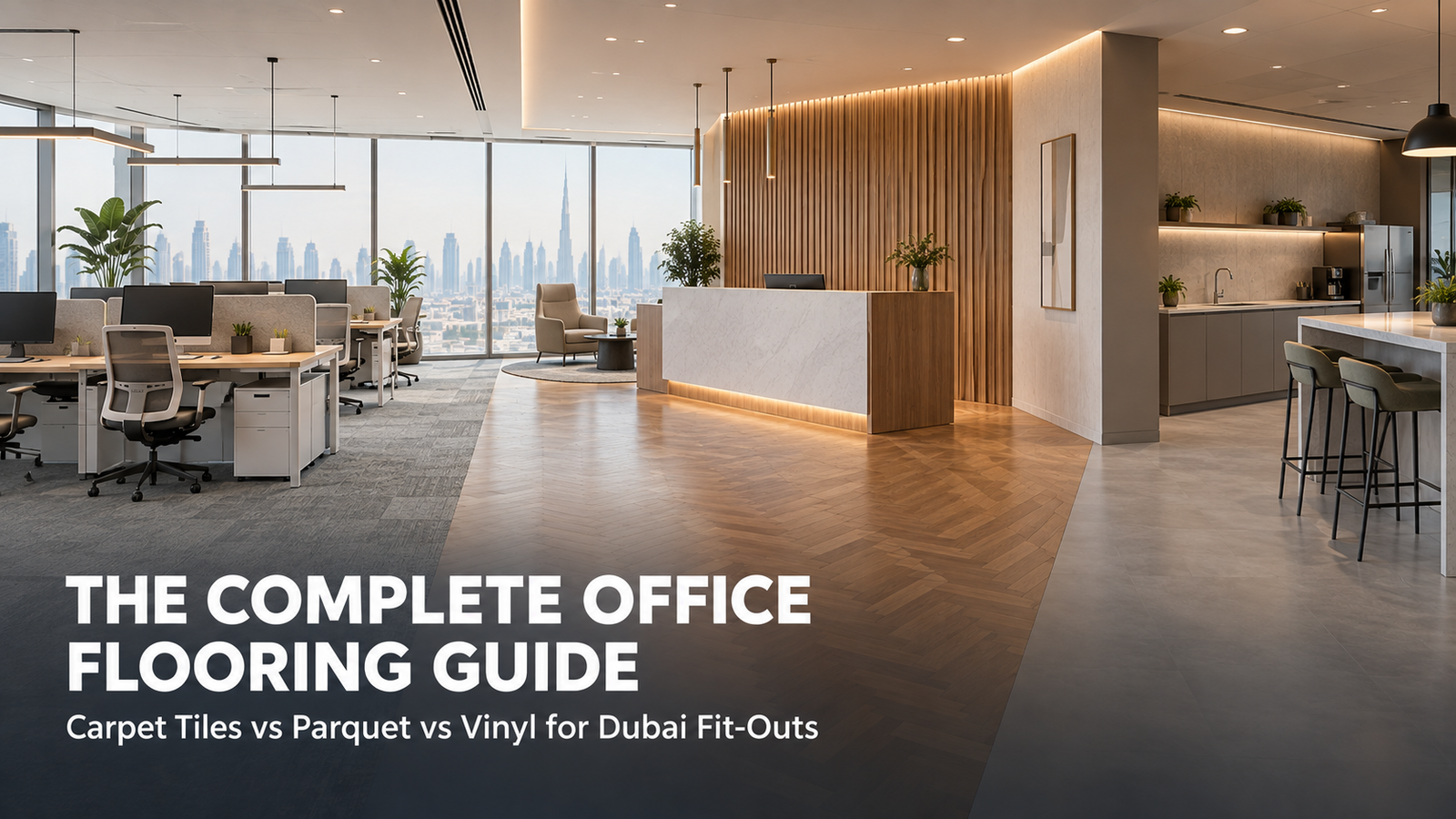
The most common flooring mistake in Dubai office fit-outs isn’t choosing the wrong material — it’s choosing one material for the entire floor. A well-specified office typically mixes all three: carpet tiles across the open desk zones for acoustic comfort, parquet in the reception and executive areas for first impressions, and vinyl in the pantry and utility zones for practicality. Treating flooring as a single office-wide decision usually means compromising on at least one of these outcomes.
How Flooring Choice Affects Furniture Selection
Flooring and furniture decisions aren’t independent — they need to be planned together. Hard flooring like parquet and vinyl requires furniture with floor-protective glides or soft-roll casters to avoid scratching, while carpeted zones need furniture rated for carpet-specific caster wheels to roll smoothly rather than dragging. This same coordination logic applies to height-adjustable desks, which cycle up and down daily and put repeated stress on whatever flooring sits beneath their base. Getting the caster-to-floor match wrong is a small detail that causes years of avoidable wear on both the furniture and the floor.
Flooring by Zone: A Practical Specification Table
| Zone | Recommended Flooring | Why |
|---|---|---|
| Open-Plan Desk Zones | Carpet Tiles | Acoustic absorption, individual tile replacement |
| Reception & Executive Offices | Parquet | First impressions, long-term durability |
| Pantry & Utility Areas | Vinyl | Spill resistance, easy cleaning |
| Meeting & Boardrooms | Parquet or premium Carpet Tiles | Depends on desired acoustic vs. aesthetic priority |
Common Mistakes When Specifying Office Flooring
- Choosing on appearance alone. A flooring sample that looks premium in a supplier showroom doesn’t tell you how it will sound, wear, or clean up after two years of daily use.
- Ignoring acoustic consequences. Replacing carpet with a hard floor for a more “elevated” look often creates a noise problem that then requires additional acoustic furniture to correct — a cost that should be weighed against the flooring decision itself.
- Specifying one material for the whole floor. As covered above, most well-designed offices mix flooring types by zone rather than applying a single material throughout.
- Overlooking installation timeline. Parquet installation and refinishing generally takes longer than carpet tile or vinyl installation, which matters if your fit-out is on a tight handover schedule.
Coordinating Flooring With Your Interior Design Team
Flooring decisions rarely happen in isolation from the rest of a fit-out — they need to align with lighting, wall finishes, and the overall design language of the space. If your project includes a full interior design and fit-out scope rather than a furniture-only refresh, our design partner DesignMaster.ae handles that broader coordination, including flooring selection as part of a complete fit-out brief. Their guide on why fit-out site visits and measurement shouldn’t be skipped covers exactly this kind of cross-discipline planning, including how flooring, acoustic treatment, and furniture all need to be assessed together during the same site walkthrough.
Sustainability Considerations in Office Flooring
Flooring is one of the largest single material footprints in any fit-out, simply by surface area, which makes it a meaningful place to factor in sustainability alongside performance. Carpet tiles increasingly come in recycled-content and take-back program options, allowing worn tiles to be recycled rather than sent to landfill — a genuine advantage over broadloom carpet, which is harder to recycle in sections. Parquet, when sourced from responsibly managed timber, is a long-lived, low-replacement-frequency material, which reduces its lifecycle impact compared to flooring that needs replacing every 8 to 10 years. Vinyl has historically lagged on sustainability credentials, though newer low-VOC and recycled-content vinyl products have narrowed that gap considerably. If sustainability reporting matters to your organization, it’s worth asking any flooring supplier for material certifications and recycled content percentages up front, rather than after the specification is finalized.
Total Cost of Ownership: Looking Past the Installation Price
The cheapest flooring to install is rarely the cheapest to own over a decade. A useful way to compare options honestly is to weigh upfront cost against replacement frequency, maintenance labor, and the downstream cost of any acoustic treatment a hard floor might require.
| Cost Factor | Carpet Tiles | Parquet | Vinyl |
|---|---|---|---|
| Relative upfront cost | Low to moderate | Highest | Low |
| Replacement frequency | Every 8–10 years (full), tiles as needed | Refinish every 5–7 years, replace 15–20+ | Every 10–15 years |
| Ongoing maintenance labor | Moderate — regular vacuuming | Low — occasional polishing | Lowest — simple wipe-down |
| Downstream acoustic cost | None — already absorptive | Possible — may need panels/rugs elsewhere | Possible, depends on underlay used |
Directional comparison — actual costs vary by supplier, finish grade, and installation complexity. Request itemized quotes for your specific project before budgeting.
Installation Process and Typical Timeline
- Site survey and subfloor assessment. Existing subfloor condition, moisture levels, and levelness are checked before any material is ordered — this step catches issues that would otherwise surface after installation.
- Material selection and sample approval. Samples are reviewed under the actual office lighting where possible, not just in a showroom, to confirm color and finish before the full order is placed.
- Subfloor preparation. Leveling compound, moisture barriers, or old flooring removal happen here, and is usually the step most likely to extend the timeline if the existing subfloor needs significant work.
- Installation. Carpet tiles and vinyl are typically the fastest to install, often completed within days for a mid-sized office. Parquet installation takes longer, particularly if on-site finishing or staining is part of the specification.
- Final inspection and handover. Seams, transitions between flooring zones, and edge finishing are checked before the space is signed off as complete.
A Simple Maintenance Schedule by Flooring Type
| Flooring Type | Daily / Weekly | Periodic |
|---|---|---|
| Carpet Tiles | Vacuum high-traffic areas daily | Deep clean every 6–12 months, spot-treat stains promptly |
| Parquet | Dry sweep or dust mop | Re-polish or refinish every 5–7 years depending on traffic |
| Vinyl | Wipe or mop as needed | Occasional re-sealing depending on product grade |
Case Study: A Mixed-Flooring Fit-Out in JLT
A 25-desk professional services office in JLT initially planned to floor the entire space in parquet for a premium look throughout. After reviewing acoustic and maintenance tradeoffs, the specification was revised to carpet tiles across the open desk area, parquet retained in the reception and two partner offices, and vinyl specified for the pantry. The mixed approach reduced material cost compared to an all-parquet specification, avoided the acoustic issues a fully hard-floored open plan would have created, and still delivered the premium first impression at reception where it mattered most for client visits.
Related Reading
Frequently Asked Questions
Which office flooring is best for acoustic performance?
Carpet tiles perform best, since soft, fibrous surfaces absorb impact noise rather than reflecting it. Hard flooring like parquet and standard vinyl reflect sound, which is why they’re best paired with rugs or soft furnishings in the same room if used in a space with other acoustic sensitivities.
Can different flooring types be mixed within the same office?
Yes, and in most well-specified Dubai offices they are. A common approach is carpet tiles in open desk zones, parquet in reception and executive areas, and vinyl in pantries or utility rooms — each material matched to what that specific zone actually needs.
How long does each flooring type typically last in a commercial office?
Carpet tiles typically last 8 to 10 years, vinyl 10 to 15 years, and parquet 15 to 20+ years with periodic refinishing. Actual lifespan depends heavily on foot traffic volume and maintenance consistency.
Does flooring choice affect furniture selection?
Yes. Hard flooring like parquet and vinyl requires furniture with protective glides or soft-roll casters to avoid scratching, while carpeted zones need carpet-rated casters to roll smoothly. This is especially relevant for frequently adjusted furniture like height-adjustable desks.
Is vinyl flooring durable enough for a busy commercial office?
Modern luxury vinyl tile (LVT) is highly durable and specifically well-suited to high-traffic, high-spill zones like pantries and utility areas, though it’s generally used selectively rather than throughout an entire office, since parquet or carpet typically better serve reception and open-desk zones respectively.
What’s the biggest mistake companies make when choosing office flooring?
Choosing a single material for the entire office based on appearance alone, without considering how each zone will actually be used. A reception area and an open-plan desk zone have very different flooring needs, and treating them the same usually means compromising on acoustics, maintenance, or cost somewhere in the building.
Can damaged carpet tiles be replaced without re-flooring the whole room?
Yes — this is one of carpet tile’s main practical advantages. Individual tiles can be lifted and swapped out for a stained or worn section, without disturbing the rest of the installed floor, which isn’t possible with solid parquet flooring.
Is any of these flooring types more sustainable than the others?
Each has a different sustainability profile: carpet tiles increasingly offer recycled-content and take-back recycling programs, responsibly sourced parquet has a long lifecycle that reduces replacement frequency, and newer low-VOC vinyl products have narrowed the sustainability gap with the other two. Ask suppliers for material certifications and recycled content percentages if this factors into your decision.
How long does office flooring installation typically take?
Carpet tiles and vinyl are generally the fastest to install, often completed within days for a mid-sized office. Parquet takes longer, especially if on-site finishing or staining is part of the specification, and subfloor preparation is usually the step most likely to extend any flooring installation timeline.
Why does subfloor condition matter before choosing flooring?
An uneven or moisture-affected subfloor can undermine even the highest-quality flooring material, leading to premature wear, visible imperfections, or installation failures. A proper site survey and subfloor assessment before ordering materials catches these issues early, when they’re far cheaper to fix.
Bringing It Together
Flooring is one of the few fit-out decisions that touches nearly every other part of the office — acoustics, furniture selection, maintenance budget, and the first impression a client forms the moment they step off the elevator. The right answer is rarely a single material applied everywhere; it’s usually a deliberate mix, matched zone by zone to what that part of the office actually needs.
If you’re planning a fit-out and want flooring specified alongside your furniture and acoustic plan rather than as a separate decision, our team can walk your space and recommend a zone-by-zone approach that works as one coordinated system.
About OfficeMaster.ae
OfficeMaster.ae is a premier supplier and manufacturer of commercial office furniture in Dubai, UAE, serving corporate, governmental, educational, and hospitality clients across the region. Learn more about us or get in touch to plan your next fit-out.
Visit Us Today!
— OfficeMaster.ae | Premium Office Furniture UAE —