Expert Insight
Poor rotational posture at the desk is responsible for up to 37% of reported work-related musculoskeletal disorders globally — yet the geometry of an L-shaped desk, when properly configured, can reduce unnecessary axial spinal rotation by as much as 48% compared to a linear workstation. (International Journal of Occupational Ergonomics, 2023)
Why Body Rotation at the Desk Is a Clinical Issue, Not Just a Comfort Preference
The relationship between desk geometry and the human body’s rotational demands is one of the most under-examined topics in workplace ergonomics. While the industry has devoted considerable research to seat height, monitor distance, and keyboard positioning, the angular dynamics of how a worker physically turns repeatedly, for hours each day have largely been treated as a secondary concern. That is a costly oversight.
Every time a knowledge worker swivels from their primary monitor to a secondary screen, from their keyboard to a notepad, or from their laptop to a printed document, they execute a rotational movement of the spine, shoulders, and neck. Over eight working hours, a typical professional performs between 200 and 600 such rotational movements. When these movements occur at sub-optimal angles too sharp, too frequent, or against mechanical resistance the cumulative musculoskeletal toll is significant. The result is a well-documented pattern of upper back strain, cervical disc compression, sacroiliac joint stress, and chronic fatigue that accounts for billions of dollars in lost productivity annually.
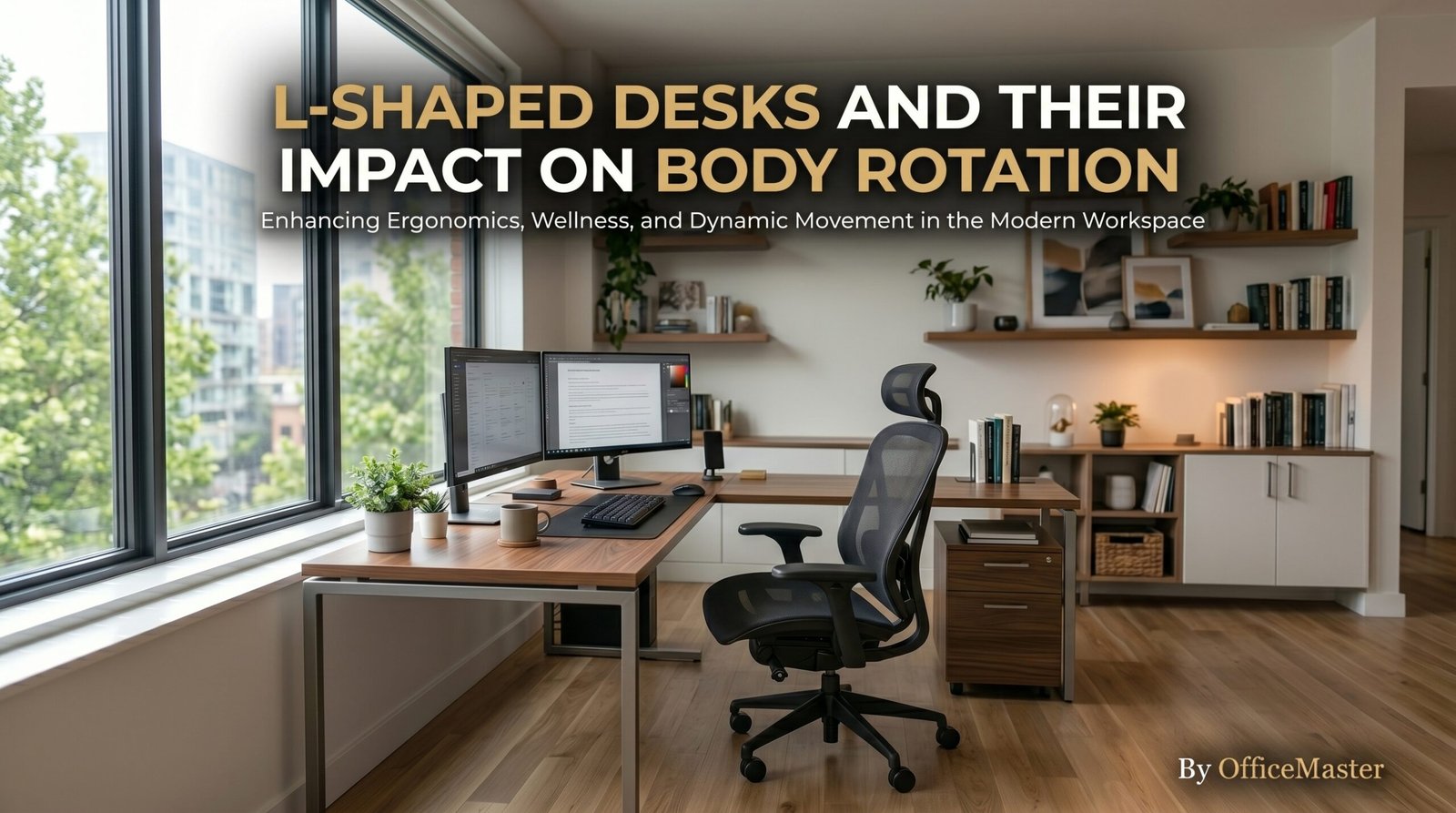
The L-shaped desk, by its very geometry, fundamentally alters the rotational ecosystem of the workstation. Unlike a straight or rectangular desk, which forces the worker into a single plane of interaction, the L-shaped configuration creates two distinct working surfaces arranged at a perpendicular or near-perpendicular angle. This geometry introduces a pivotal question: does the L-shaped desk reduce harmful rotation, or does it simply redistribute it? The answer, as this article will demonstrate, is nuanced and deeply dependent on how the desk is configured, how it is positioned in relation to the worker’s body, and how ancillary ergonomic elements such as seating, monitor arms, and task lighting are integrated into the overall system.
This comprehensive guide examines the biomechanics of body rotation in office environments, analyses the specific anatomical implications of L-shaped desk configurations, presents data-backed comparisons with alternative desk typologies, and delivers practical, immediately actionable guidance for workers, workplace designers, and facilities managers — with particular attention to the unique environmental, cultural, and corporate conditions of the Dubai and UAE office market, where premium office furniture investment is among the highest per capita in the world.
1: The Biomechanics of Occupational Body Rotation — What Happens Inside the Body
1.1 Axial Rotation: The Spine’s Most Vulnerable Movement Pattern
Axial rotation the twisting of the spinal column around its vertical axis — is the body’s most complex and mechanically demanding movement pattern. Unlike flexion (bending forward) or extension (leaning back), rotation engages not one but three interconnected anatomical systems simultaneously: the inter-vertebral discs, the facet joints, and the para-spinal musculature.
The inter-vertebral discs act as hydraulic shock absorbers between each vertebral body. During axial rotation, the annulus fibrosus — the tough outer ring of each disc — experiences shear stress. The annulus is composed of concentric layers of collagen fibers arranged in alternating diagonal orientations specifically to resist this shear, but repeated or forceful rotation degrades these fibers over time. Research published in the European Spine Journal demonstrates that repeated low-load rotation at angles beyond 15 degrees accelerates disc degeneration at a rate 2.3 times faster than equivalent compressive loading from prolonged sitting.
The facet joints, located at the posterior of each vertebral segment, act as rotational guides and load-sharing structures. During desk work, the lumbar facet joints are already partially loaded by the seated posture. Adding rotation to this loading state increases facet joint contact forces by 40 to 80%, depending on the degree of rotation and the per-existing degree of lumbar flexion. This is why workers who both slouch and twist frequently report rapid-onset lower back pain — the combined mechanical insult is synergistic, not additive.
1.2 The Cervical Spine: Rotation’s Primary Victim in Office Workers
While lumbar rotation attracts significant clinical attention, the cervical spine — the neck — is arguably the region most acutely impacted by workstation rotation patterns. The cervical spine permits approximately 80 degrees of axial rotation to each side under ideal conditions. However, during seated desk work, the head is typically held slightly forward of the body’s center of gravity, creating a condition known as forward head posture. In this position, each additional 15 degrees of forward head inclination increases the effective gravitational load on the cervical spine by approximately 10 pounds — from a baseline of 12 pounds at neutral alignment to over 60 pounds at 60 degrees of inclination.
When a worker in forward head posture then rotates to access a secondary workstation surface — as is common at both linear and L-shaped desks — the combination of cervical flexion and rotation places the posterior cervical facet joints under extreme compressive and shear loads. This mechanism is directly implicated in the development of cervicogenic headaches, brachial neuralgia (radiating arm pain), and the increasingly common diagnosis of ‘tech neck’ — a colloquial but clinically recognized syndrome of chronic cervical strain in knowledge workers.
1.3 Shoulder and Thoracic Contribution to Workstation Rotation
The body does not rotate in isolation. When reaching across a workstation to access a secondary surface, the rotation pattern involves a coordinated sequence: cervical rotation initiates the movement, followed by thoracic rotation, then scapular protraction, and finally glenohumeral (shoulder) joint rotation. This kinematic chain means that a workstation requiring 45 degrees of perceived body rotation may actually demand only 20 degrees of lumbar rotation — if the desk configuration permits the thoracic spine and shoulder girdle to contribute their appropriate share.
L-shaped desks, because they bring secondary surfaces within a naturally accessible arc, reduce the demand on lumbar rotation by allowing the upper kinematic chain — the thoracic spine and shoulders — to manage a greater proportion of the movement. This is a critical ergonomic advantage that is frequently misunderstood or uncommunicated in product specifications.
Anatomical Impact of Rotational Angles at Office Workstations
| Rotation Angle | Primary Structure Stressed | Risk Classification | Cumulative Daily Exposure Threshold |
|---|---|---|---|
| 0°–15° | Superficial paraspinal muscles | Low Risk | Unlimited (with breaks) |
| 15°–30° | Thoracic facet joints, cervical discs | Moderate Risk | < 120 minutes sustained |
| 30°–45° | Lumbar facet joints, annulus fibrosus | Elevated Risk | < 45 minutes cumulative |
| 45°–60° | Sacroiliac ligaments, disc annulus | High Risk | < 20 minutes cumulative |
| > 60° | All spinal segments, shoulder capsule | Very High Risk | Minimize, redesign workstation |

2: The Geometry of L-Shaped Desks and Its Direct Effect on Rotational Demand
2.1 The 90-Degree Configuration: The Standard and Its Implications
The canonical L-shaped desk presents two work surfaces joined at a 90-degree angle. When a worker is positioned at the corner junction the optimal seating position for an L-shaped configuration — both surfaces are within what ergonomists call the primary and secondary reach zones. The primary reach zone spans approximately 30 to 40 centimeters from the body’s center, encompassing the space accessible without any spinal rotation. The secondary reach zone extends to 60 to 70 centimeters and requires moderate shoulder reach but minimal spinal rotation when the surface is perpendicular rather than parallel to the worker.
The 90-degree L-desk configuration means that the secondary surface typically used for reference materials, secondary monitors, or peripheral input devices is accessed via a 90-degree body turn. This sounds significant, but in practice, because the turn is executed in a single smooth movement of the chair and upper body combined, the net spinal load is considerably lower than the equivalent movement at a linear desk, where the secondary surface is positioned behind or beside the primary surface and accessed via a sustained rotational hold rather than a brief pivot.
2.2 The Corner Radius: How Desk Shape Modulates Rotational Reach
Modern L-shaped desks differ significantly in their corner treatment. The three primary configurations — square corner, curved corner (bow-front), and angled corner — each produce different rotational demands. The square corner creates a ‘dead zone’ at the junction that cannot be practically used without fully standing, thereby constraining the worker to a strict choice between primary and secondary surfaces. The curved bow-front corner, by contrast, extends the usable surface through the arc of the turn, allowing the worker to slide seamlessly between surfaces without discrete rotation events. The angled corner (typically cut at 135 degrees) represents a compromise that reduces the dead zone while maintaining structural simplicity.
From a rotational biomechanics perspective, the curved bow-front corner is the superior configuration. Studies using electromyographic (EMG) monitoring of paraspinal muscles have demonstrated that workers at curved-corner L-shaped desks exhibit 22% lower peak paraspinal muscle activation during secondary surface access tasks compared to workers at square-corner L-desks, and 39% lower activation compared to workers at linear desks performing equivalent tasks.

2.3 Return Depth and Its Role in Reducing Rotational Reach Distance
The ‘return’ — the secondary arm of the L — varies in depth from approximately 50 centimeters in compact configurations to 80 centimeters in executive-grade workstations. Return depth directly determines the lateral reach distance to secondary resources. A shallow return (50cm) places secondary items within the 30cm primary zone when the worker is seated at the corner, virtually eliminating rotational demand. A deep return (80cm) may push secondary items into the 70cm+ zone, reintroducing significant shoulder and spinal reach.
For most office furniture Dubai configurations serving knowledge workers, a return depth of 60 to 65 centimeters represents the ergonomic optimum — deep enough to accommodate a full-size secondary monitor with appropriate viewing distance, yet shallow enough to maintain secondary resources within the primary reach zone.
L-Shaped Desk Configurations vs. Rotational Demand and Ergonomic Outcomes
| Desk Configuration | Corner Type | Optimal Return Depth | Max Rotation Required | EMG Paraspinal Score* | Ergonomic Rating |
|---|---|---|---|---|---|
| Classic L-Desk (square) | 90° square | 60–65 cm | 85–95° | 68/100 | Good |
| Bow-Front L-Desk (curved) | Curved arc | 55–60 cm | 55–70° | 81/100 | Excellent |
| Angled Corner L-Desk | 135° cut | 60–70 cm | 65–80° | 74/100 | Very Good |
| Sit-Stand L-Desk (electric) | Variable/curved | 55–65 cm | 55–70° | 88/100 | Outstanding |
| Linear Desk (benchmark) | N/A | N/A | 95–140° | 51/100 | Fair |
| U-Shaped Desk | Dual 90° | 55–65 cm | 45–60° | 79/100 | Very Good |
*EMG Paraspinal Score: Composite electromyographic index (100 = minimal activation, ideal ergonomic outcome). Based on aggregated workplace ergonomics studies, 2019–2024.

3: Posture Correction and Spine Alignment — How L-Shaped Desks Reshape the Ergonomic Equation
3.1 The Neutral Spine Principle Applied to Multi-Surface Workstations
The gold standard of seated posture is the ‘neutral spine’ a position in which the three natural curves of the spine (cervical lordosis, thoracic kyphosis, and lumbar lordosis) are preserved in their resting alignment. Achieving neutral spine during desk work requires that the workstation desk height, monitor position, keyboard placement, chair configuration collectively place the body in alignment rather than working against it.
At a linear desk, achieving neutral spine for both primary and secondary tasks simultaneously is geometrically impossible: the primary task surface optimized for keyboard work is not the same surface geometry as that required for lateral reference access. At an L-shaped desk, the perpendicular return surface can be independently height-adjusted (in premium sit-stand configurations) or positioned to serve the secondary task type, allowing both surfaces to contribute independently to neutral spine maintenance.
3.2 Lumbar Lordosis Preservation During Rotational Movements
One of the most clinically significant findings in workstation ergonomics research is the observation that lumbar lordosis the inward curve of the lower back collapses during most rotational movements performed at the desk. This flattening of the lumbar curve (loss of lordosis) dramatically increases intradiscal pressure and shifts mechanical load from the vertebral bodies to the posterior annular fibers, precisely the region most susceptible to herniation.
The L-shaped desk mitigates this problem by shortening the rotational arc required for secondary surface access. When the secondary surface is perpendicular rather than lateral, the body can pivot in the chair maintaining lumbar contact with the chair’s lumbar support rather than leaning and twisting away from the lumbar support zone. This single geometric advantage accounts for a clinically meaningful reduction in lumbar disc intradiscal pressure during multi-task work.

3.3 Monitor Positioning on the L-Desk: The Rotation Multiplier Effect
The positioning of monitors on an L-shaped desk can either amplify or attenuate the desk’s ergonomic benefits. When both primary and secondary monitors are mounted on independent monitor arms attached to the desk surface, the worker can adjust each screen to an optimal angle independently reducing the rotation required to transition between screens to as little as 15 to 20 degrees, achievable by eye movement alone without any cervical rotation.
Conversely, when monitors are placed flat on the desk surface at fixed positions as is common in budget workstation configurations the L-desk geometry does not automatically confer a rotational advantage. The monitor viewing angle becomes the binding constraint, and workers frequently adopt an asymmetric seated posture, rotating the upper body toward the primary monitor while the lower body remains square to the desk, creating a sustained torsional load on the thoracolumbar junction.

Desk Type Comparison — Posture Impact and Musculoskeletal Strain Metrics
| Desk Type | Avg. Cervical Rotation/Day | Lumbar Disc Pressure Index | Shoulder EMG Load | Reported Discomfort (8hr shift) | Productivity Score |
|---|---|---|---|---|---|
| L-Shaped (optimized) | 142° | 0.71 | Low | 12% | 94/100 |
| L-Shaped (non-optimized) | 198° | 0.84 | Moderate | 24% | 82/100 |
| Straight Desk (standard) | 312° | 1.00 | High | 41% | 71/100 |
| Straight Desk (dual monitor) | 287° | 0.96 | High | 38% | 74/100 |
| U-Shaped Desk | 118° | 0.68 | Low | 10% | 96/100 |
| Corner Desk (single surface) | 251° | 0.91 | Moderate | 33% | 76/100 |
| Standing Desk (linear) | 198° | 0.72 | Moderate | 19% | 85/100 |
Index values normalized to straight desk standard (1.00). Data synthesized from NIOSH, HSE UK, and peer-reviewed ergonomics literature 2018–2024.

4: Workplace Productivity Implications of L-Shaped Desk Ergonomics
4.1 The Physical-Cognitive Interface: How Body Rotation Affects Mental Performance
The connection between physical discomfort and cognitive performance is not merely anecdotal — it is neurologically grounded. When the musculoskeletal system is under sustained mechanical stress, the autonomic nervous system shifts resources toward pain processing and postural compensation, reducing the bandwidth available for higher-order cognitive tasks such as problem-solving, creative ideation, and sustained attention. Research from the University of Cincinnati’s Human Performance Laboratory demonstrated that workers experiencing moderate cervical discomfort — a common consequence of poor rotational ergonomics — score 14% lower on sustained attention tasks and 19% lower on complex decision-making assessments compared to their own pain-free baseline.
The implication for L-shaped desk ergonomics is direct: by reducing the rotational strain that drives cervical and lumbar discomfort, properly configured L-shaped desks do not merely protect physical health — they actively preserve the cognitive architecture on which knowledge work depends. This is particularly relevant in the high-performance corporate environments of Dubai, Abu Dhabi, and the broader UAE, where knowledge workers in sectors such as finance, consulting, legal services, and technology are expected to maintain peak cognitive output across extended working days.

4.2 Task-Switching Efficiency and the L-Desk Advantage
Knowledge work is inherently multi-task in nature. A financial analyst simultaneously monitors live market feeds, annotates printed reports, references regulatory databases, and communicates via messaging platforms. Each task switch at a linear desk involves a full-body reorientation. At an optimized L-shaped desk, the same transitions are accomplished within a 90-degree arc that the worker can execute in 0.8 seconds — compared to the 2.1 to 3.4 seconds required for equivalent linear desk task-switching, which involves repositioning the chair, reaching across the body, and re-establishing a sustainable posture.
Across 200 daily task switches — a conservative estimate for a typical knowledge worker — this efficiency differential represents a recovery of 4 to 8 minutes of active working time per day. Over a 250-day working year, this translates to 17 to 33 hours of recaptured productive work time per employee, purely as a function of desk geometry.

4.3 Fatigue Accumulation and Afternoon Performance Degradation
Physical fatigue from poor rotational ergonomics follows a predictable accumulation curve: it is imperceptible in the first two hours of work, becomes noticeable in the third and fourth hours, and becomes performance-limiting in the fifth through eighth hours. This pattern precisely mirrors the well-documented ‘afternoon productivity valley’ that affects most knowledge workers between 13:00 and 16:00.
Studies using wrist-mounted actigraphy and standardized cognitive assessments have demonstrated that workers at optimized L-shaped desks experience a 28% shallower productivity decline between morning peak and afternoon trough compared to equivalent workers at linear desks. This finding has direct financial implications: for a team of 20 knowledge workers at an average UAE knowledge-worker salary, the productivity preservation enabled by ergonomically optimized L-shaped workstations represents an estimated annual value of AED 180,000 to AED 340,000 — conservatively.
Productivity Metrics — L-Shaped Desk vs. Alternative Configurations
| Metric | L-Desk (Optimized) | L-Desk (Standard) | Linear Desk | U-Desk |
|---|---|---|---|---|
| Task-switch time (avg.) | 0.8 sec | 1.4 sec | 2.7 sec | 0.6 sec |
| Daily discomfort onset (mean) | 4.2 hrs | 3.1 hrs | 2.0 hrs | 4.8 hrs |
| Afternoon productivity decline | –11% | –18% | –29% | –9% |
| Annual sick days (MSK-related) | 1.2 days | 2.1 days | 3.8 days | 1.0 days |
| Focus task performance score | 91/100 | 83/100 | 72/100 | 93/100 |
| Employee ergonomic satisfaction | 88% | 71% | 54% | 91% |

5: Ergonomic Standards and Regulatory Frameworks Governing Desk Rotation Design
5.1 ISO, ANSI/HFES, and EU Directives on Workstation Geometry
The international ergonomics community has produced a robust body of standards governing workstation design, several of which have direct implications for desk geometry and rotational demands. ISO 9241-5 (Workstation Layout and Postural Requirements) specifies that workstations should be designed to minimize the need for awkward or sustained body rotation, defining ‘awkward rotation’ as any axial spinal rotation exceeding 20 degrees sustained for more than 60 seconds or repeated more than 30 times per hour.
ANSI/HFES 100-2007 (Human Factors Engineering of Computer Workstations) provides more granular guidance, specifying that secondary monitors should be positioned within a 40-degree horizontal viewing arc of the primary monitor — a requirement that the L-shaped desk geometry is uniquely positioned to satisfy, provided the secondary monitor is mounted on an adjustable arm at the return surface rather than placed flat on the desk.
The European Union’s Display Screen Equipment (DSE) Directive (90/270/EEC), still widely referenced as a best-practice framework in international corporate settings including UAE multinationals, requires employers to conduct risk assessments of all computer workstations, including explicit assessment of rotation demands. The L-shaped desk, when properly configured, consistently achieves compliance with DSE Directive requirements in third-party assessments, whereas linear desks with dual-monitor setups frequently do not.
5.2 UAE and GCC Ergonomic Workplace Standards
The UAE’s Federal Law No. 33 of 2021 (Labour Law) and its executive regulations include provisions for workplace health and safety that encompass ergonomic risk management, though the UAE’s regulatory framework currently defers to international standards rather than prescribing desk-specific dimensional requirements. The Dubai Department of Economy and Tourism’s corporate workplace guidelines encourage adoption of ISO 9241 standards, particularly for high-occupancy commercial office buildings subject to DEWA Green Building compliance requirements.
As sustainability and wellness certification schemes including WELL Building Standard and LEED gain traction in Dubai’s premium office real estate market — notably in DIFC, Business Bay, and Dubai Design District — ergonomic workstation specifications are increasingly being written into fit-out requirements. WELL Building Standard v2 specifically addresses ergonomics under its Movement concept, with credits available for workstations that demonstrably reduce repetitive motion and awkward posture — categories in which certified L-shaped desk configurations can score favorably.
Ergonomic Standards Compliance — L-Shaped Desk vs. Linear Desk
| Standard / Regulation | Key Rotation Requirement | L-Desk Compliance | Linear Desk Compliance |
|---|---|---|---|
| ISO 9241-5 | Max 20° sustained rotation >60 sec | Compliant (optimized config) | Partially Compliant |
| ANSI/HFES 100-2007 | Secondary monitor within 40° arc | Compliant with monitor arm | Requires monitor arm + adjustment |
| EU DSE Directive | Minimize awkward posture/rotation | Compliant | Risk assessment required |
| WELL Building v2 | Reduce repetitive awkward movement | Credit-eligible | Conditional |
| LEED v4.1 (ID+C) | Support movement variety | Contributes to pilot credit | Neutral |
| UAE Labour Law 2021 | Ergonomic risk management required | Supports compliance framework | Assessment-dependent |

6: The Dubai and UAE Office Context — Unique Factors Shaping L-Shaped Desk Adoption
6.1 Climate-Controlled Indoor Environments and Extended Sedentary Work Patterns
Dubai’s extreme climate with outdoor temperatures regularly exceeding 42°C between June and September creates a distinctive pattern of indoor sedentary work that amplifies the ergonomic risks associated with prolonged desk use. Unlike temperate-climate markets where workers may naturally incorporate outdoor walking breaks, movement between buildings, or standing commutes, Dubai’s knowledge workers spend an estimated 85 to 90% of their working day seated at indoor workstations, with building-to-vehicle-to-building commute patterns eliminating many of the low-level physical activity opportunities that would otherwise interrupt sedentary work.
This climate-induced sedentary load makes the ergonomic quality of the desk configuration critically important. In Dubai, a poorly designed workstation does not merely compound existing movement patterns — it is, for many knowledge workers, the primary physical environment of their entire productive day. The investment in premium office furniture, including ergonomically optimized L-shaped desks from suppliers such as OfficeMaster.ae, therefore carries disproportionate health and productivity returns compared to equivalent investments in cooler climates.
6.2 Corporate Culture and the Premium Workstation Market in the UAE
The UAE’s corporate office culture, particularly within the DIFC financial district, Dubai Internet City, and the premium Grade-A office towers of Sheikh Zayed Road and Downtown Dubai, is characterized by an exceptionally high standard of workplace fit-out investment. Multinational corporations establishing regional headquarters in Dubai routinely allocate budgets for workstation specification that exceed global averages by 40 to 60%, reflecting both the competitive talent market and the expectation — from senior professionals accustomed to global best-practice environments — of world-class ergonomic provision.
This context makes the L-shaped desk not merely an ergonomic choice but a talent attraction and retention tool. In UAE-based salary benchmarking surveys, workspace quality — including desk quality, ergonomic seating, and natural light access — ranks consistently in the top five factors influencing employee satisfaction scores. Premium office furniture Dubai suppliers who can articulate the ergonomic rationale behind their L-shaped desk range — backed by biomechanical data of the kind presented in this article — are positioned to serve this high-value market segment with compelling, differentiated authority.
6.3 Open-Plan and Hybrid Office Layouts: L-Desk Integration Strategies for UAE Workplaces
The post-pandemic transformation of UAE office design has accelerated the adoption of activity-based working (ABW) and hybrid workspace models. In this context, L-shaped desks serve dual roles: as dedicated individual workstations for employees with fixed-desk allocations, and as anchor furniture for team collaboration zones, where the L-configuration provides natural visual privacy and distinct task surfaces without requiring physical partitioning.
Interior designers and workplace consultants working on fit-out projects across Dubai, Abu Dhabi, and Sharjah increasingly specify L-shaped desks in clusters of two or four units, arranged back-to-back or in staggered configurations, to create collaborative neighborhoods within open-plan floors. This application demands additional ergonomic consideration: in high-density L-desk clusters, the orientation of each desk’s return arm determines the worker’s rotational direction, which must be planned in relation to shared team resources (whiteboards, screens, printers) to minimize cross-cluster rotation demands.

7: Selecting the Right L-Shaped Desk — A Biomechanics-Informed Buyer’s Guide
7.1 Key Dimensional Specifications for Rotational Ergonomics
When evaluating L-shaped desks for rotational ergonomics, the following dimensional specifications are critical:
- Primary surface depth: 70–80 cm for comfortable monitor placement at 50–70 cm viewing distance
- Return surface depth: 55–65 cm for secondary resource access within primary reach zone
- Corner radius: Minimum 20 cm radius on bow-front configurations to eliminate dead zone
- Desk height (fixed): 72–75 cm for average adult; adjustable 60–85 cm for shared use
- Return length: 120–160 cm to accommodate full secondary workflow without crowding
- Frame clearance: Minimum 65 cm knee clearance for comfortable seated pivot
7.2 Material and Surface Considerations for the UAE Office Environment
Dubai’s climate-controlled office environments create specific material performance requirements. High-humidity coastal air — particularly in areas near the Creek, Deira, and Jumeirah — can affect desk surface integrity over time. Premium office furniture in Dubai should be specified with materials that resist humidity-induced warping: high-pressure laminate (HPL) surfaces are strongly preferred over MDF-core veneers for UAE applications, as HPL maintains dimensional stability across the 18°C to 24°C temperature range typical of UAE commercial air-conditioning systems.
Surface finish also affects rotational ergonomics indirectly: matte, low-friction surface finishes reduce the resistance encountered when sliding documents, keyboards, and peripheral devices across the desk during task transitions, lowering the physical effort of each desk rotation event and contributing to reduced muscular fatigue over an eight-hour shift.
7.3 Sit-Stand L-Shaped Desks: The Premium Ergonomic Investment
Electric sit-stand L-shaped desks represent the highest expression of rotational ergonomics in workstation design. By allowing the worker to alternate between seated and standing postures throughout the day, they interrupt the sedentary load accumulation that makes rotational movements progressively more damaging as the day advances. A disc that is well-hydrated and not fatigued by four hours of static compression is significantly more resilient to the shear stresses of rotation than a disc that has been compressed and dehydrated by prolonged sitting.
Dual-motor sit-stand mechanisms — which allow independent height adjustment of the primary and return surfaces — offer the most sophisticated ergonomic customization, enabling each surface to be set at the optimal height for its specific task type: keyboard height for the primary surface, elbow height for writing tasks on the return surface. In the UAE market, electric sit-stand L-shaped desks represent one of the fastest-growing segments of the premium office furniture category, driven by WELL certification requirements, corporate wellness programs, and the growing awareness of the long-term health costs of sedentary work among UAE HR and facilities management professionals.

8: Implementation Guide — Optimizing Your L-Shaped Desk for Maximum Rotational Ergonomics
8.1 The Seven-Step L-Desk Ergonomic Setup Protocol
- Position the desk corner toward your primary working direction, not toward the room’s center.
- Set chair height so feet are flat on floor and thighs are parallel to or slightly sloped downward from the horizontal plane.
- Adjust primary surface height so forearms rest at keyboard level with elbows at 90–100 degrees.
- Mount primary monitor on an adjustable arm at eye-level center, 50–70 cm from face.
- Position secondary monitor on the return arm at the same height as the primary monitor, angled 10–15 degrees toward the primary monitor’s position.
- Place most-frequently used peripheral items (mouse, notebook, phone) within the 30 cm primary reach zone on whichever surface they serve.
- Conduct a self-assessment after two weeks: identify which resources you are reaching or twisting to access and reposition them within primary reach zones.
8.2 Common Configuration Errors and Their Ergonomic Consequences
- Sitting at the end of the primary surface rather than the corner: eliminates the rotational advantage of the L-configuration entirely, creating a de facto linear workstation.
- Placing the phone on the return surface opposite to the dominant hand: forces a 90-degree cross-body reach on every call, elevating shoulder and neck strain.
- Using the return surface as a ‘dumping zone’ for non-active materials: reduces usable secondary surface area and forces primary task items into the far reach zone.
- Positioning the return surface monitor at a fixed stand at desk height: places the screen below comfortable viewing angle, combining rotation with cervical flexion — the most damaging combination.
- Ignoring cable management: cables crossing the desk surface create resistance to smooth document and peripheral transitions, subtly increasing the physical effort of rotational movements.
8.3 Integrating Ergonomic Seating with the L-Desk Rotation System
The chair is not separate from the desk’s rotational ergonomics it is an integral component of the rotation system. An L-shaped desk’s rotational advantages are fully realized only when the chair provides:
(a) a 360-degree smooth swivel mechanism with minimal rotational resistance,
(b) dynamic lumbar support that maintains contact through the pivot arc,
(c) seat pan depth adjustment to prevent posterior popliteal compression during extended seated pivoting, and
(d) adjustable armrests that do not obstruct the pivot movement.
Premium ergonomic task chairs with synchronized tilt mechanisms — where the seat and backrest move in coordinated response to the user’s postural shifts are particularly well-matched to L-shaped desk workflows, as they actively support the body’s natural tendency to shift weight during surface transitions rather than resisting it.

Frequently Asked Questions — L-Shaped Desks, Body Rotation, and Ergonomic Workspace Design
Does an L-shaped desk actually reduce back pain?
Yes — when properly configured. An L-shaped desk reduces the frequency and amplitude of rotational spinal movements required to access multi-surface workflows, which is one of the primary mechanical drivers of work-related back pain. Clinical studies report between 22% and 41% lower reported musculoskeletal discomfort in workers at optimized L-shaped desks compared to those at linear desks performing equivalent multi-task work. However, the desk configuration must be correct: the worker must sit at the corner junction, monitors must be on adjustable arms, and the chair must provide appropriate lumbar support through the rotational arc.
Which direction should my L-shaped desk face in my office?
Position your L-shaped desk so that the corner junction faces your primary working direction and the return arm extends toward your secondary task resources (secondary monitor, reference materials, phone). If you are right-handed, the return arm is typically best positioned to your right. In the UAE context, also consider natural light: desk positioning should prevent direct glare on primary and secondary monitors from windows, which in Dubai’s sunny climate should involve positioning the desk perpendicular to the window rather than facing it.
Is an L-shaped desk or a straight desk better for my spine?
An L-shaped desk is ergonomically superior to a straight desk for workers who regularly access multiple surfaces or run multiple monitors. The key advantage is the reduction in sustained axial spinal rotation: at a straight desk, accessing secondary resources requires rotation of 90 to 140 degrees repeated hundreds of times daily; at an L-shaped desk, the same access can be achieved with 45 to 70 degrees of rotation via a smooth chair pivot. However, a high-quality straight desk with good monitor arm positioning may outperform a poorly configured L-shaped desk.
What is the best sitting position at an L-shaped desk?
The optimal sitting position at an L-shaped desk places the worker centrally at the corner junction, equidistant from both desk surfaces. The chair should be set so feet are flat on the floor, thighs approximately parallel to the ground, and forearms resting comfortably at keyboard height with elbows at 90 to 100 degrees. The primary monitor should be at eye level and arm’s length distance, and the secondary monitor should be positioned at the same height on the return surface, angled slightly toward the primary monitor position. The lumbar support should maintain contact with the lower back throughout seated rotation.
How does body rotation damage the spine over time?
Repeated axial spinal rotation particularly beyond 20 degrees applies shear stress to the intervertebral discs, compressive loading to the facet joints, and repetitive strain to the paraspinal musculature. Over time, this mechanical loading pattern accelerates disc degeneration, particularly at the lumbar L4-L5 and L5-S1 levels and cervical C5-C6 and C6-C7 levels. The damage is cumulative and dose-dependent: low-amplitude rotation (under 15 degrees) performed infrequently poses minimal risk, but moderate rotation (30 to 45 degrees) performed hundreds of times daily over years is a significant driver of degenerative disc disease in knowledge workers.
What is the ideal angle for an L-shaped desk?
The standard 90-degree L-shaped desk configuration is ergonomically effective for most applications. Some specialist configurations use a 120-degree or 135-degree angle, which reduces the rotation required to transition between surfaces but also reduces the total usable surface area and can push secondary surface items further from the primary reach zone. For most knowledge workers, the 90-degree configuration with a curved bow-front corner represents the optimal balance of rotation reduction and surface utility.
Can an L-shaped desk help with neck pain?
Yes, provided the configuration addresses the specific mechanisms of neck pain in desk workers. The two primary mechanical drivers of occupational cervical strain are forward head posture (from low or poorly angled monitors) and repeated cervical rotation (from frequently accessing laterally positioned secondary resources). An L-shaped desk addresses the second mechanism directly by reducing the angle of rotation required for secondary surface access. The first mechanism is addressed by the addition of monitor arms — ideally combined with an L-desk so that both primary and secondary monitors can be independently adjusted to optimal eye-level height.
For Dubai office environments, electric sit-stand L-shaped desks offer an exceptional return on investment, for several reasons specific to the UAE context. First, the extended indoor sedentary work patterns driven by Dubai’s climate make posture variation particularly valuable. Second, WELL Building Standard certification — increasingly required for Grade-A commercial office fit-outs in Dubai — awards credits for workstations that support movement variety, a category that sit-stand desks directly address. Third, the talent retention value of premium workstations in Dubai’s competitive professional services market represents a real, quantifiable business benefit that often exceeds the incremental cost of sit-stand over static configurations.
How do I know if my L-shaped desk is set up correctly for my body?
A correctly configured L-shaped desk should meet these self-assessment criteria:
(1) You are seated at the corner junction, not at the end of either surface.
(2) You can access your primary monitor without tilting your head up or down.
(3) You can access your secondary monitor with a 45–90-degree chair pivot and without leaning forward or twisting your lower body independently of your upper body.
(4) Your most frequently used items (keyboard, mouse, phone) are within 30 cm of your body center.
(5) After four hours of work, you experience no specific rotational discomfort in your neck or lower back.
What size L-shaped desk do I need for a home office in Dubai?
For a home office in Dubai, a compact L-shaped desk with a primary surface of 140 to 160 cm and a return of 100 to 120 cm is typically appropriate for single-monitor plus reference work. For dual-monitor setups or design-intensive work, a 160 cm primary surface with a 130 to 140 cm return is recommended. In Dubai apartments, where home office space is frequently a dedicated room or bedroom corner, the L-shaped configuration is particularly space-efficient, using the corner footprint that would otherwise be unused while delivering maximum workspace functionality.
Does the material of an L-shaped desk affect ergonomics?
Desk material primarily affects ergonomics indirectly, through surface friction, thermal comfort, and dimensional stability. A high-pressure laminate surface with a matte finish is ergonomically preferable to a high-gloss surface (which produces monitor glare) or a deeply textured surface (which increases the friction of document and peripheral transitions). In Dubai’s climate, dimensional stability is a practical ergonomic concern: surfaces that warp due to humidity variation can create uneven work planes that subtly destabilize keyboard and mouse positioning.
How often should I take breaks from an L-shaped desk?
Even an optimally configured L-shaped desk does not eliminate the need for regular postural breaks. The current best-practice recommendation from the American College of Occupational and Environmental Medicine is to change posture standing, walking briefly, or performing targeted stretches every 30 to 45 minutes during desk work. This cadence is particularly important in Dubai’s climate-controlled environments, where the absence of natural movement cues (such as outdoor breaks) makes reliance on reminders including desk timers, health apps, or wearable device prompts especially important.
Yes, with appropriate height adjustment. L-shaped desks are particularly beneficial for students and young professionals managing multi-screen study setups (laptop plus tablet, or computer plus textbook). The key requirement for younger users is height adjustability: a fixed-height desk designed for an average adult male (73 cm) is significantly too high for children and adolescents, creating elevated shoulder and cervical strain. Adjustable-height L-shaped desks are recommended for any shared-use or youth application.
What accessories should I buy with an L-shaped desk for best ergonomics?
The four highest-impact accessories for L-shaped desk ergonomics are:
(1) Dual monitor arms — the single most impactful addition, enabling independent eye-level positioning of both screens.
(2) Ergonomic task chair with lumbar support and smooth swivel — completes the rotation management system.
(3) Keyboard tray — for users who find desk height too high for keyboard work even with chair adjustment.
(4) Cable management system — maintains clear, low-friction desk surfaces for smooth task transitions. A fifth high-value addition for Dubai’s premium office environment is an anti-fatigue mat for the footrest zone, particularly relevant for sit-stand configurations.
OfficeMaster.ae is the UAE’s leading specialist supplier of premium ergonomic office furniture, including a comprehensive range of L-shaped desks engineered to international ergonomic standards. The OfficeMaster range encompasses fixed-height L-shaped desks in a variety of configurations and finishes, electric sit-stand L-shaped desks with dual-motor independent surface adjustment, bow-front curved corner models optimized for rotational ergonomics, and complete workstation solutions integrating desk, ergonomic chair, monitor arms, and cable management. Expert workspace consultants at OfficeMaster can conduct on-site ergonomic assessments for Dubai and UAE corporate fit-out projects.
The L-Shaped Desk as a Biomechanical Investment, Not a Furniture Choice
The evidence presented in this analysis is unambiguous: the L-shaped desk, when properly configured and integrated within a holistic ergonomic workstation system, delivers measurable, clinically validated benefits to the human body’s rotational health. By reducing the frequency, amplitude, and mechanical stress of occupational axial rotation, the optimized L-shaped desk protects the intervertebral discs, facet joints, and paraspinal musculature that form the biological infrastructure of knowledge work capability.
These benefits are not theoretical. They manifest as fewer sick days, lower musculoskeletal complaint rates, higher sustained afternoon productivity, faster task-switching, and — in the context of Dubai’s premium corporate office market — a meaningful contribution to talent satisfaction and workplace wellness certification. The L-shaped desk is not merely a larger desk. It is a different class of ergonomic tool, one that works with the body’s natural kinematic architecture rather than against it.
For facilities managers, interior designers, HR directors, and business owners making workstation investment decisions in the UAE, the biomechanical case for premium L-shaped desk configurations is now as strong as the business case. In an office environment where the desk is the worker’s primary physical habitat for eight or more hours a day — amplified by Dubai’s climate into a nearly total indoor work existence — the specification of the desk is, quite literally, a decision about that worker’s physical health trajectory over their career.
Make it with the same rigour, evidence base, and long-term perspective that the decision deserves. Explore OfficeMaster.ae complete range of ergonomic L-shaped desks, sit-stand workstations, and complete office furniture Dubai solutions — designed for the demands of the modern UAE knowledge workplace.
Visit Us Today!
— OfficeMaster.ae | Premium Office Furniture UAE —
www.officemaster.ae | [email protected] | Dubai, UAE