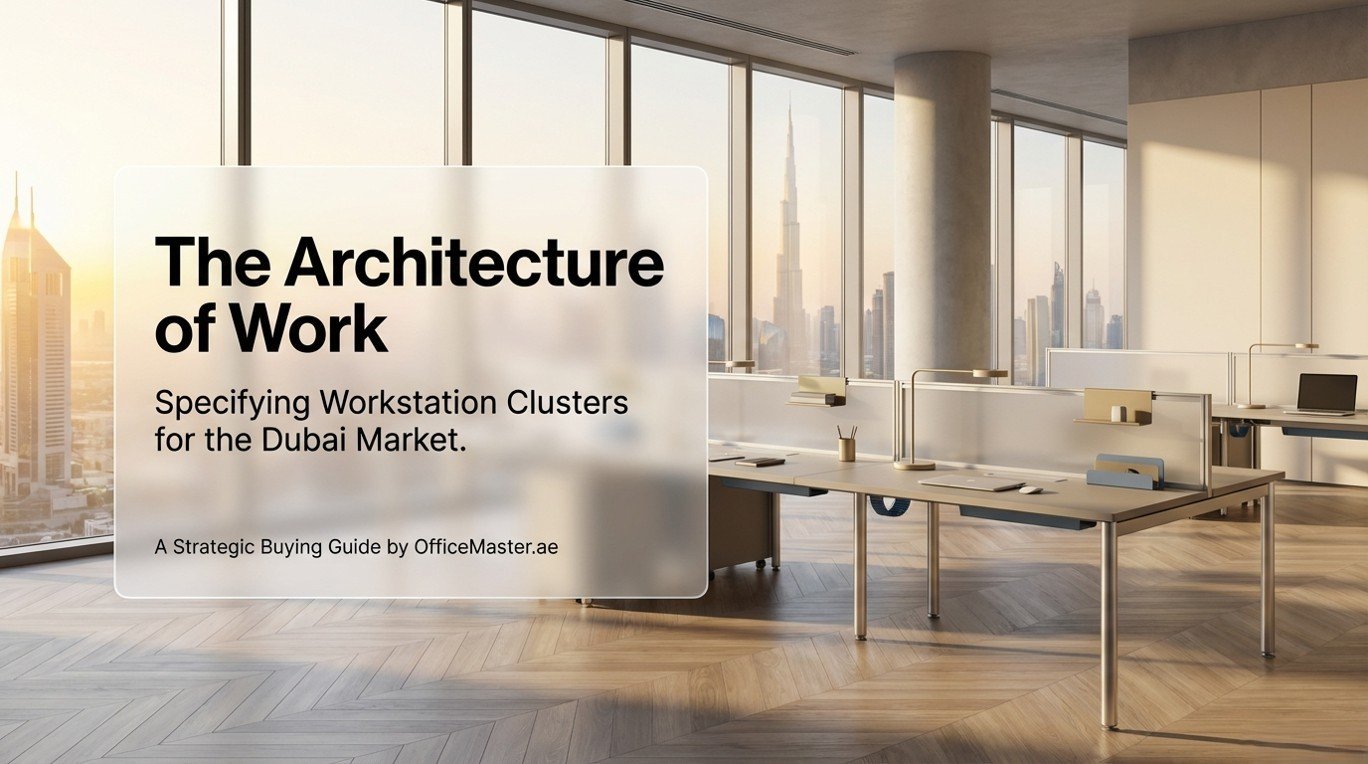
Dubai’s commercial real estate market has never been more dynamic. From gleaming DIFC towers to sprawling free-zone campuses in Dubai Silicon Oasis, businesses across every sector are rethinking how their teams work and where. At the center of this transformation sits an often-underestimated decision: choosing the right workstation cluster.
A poorly planned cluster arrangement wastes floor space, kills team collaboration, and quietly drains productivity. The right one? It becomes the architectural backbone of your culture a system that scales with your headcount, supports your ergonomic commitments, reflects your brand, and keeps your fit-out budget firmly under control.
This guide is built specifically for decision-makers operating in the UAE market HR managers selecting their first fit-out, operations directors upgrading 200-seat open-plan floors, and startup founders configuring a co-working-style agile hub. Whether you are searching for office furniture Dubai-wide or evaluating commercial office furniture UAE suppliers for a multi-site rollout, the insights below will sharpen every procurement decision you make.
We cover everything: cluster types and their ideal use cases, space-planning mathematics, ergonomics mandates, material science, cable management solutions, scalability roadmaps, and honest pricing benchmarks in AED all grounded in the realities of doing business in Dubai and the wider UAE.
Key Insight: According to JLL’s 2024 UAE Workplace Report, companies that invest in purpose-designed workstation clusters report a 23% improvement in employee satisfaction scores and a 17% reduction in unplanned absenteeism within 18 months of fit-out completion.
1. Understanding Workstation Clusters: The Fundamentals
A workstation desk is a structured grouping of individual desks typically two to twelve arranged to support a defined team function. Unlike standalone desks, clusters share common infrastructure: cable management raceways, shared storage, privacy screens, and power distribution units. This shared architecture is what makes them more cost-efficient per seat and more space-efficient per square meter than isolated desk arrangements.
In the Dubai market, cluster configurations are the dominant choice across tech companies, financial services firms, media agencies, and government entities alike. The reason is pragmatic: the UAE’s rapid workforce growth means that fit-outs must be scalable by design, not by accident.
Why Cluster Configuration Matters More Than You Think
Cluster design directly influences four business-critical outcomes: team communication velocity, space utilization rate, IT infrastructure cost, and employee wellbeing scores. A 2024 survey by Colliers International Middle East found that 68% of UAE office fit-out decisions are driven by a need to improve team collaboration and cluster layout is the single greatest lever available to achieve that goal.

2. The Four Major Cluster Types — Matched to Your Team
Not all clusters serve the same purpose. The four primary configurations each carry distinct space requirements, collaboration profiles, and cost implications. Understanding where each type excels is the foundation of any intelligent workstation Dubai specification.
2.1 Linear Bench Clusters
Linear bench systems position desks in a straight row, side-by-side, with a shared central beam. They are the most space-efficient configuration available, capable of achieving densities of 7–9 sq.m. per person in modern open-plan environments. Bench systems are the darling of tech startups, call centers, and hot-desking environments where staff rotations are high.
Ideal for: Call centers, tech firms, BPOs, hot-desking hubs, co-working operators.
Space efficiency: Very High. Bench systems can seat 30–40% more people per sq.m. than traditional assigned-desk layouts.
Key limitation: Acoustic privacy is minimal. Complement with acoustic panels, meeting pods, or office partition UAE solutions.
2.2 Back-to-Back (Facing) Clusters
Back-to-back clusters position two linear rows facing each other across a shared cable spine. This creates natural team pairing useful for roles where frequent peer consultation is expected, such as software development pairs, design teams, or trading desks. The shared spine dramatically reduces cabling cost per seat.
Ideal for: Software development teams, design studios, financial trading floors, customer success pairs.
Privacy note: Central privacy screens (400–600mm height) are strongly recommended to reduce visual distraction across the facing rows.
2.3 Cubicle Clusters
The cubicle is frequently dismissed as an artefact of 1990s corporate culture, but in 2025 it occupies a distinct and valuable niche. High-panel cubicle systems with screens at 1,200–1,500mm provide genuine acoustic separation and visual privacy. They are the preferred solution in legal firms, HR departments, finance teams handling sensitive data, and government offices where document confidentiality is a compliance requirement.
Contemporary cubicle systems from suppliers of modern office furniture Dubai have evolved dramatically. Today’s versions feature slim aluminum frames, integrated power and USB hubs, fabric-wrapped acoustic panels, and glass insets that maintain a sense of openness while preserving privacy.
Ideal for: Legal, HR, finance, government, healthcare administration, confidential client services.
2.4 Collaborative Pod Clusters
Pod clusters represent the most sophisticated configuration category a hybrid arrangement that combines open-bench seating with semi-enclosed collaboration zones. They are the architecture of choice for organizations embracing activity-based working (ABW), where employees choose their environment based on the task at hand.
A well-designed pod cluster typically includes four to eight seats arranged around a shared collaborative hub often a low-profile table with integrated power, a pinboard, and a screen mount enclosed by curved acoustic screens. The result is a self-contained team neighborhood that reduces the need for formal meeting rooms.
Ideal for: Creative agencies, innovation labs, consulting firms, ABW environments, leadership team clusters.
Workstation Cluster Types vs. Office Size & Team Function
| Cluster Type | Min. Team Size | Space/Seat (sq.m.) | Best Office Size | Ideal Industry |
|---|---|---|---|---|
| Linear Bench | 4+ | 6–8 sq.m. | Any (200 sq.m.+) | Tech, BPO, Call Centre |
| Back-to-Back | 6+ | 7–9 sq.m. | Medium–Large | Finance, Dev, Design |
| Cubicle | 2+ | 9–12 sq.m. | Medium–Large | Legal, HR, Government |
| Collaborative Pod | 4–8 per pod | 8–11 sq.m. | Large (500 sq.m.+) | Creative, Consulting, ABW |

3. Space Planning in Dubai: The Numbers You Need to Know
Space in Dubai commands a premium — Grade A office space in DIFC and Downtown Dubai averages AED 250–350 per sq. ft. per annum. Every square meter wasted on inefficient cluster layouts has a direct financial cost. Intelligent space planning is therefore not an aesthetic exercise; it is a profit center.
3.1 The Space Planning Formula
The industry-standard formula for Dubai office fit-outs is: Total Usable Area ÷ Target Headcount = Sq.M. Per Person. Most UAE employers target 8–12 sq.m. per person for a balanced environment enough to support both focus work and informal collaboration without overcrowding.
3.2 Circulation and Compliance
UAE fire and safety regulations (governed by Civil Defense requirements and Dubai Municipality standards) mandate minimum corridor widths of 1,200mm for primary circulation routes and 900mm for secondary aisles between cluster rows. Any workstation Dubai specification must account for these clearances before the cluster footprint is finalized.
As a practical rule of thumb, allocate 25–30% of your total floor area to circulation, common areas, and support spaces. The remaining 70–75% is available for workstation clusters, enclosed offices, and collaborative zones.
3.3 Cluster Layout Versus Team Size — Quick Reference
Cluster Layouts vs. Recommended Team Sizes
| Team Size | Recommended Layout | Cluster Qty | Est. Floor Area Required | Notes |
|---|---|---|---|---|
| 2–5 | L-Shape or Linear 2-seat | 1–2 | 30–60 sq.m. | Ideal for small private offices |
| 6–12 | Linear bench or 6-seat pod | 1–3 | 70–130 sq.m. | Back-to-back viable at 10+ |
| 13–25 | Back-to-back or mixed pod | 3–6 | 140–250 sq.m. | Add acoustic screens |
| 26–50 | Zoned open plan, multiple types | 6–14 | 260–500 sq.m. | Introduce quiet zones |
| 51–100 | Full ABW or mixed cluster park | 14–28 | 510–900 sq.m. | Dedicated collaboration rooms |
| 100+ | Multi-zone workstation campus | 28+ | 900 sq.m.+ | Phased fit-out recommended |
4. Ergonomics: The Non-Negotiable Foundation of Cluster Design
The UAE’s Ministry of Human Resources and Emiratization (MOHRE) and various free-zone authorities increasingly reference international ergonomic standards in their fit-out guidelines. Beyond compliance, ergonomics directly impacts retention — an often-overlooked cost driver in Dubai’s competitive talent market, where replacement hiring can cost 50–200% of an employee’s annual salary.
4.1 Desk Height and Posture
Standard fixed-height desks are manufactured at 720–750mm, which suits users between 160–185cm in height. Given the UAE’s highly international workforce — spanning body types and height ranges from across Asia, Europe, Africa, and the Americas — height-adjustable desks are the most inclusive specification choice for any ergonomic workstation UAE deployment.
Sit-stand desks with electric or pneumatic lift mechanisms are now available from local suppliers of commercial office furniture UAE at price points that make them accessible for mid-range fit-outs. A typical electric sit-stand cluster desk can be sourced in Dubai for AED 900–2,400 per unit depending on the size, mechanism quality, and cable management integration.
4.2 Screen and Keyboard Positioning
The top of the monitor should sit at or slightly below eye level, with the screen positioned 50–70cm from the face. Keyboard trays — integrated into the cluster’s cable management beam — are particularly valuable in bench systems where desk depth may be limited to 600mm.
4.3 Chair Integration — Do Not Specify in Isolation
Workstation clusters and task chairs must be specified together. The seat height range of the chosen chair determines whether a fixed-height or adjustable desk is appropriate. Many Dubai fit-outs make the costly mistake of purchasing clusters and chairs from different suppliers without verifying compatibility — particularly the relationship between armrest height and desk surface height.
4.4 Lighting in Cluster Environments
Cluster-level task lighting reduces eye strain and complements ambient ceiling systems. Integrated LED task lights — mounted to the cluster’s privacy screen or cable beam — are now a standard inclusion in premium workstation packages Dubai buyers expect. Look for lighting rated at 300–500 lux at desktop level, with adjustable color temperature (3,000K–5,000K) to support circadian rhythm management.
Ergonomic Benchmark: The WELL Building Standard, increasingly adopted by Grade A office developments in Dubai, specifies a minimum of 300 lux at workstations and recommends ergonomic furniture specifications that support 60-minute posture variation cycles.

5. Materials, Finishes, and Durability — What Survives the UAE Climate
Dubai’s climate presents unique material challenges. Extreme ambient heat, aggressive air conditioning cycles, and high-humidity coastal air (especially in areas like Dubai Marina and JBR) create an environment that accelerates the degradation of lesser-quality materials. Choosing durable, climate-appropriate finishes is not just a quality preference — it is a total cost of ownership calculation.
5.1 Desktop Surface Materials
Desktop Material Durability Comparison — UAE Climate Context
| Material | Durability (yrs) | Heat Resistance | Scratch Resistance | Price Range (AED/sq.m.) | Recommended Use |
|---|---|---|---|---|---|
| High-Pressure Laminate (HPL) | 10–15 | Good | Excellent | 120–280 | General office, bulk fit-outs |
| Melamine-Faced Chipboard (MFC) | 6–10 | Moderate | Good | 80–160 | Budget fit-outs, temporary |
| Solid Surface (e.g., Corian) | 15–20+ | Excellent | Excellent | 350–700 | Executive, reception, premium |
| Tempered Glass | 10–15+ | Excellent | Moderate | 280–550 | Executive clusters, design studios |
| Solid Wood Veneer | 12–18 | Moderate | Good | 300–650 | Executive offices, boardrooms |
| Compact Laminate (13mm+) | 15–20 | Very Good | Outstanding | 200–420 | Heavy-use, hot-desking clusters |
5.2 Frame Materials
Steel frames powder-coated or epoxy-painted are the dominant structural choice for commercial office furniture UAE environments. They offer the best strength-to-weight ratio, resist humidity-driven corrosion when correctly finished, and can be powder-coated in virtually any RAL color. Aluminum extrusion frames are lighter and inherently corrosion-resistant but command a 20–35% price premium.
Avoid untreated MDF for structural components in Dubai’s climate. Moisture infiltration particularly in ground-floor offices in coastal areas causes MDF substrate to swell and delaminate, typically within 3–5 years.
5.3 Screen and Partition Materials for Clusters
Fabric-wrapped acoustic screens remain the most effective material for cluster privacy screens, offering both visual separation and meaningful sound absorption (NRC 0.65–0.85 depending on fabric weight and core material). Glass or Perspex screens deliver a premium aesthetic but contribute negligible acoustic benefit suitable for environments where ambient noise is already well-controlled through ceiling or wall treatments.
When specifying office partition UAE elements for cluster integration, ensure the panel system uses the same fixing methodology as the cluster frame mixed systems create installation complications and compromise the warranty of both products.

6. Cable Management — The Detail That Defines the Fit-Out
In an era of 4K screens, multi-device workstations, and the IoT-enabled office, cable management is no longer a cosmetic afterthought. A cluster that ships without integrated cable management infrastructure will generate significant ongoing maintenance costs and create the kind of visual disorder that undermines the entire investment in modern office furniture Dubai aesthetics.
6.1 The Three-Layer Cable Management System
Best-practice cable management in a workstation cluster operates at three levels. First, the under-desk cable tray or J-channel captures device cables laptop chargers, monitors, peripherals running them horizontally to the power point. Second, the central cable beam or spine (for bench and back-to-back systems) collects under-desk runs and channels them vertically down to the floor. Third, the floor box or cable riser connects the cluster infrastructure to the building’s electrical and data distribution.
6.2 Power Specifications for Dubai Office Fit-Outs
The UAE operates on a 220–240V, 50Hz electrical system. Cluster power modules should be specified with UAE three-pin sockets (Type G, BS 1363) as the primary outlet, supplemented by USB-A and USB-C charging ports at 18W+ fast-charge specification. For compliance with DEWA (Dubai Electricity and Water Authority) standards, all electrical components must carry appropriate CE or DEWA-approved certification.
High-density workstation environments particularly call centers or trading floors should work with a licensed MEP consultant to size the electrical load correctly. A 4-person cluster with dual monitors per seat, telephone systems, and local storage draws approximately 2.5–4.0kW under full operational load.
Best Practice: Always specify cluster power modules with individually switched sockets and built-in surge protection. Power surges — particularly common in areas of Dubai undergoing active infrastructure development — are the leading cause of hardware failure in commercial office environments.

7. Scalability and Modular Design — Building for Growth
One of Dubai’s defining business characteristics is growth velocity. Companies that occupy a 20-seat office in Q1 may need 50 seats by Q4. Any workstation cluster system specified for a Dubai or UAE environment must be evaluated not only on its current configuration but on its architectural capacity to scale without requiring full replacement.
7.1 What Makes a Cluster Truly Modular?
True modularity in office desks UAE context means: the cluster can grow by adding legs, beams, or desktop extensions without dismantling the existing installation; the privacy screen system accepts additional panels in the same fixing track; and the power and cable management infrastructure can be extended with additional modules rather than rewired from scratch.
Ask suppliers for explicit confirmation on these three points before purchase. Many products are marketed as modular office furniture but offer only cosmetic variations rather than genuine structural scalability.
7.2 Phased Fit-Out Strategy
For businesses fitting out a new Dubai space with growth in mind, a phased approach reduces upfront capital expenditure while protecting the long-term fit-out investment. Phase 1 specifications for 60% of target headcount, leaving planned white space for Phase 2 expansion. The cluster system specified in Phase 1 must have documented catalogue continuity — meaning the same product will remain available and compatible for at least five years.
OfficeMaster.ae modular workstation range is designed with a minimum five-year catalogue guarantee, ensuring that Phase 2 additions match Phase 1 installations in finish, dimension, and fixing compatibility.

8. Budget Considerations and Pricing Benchmarks in AED
One of the most frequently searched queries in the UAE office procurement space is what a workstation actually costs. Pricing varies dramatically based on system complexity, material specification, ergonomic features, and supplier. The table below provides honest, market-calibrated benchmarks based on current UAE supplier data.
8.1 Workstation Package Pricing in AED — 2025 Market Benchmarks
Workstation Package Pricing Benchmarks — Dubai & UAE Market (Per Seat, AED)
| Category | System Type | Price Per Seat (AED) | Includes | Suitable For |
|---|---|---|---|---|
| Entry Level | Fixed bench, MFC top, basic screen | 800–1,500 | Desk, screen, cable tray | Startups, temporary fit-outs |
| Mid-Range | Bench or pod, HPL top, acoustic screen | 1,500–3,500 | Desk, screen, power module, cable mgmt | SMEs, growing teams |
| Premium | Height-adj., compact laminate, glass screen | 3,500–7,000 | All above + sit-stand, task light | Tech firms, professional services |
| Executive | Solid surface, aluminium frame, custom pod | 7,000–18,000+ | Full integration, custom spec | C-suite, creative agencies |
| Government / High-Density | Heavy-duty bench, MFC/HPL, full cable | 1,200–2,800 | Compliant spec, bulk supply | Government, call centres, BPOs |
8.2 Total Cost of Ownership — Beyond the Purchase Price
The purchase price of a workstation cluster is typically 40–60% of its true 10-year cost of ownership. Installation, delivery, maintenance, replacement components, and the opportunity cost of replacement-driven disruption account for the remainder. When evaluating workstation packages Dubai suppliers offer, always request information on: delivery lead times (typically 3–8 weeks for stocked items, 8–16 weeks for custom orders), installation costs (typically AED 150–400 per workstation), warranty terms (minimum 3 years structural, 1 year on mechanism for sit-stand), and spare part availability.
Cost Intelligence: VAT (5% in UAE) applies to all office furniture purchases. Factor this into your budget before submitting board approval. For purchases above AED 100,000, negotiate with suppliers for VAT-inclusive pricing and extended payment terms — most established Dubai office furniture suppliers will accommodate structured payment on large contracts.

9. Modern Office Trends in the UAE — What Forward-Looking Businesses Are Doing
The UAE office landscape in 2025 is being shaped by a convergence of post-pandemic working pattern shifts, government-led smart city initiatives, and an unprecedented pipeline of Grade A commercial construction across Dubai, Abu Dhabi, and Sharjah. Understanding these trends allows procurement teams to specify workstations that will remain relevant for the life of their fit-out lease.
9.1 Hybrid Work Infrastructure
The hybrid working model — where employees split their week between home and office — has fundamentally changed how clusters are specified. Hot-desking ratios of 0.7–0.8 desks per employee (compared to 1:1 in the pre-2020 era) mean fewer workstations serving more people. This shifts the specification emphasis toward: highly adjustable ergonomic features (to support multiple body types using the same desk), robust cable management for bring-your-own-device (BYOD) environments, and easy-clean surface materials that support rapid desk turnaround.
9.2 Biophilic Design Integration
Dubai’s most progressive office fit-outs are integrating natural elements directly into cluster configurations — planter dividers replacing traditional privacy screens, natural wood-grain finishes replacing synthetic laminates, and stone-effect solid surface desktops replacing standard HPL. This biophilic approach has measurable wellbeing benefits: a 2023 Human Spaces report found that employees in biophilic offices report 15% higher wellbeing scores and 6% higher productivity rates.
9.3 Technology-Embedded Clusters
Wireless charging surfaces, integrated video conferencing mounts, and smart desk sensors (occupancy detection for space utilization analytics) are becoming standard inclusions in premium office fit-out Dubai projects. Smart desk sensors in particular are valuable for UAE businesses managing hybrid teams — they provide real-time data on space utilization that informs future cluster configuration decisions.
9.4 Sustainability and Circular Economy
The UAE’s Net Zero 2050 Strategic Initiative is driving sustainability requirements down into individual procurement decisions. Forward-looking businesses are specifying office furniture with documented Environmental Product Declarations (EPDs), sourcing clusters manufactured from recycled-content steel frames, and choosing suppliers who offer take-back or trade-in programmed for end-of-life furniture. LEED v4.1 and BREEAM certification requirements — both common in Dubai Grade A developments — carry specific furniture sourcing provisions that procurement teams must be aware of.

10. Expert Buying Tips — From Dubai’s Office Furniture Specialists
After years of executing office fit-out Dubai projects ranging from 10-seat startup spaces to 500-seat regional headquarters, our team at OfficeMaster.ae has distilled the most consequential buying decisions into the following expert recommendations.
10.1 Start with a Space Audit, Not a Product Catalogue
Before opening any supplier brochure, measure your floor plate accurately, mark out all columns and service cores, identify your primary and secondary circulation routes, and plot your power and data distribution points. The cluster system you choose must work around these fixed constraints — not the other way around.
10.2 Test Before You Buy
Insist on a showroom visit or physical sample order before committing to a large cluster purchase. Surfaces that look premium in a catalogue photograph can feel cheap at touch. Sit at the desk, test the cable management, open and close the screen adjustment, and check the drawer action. Dubai has a strong office furniture showroom culture — use it.
10.3 Negotiate on Lifecycle, Not Unit Price
The most sophisticated buyers negotiate warranty extensions, annual maintenance contracts, and product catalogue guarantees rather than squeezing suppliers on unit price. A 5% unit price reduction that comes with a 1-year instead of 3-year warranty will almost certainly cost more over the fit-out lifecycle.
10.4 Validate UAE-Specific Compliance
Ensure all electrical components carry appropriate ESMA (Emirates Standards and Metrology Authority) approval or equivalent CE certification. Check that fire-retardant ratings on screen fabrics and panel materials meet UAE Civil Defense specifications — particularly important for fit-outs in DIFC, ADGM, or other regulated free zones with their own compliance layers.
10.5 Plan Your Cable Management from Day One
Cable management is significantly cheaper to integrate during cluster installation than to retrofit. If you are purchasing a cluster system that offers optional cable management components, always include them in the initial specification — even if some positions will be unoccupied initially. The cost of adding cable management to an installed cluster is typically 3–4 times the cost of including it during initial fit-out.
11. How OfficeMaster.ae Compares — An Honest Assessment
The Dubai office furniture market includes a range of suppliers from ultra-budget importers to premium international brands. Understanding where OfficeMaster.ae sits in this landscape helps buyers make an informed decision.
Supplier Comparison Matrix — Dubai Office Furniture Market
| Criterion | Budget Importers | Global Premium Brands | OfficeMaster.ae |
|---|---|---|---|
| Price Per Seat | AED 500–1,200 | AED 5,000–20,000+ | AED 900–7,000 |
| Warranty | 6–12 months | 5–10 years | 3–7 years |
| Customization | Limited (stock colors) | Extensive (long lead) | Extensive (3–6 week lead) |
| Local Stock Availability | High (limited range) | Low (import-heavy) | High (broad range) |
| Installation Service | Not included | Included (premium cost) | Included (transparent pricing) |
| Space Planning Support | Not offered | Available (additional fee) | Complimentary consultation |
| Catalogue Continuity | 12–24 months | 5–10 years | 5+ years guaranteed |
| Sustainability Credentials | None documented | LEED / BREEAM certified | EPD available on request |
OfficeMaster.ae occupies the professional mid-to-premium tier — the optimal value position for growing UAE businesses that need quality, customization, and service without the import timelines and cost premiums of global luxury brands.

12. Future Trends in UAE Office Workstations — What’s Coming Next
The workstation of 2027–2030 will look and function meaningfully differently from today’s specifications. Understanding these trajectories allows forward-thinking procurement teams to future-proof their current investments.
- AI-Powered Adaptive Desks
Desks equipped with embedded sensors and machine learning capabilities will automatically adjust height, monitor position, and lighting based on identified user biometrics and work patterns. Early commercial versions are already appearing in tech-sector fit-outs in Dubai Internet City.
- Circular Economy as Standard
By 2030, leading UAE office furniture suppliers are expected to offer fully circular product programmed — where every component of a workstation cluster can be returned, refurbished, and redeployed at end of life. Regulatory pressure from the UAE Green Economy Initiative will accelerate this transition.
As open-plan offices wrestle with the noise challenge, next-generation cluster screens will integrate active noise-cancellation technology — small transducers embedded in screen panels that generate counter-waves to neutralize ambient noise within the cluster boundary. Pilot installations exist in Singapore and London; commercial availability in Dubai is projected by 2026–2027.
- Augmented Reality Space Planning
AR-based space planning tools — accessible via standard iPad or smartphone — will allow facilities managers to visualize full cluster configurations in their actual office space before any purchase is committed. OfficeMaster.ae is currently in beta testing of an AR space planning tool specifically calibrated for UAE office dimensions and building typologies.
13. Frequently Asked Questions — Workstation Buying Guide Dubai
Q: How much does a workstation cluster cost in Dubai?
A workstation cluster in Dubai costs between AED 800 and AED 18,000+ per seat, depending on the system type, materials, ergonomic features, and customization level. Mid-range clusters with HPL surfaces, acoustic screens, and integrated cable management typically fall between AED 1,500 and AED 3,500 per seat. Budget fit-outs using MFC-surface bench systems can achieve AED 800–1,200 per seat. Premium and executive configurations using height-adjustable mechanisms and solid surface finishes range from AED 4,000 to AED 15,000 per seat.
Q: What is the delivery lead time for office workstations in the UAE?
Standard in-stock configurations are typically delivered and installed within 3–8 working days across Dubai and the wider UAE. Custom-manufactured clusters — unique dimensions, non-standard finishes, bespoke configurations — carry lead times of 4–12 weeks depending on the manufacturer’s location and production schedule. OfficeMaster.ae maintains a substantial local stock position to support rapid deployment for urgent fit-out timelines.
Q: Can I customize the size and color of my workstation cluster?
Yes. Most professional office furniture suppliers in Dubai offer customization on desktop dimensions (depth, width, and shape), frame colors (standard RAL palette, custom colors on request), screen fabric (hundreds of textile options), and configuration geometry. Standard customization add 2–4 weeks to lead times; highly bespoke specifications may add 6–10 weeks. Minimum order quantities for custom work typically apply — usually four to six units.
Q: Is VAT included in workstation prices in the UAE?
UAE VAT at 5% applies to all office furniture purchases unless the buyer holds a valid VAT exemption (rare in the commercial furniture context). Most supplier quote prices are exclusive of VAT. Always confirm whether quoted prices are VAT-inclusive or exclusive before committing to a purchase or submitting internal budget approvals.
Q: How do I calculate how many workstations I need for my Dubai office?
Divide your total usable floor area (in sq.m.) by your target allocation per person (typically 8–12 sq.m. in Dubai). Subtract 25–30% of total area for circulation, meeting rooms, kitchens, and reception. The remaining area, divided by your per-person target, gives your maximum workstation count. For hybrid workforces, apply a desk-sharing ratio — typically 0.7–0.85 desks per employee — to arrive at your actual cluster quantity.
Q: What ergonomic standards apply to office workstations in the UAE?
The UAE does not currently have a singular mandatory ergonomic standard equivalent to ISO 9241, but many free zones and Grade A landlords reference international standards in their fit-out guidelines. The WELL Building Standard (particularly WELL v2) is increasingly adopted in Dubai and provides detailed ergonomic specifications for workstations including monitor height, keyboard positioning, lighting levels, and sit-stand provision. We recommend specifying to WELL v2 as a baseline, even if certification is not sought.
Q: How long does office workstation installation take?
A typical installation of a 10-seat cluster can be completed by a professional team in 4–6 hours. A 50-seat open-plan installation typically takes 2–3 working days. Large-scale fit-outs (100+ seats) are usually phased over 1–3 weeks to allow concurrent fit-out activities (flooring, partitioning, electrical) to progress in other zones. Most Dubai office furniture suppliers offer after-hours and weekend installation to minimize disruption to existing operations.
Q: What is the difference between a workstation and a regular office desk?
A standalone office desk is a singular piece of furniture with no designed relationship to adjacent desks. A workstation is an integrated system — combining a desk surface, structural frame, cable management infrastructure, power distribution, privacy screens, and storage — designed to function as part of a coordinated cluster. Workstations are significantly more cost-efficient per seat at scale, offer better cable management, and deliver a more cohesive aesthetic in commercial office environments.
Q: Are sit-stand desks worth the extra cost in Dubai offices?
Yes, for most commercial environments. Height-adjustable sit-stand desks carry a 40–80% premium over fixed-height equivalents (roughly AED 500–1,500 extra per unit), but this investment is recovered through reduced musculoskeletal complaint sick days, improved employee satisfaction scores, and the flexibility to accommodate a wider range of body types and working preferences. For client-facing offices, sit-stand clusters also signal a genuine commitment to employee wellbeing that supports talent attraction and retention narratives.
Q: How do I manage cables in a modern Dubai workstation cluster?
Best-practice cable management uses a three-layer system: under-desk cable trays or J-channels for device-level cable capture; a central spine or beam (in bench and back-to-back systems) for horizontal cable routing; and floor boxes or cable risers for connection to building infrastructure. Specify clusters with built-in cable management infrastructure from the outset — retrofitting is expensive and visually disruptive. Wireless charging pads and USB hub modules can further reduce surface cable clutter.
Q: What is the best workstation cluster for a small Dubai startup?
For startups in the 5–15 person range, a six-seat linear bench cluster with HPL surface, 600mm depth, integrated cable management, and 400mm fabric acoustic screens offers the best balance of cost, space efficiency, and professional aesthetic. Budget AED 1,800–2,800 per seat for a quality mid-range specification. Priorities modularity — ensure the system you choose can grow by adding additional bench units as headcount increases.
Q: Can office workstations be delivered to free zones in Dubai?
Yes. All major Dubai free zones — including DIFC, DMCC, Dubai Internet City, Dubai Media City, Jebel Ali, and Dubai Silicon Oasis — are accessible for commercial furniture delivery and installation. Some free zones have specific building access protocols (dedicated loading bays, insurance requirements, fit-out NOC requirements) that suppliers must comply with. Reputable suppliers like OfficeMaster.ae are experienced with these requirements and manage the logistics on behalf of their clients.
Q: How should I maintain my office workstation cluster?
Routine maintenance involves weekly surface cleaning with a non-abrasive, pH-neutral cleaner; quarterly inspection of cable management channels for accumulated dust; annual check of mechanical components (sit-stand mechanisms, drawer runners, screen adjustment tracks); and biannual inspection of electrical modules for signs of wear or damage. HPL and compact laminate surfaces are the most maintenance-friendly — they are resistant to most cleaning chemicals and do not require periodic refinishing. Fabric acoustic screens should be vacuumed monthly and deep-cleaned annually.
Q: Is it better to buy or lease office workstations in the UAE?
Both models are available in the UAE market. Purchasing delivers better total cost of ownership over a 5–10 year horizon (typically 20–35% cheaper than leasing over the same period) and gives you full ownership of an appreciable asset. Leasing provides cash flow flexibility, predictable monthly costs, and the ability to upgrade or reconfigure at lease-end — attractive for rapidly scaling businesses or those in short-term office arrangements. Several Dubai office furniture suppliers now offer furniture-as-a-service (FaaS) models with monthly per-seat rates and built-in maintenance.
Q: How do I choose between open-plan bench clusters and cubicles for my Dubai team?
The decision framework is straightforward: if your team’s work is primarily collaborative, project-based, and communication-intensive, open-plan bench clusters are the right choice. If your team handles sensitive data, conducts confidential client conversations, requires deep focus for extended periods, or works in a regulated industry with privacy compliance requirements, cubicle or high-screen pod clusters are more appropriate. Many Dubai offices now deploy a hybrid — open bench for the majority of staff, with a dedicated zone of high-screen cubicles for focus work and sensitive tasks.
15. Your Next Step: Get the Cluster Configuration Right
Choosing the right workstation cluster is one of the highest-leverage decisions in any office fit-out Dubai project. Done well, it transforms how your team communicates, performs, and feels about coming to work every day. Done poorly, it creates a cascade of productivity, ergonomic, and aesthetic problems that no amount of subsequent decoration can resolve.
The framework in this guide cluster type selection, space planning mathematics, ergonomic specification, material selection for the UAE climate, cable management architecture, scalability planning, and honest budget benchmarking gives you every tool you need to make a confident, informed decision.
OfficeMaster.ae has helped hundreds of businesses across Dubai and the wider UAE specify, supply, and install workstation clusters that perform for the life of their office lease. Our team offers complimentary space planning consultations, physical showroom visits in Dubai, and rapid quotation turnarounds because we know your time is a premium resource.
Whether you need ten seats or five hundred, a single-type cluster or a complex multi-zone ABW environment, we have the product range, the local stock position, and the specification expertise to deliver. As Dubai’s trusted name in office furniture and a leading provider of commercial office furniture UAE businesses rely on, we are ready to bring your workspace vision to life.