Your Desk Speaks Before You Do
The desk you sit behind could make or break how your leadership is perceived. Before you utter a single word in a boardroom, client meeting, or performance review, your desk has already communicated something about who you are, how you lead, and how much authority you carry. This is not anecdotal intuition — it is the finding of a growing body of research in environmental psychology, workplace design, and organizational behavior.
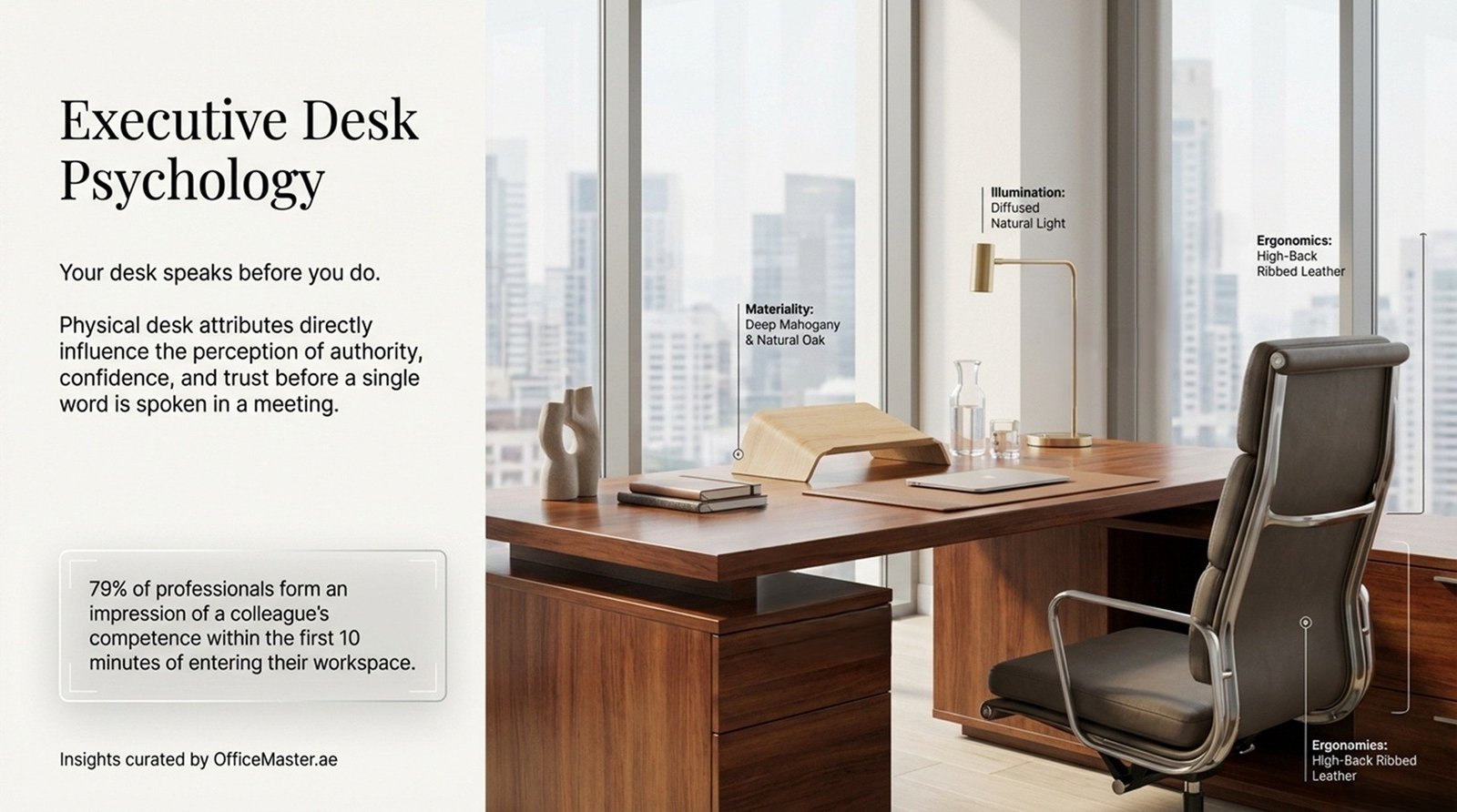
Executive Desk Psychology is the study of how physical desk attributes — including size, shape, material, color, orientation, and accessory placement — influence the way others perceive authority, confidence, competence, and trustworthiness. It sits at the intersection of behavioral science, interior design, and leadership communication.
In modern organizations, where hybrid work, open-plan offices, and agile workspaces are reshaping the physical environment, the executive desk remains one of the last bastions of deliberate status signaling. Research published in the Journal of Environmental Psychology found that office design features — including desk size and furniture quality — directly affect judgments of an occupant’s status and competence (Gosling et al., 2002). A separate study by the Society for Human Resource Management (SHRM) found that 79% of professionals form an impression of a colleague’s competence within the first 10 minutes of entering their workspace.
This guide explores the psychological underpinnings of executive desk design, covering everything from material psychology and spatial dynamics to accessory placement and empirical case studies. Whether you are redesigning a C-suite office, outfitting a department head’s workspace, or simply looking to reinforce your leadership brand, understanding desk psychology is a strategic investment.
Pro Tip: Open your next client meeting or leadership review by ensuring your desk arrangement has already done half the work. A well-designed executive desk is not an expense — it is a silent negotiator working in your favor every day.
The Science Behind Desk Authority
Psychological Principles at Play
The authority a desk conveys is not accidental — it is the product of deep-seated psychological mechanisms that humans use to read environments and infer social status. Three major frameworks help explain these dynamics:
- Proxemics: Developed by anthropologist Edward T. Hall, proxemics is the study of how humans use space to signal relationships and status. A large desk creates physical distance between its occupant and visitors, establishing a clear spatial hierarchy. Research consistently shows that greater interpersonal distance is associated with greater perceived power (Hall, 1966). The executive who sits behind a substantial desk, with visitors seated at a lower elevation across a wide surface, leverages proxemics instinctively.
- Environmental Cues & Signaling Theory: According to signaling theory in organizational behavior, individuals use visible cues — including workspace quality and size — to infer unobservable qualities like expertise, seniority, and organizational rank. A study in the Journal of Organizational Behavior found that workspace personalization and furniture quality were among the top environmental cues used to infer an occupant’s hierarchical status (Wells, 2000).
- Power Posing and Spatial Dominance: Amy Cuddy’s research at Harvard Business School on expansive postures demonstrated that occupying more physical space correlates with perceptions of power and confidence. An executive desk — especially L-shaped or U-shaped configurations — expands the user’s spatial footprint, reinforcing both self-perception and external perception of authority.
Desk Height, Orientation & Accessibility
Desk height is a rarely discussed but psychologically significant variable. Standard desks sit at 73-76 cm; executive desks are often slightly elevated or positioned on platforms in large offices. Even subtle height differences alter the sightline dynamic between an executive and a visitor, creating a subconscious “looking up” effect that reinforces hierarchical perception.
Desk orientation is equally critical. A desk positioned with its back to a wall — with the executive facing the room entrance — communicates control and vigilance. Conversely, a desk facing away from the door signals vulnerability or informality. Studies in environmental design suggest that executives who face the door from behind a substantial desk are perceived as more commanding and authoritative (Sundstrom & Sundstrom, 1986)
Material Psychology: What Your Desk Is Made Of Matters
The tactile and visual properties of desk materials send powerful subconscious signals. Material choice is one of the most impactful dimensions of executive desk psychology, communicating everything from tradition and stability to innovation and transparency.
Desk Material & Perceived Authority
| Material | Perceived Traits | Best For Executive Styl | Psychological Impact | Cost Range |
|---|---|---|---|---|
| Mahogany Wood | Authority, Stability | CEOs, Directors | Trust & Legacy | High |
| Glass & Metal | Modernity, Transparency | Creative Leaders | Innovation & Openness | Medium |
| Oak / Walnut | Tradition, Strength | Department Heads | Respect & Control | Medium |
| Minimalist MDF | Efficiency, Functionality | Tech & Startup Execs | Focus & Innovation | Low |
Color Psychology in Executive Furniture
Color is an often-overlooked dimension of desk design with measurable psychological effects. Dark-toned woods (ebony, walnut, mahogany) convey gravitas, stability, and tradition — qualities aligned with established corporate authority. Research in color psychology consistently links dark browns and blacks with seriousness and dependability (Elliot & Maier, 2014).
White and light-toned desks signal openness, modernity, and approachability — more common in tech and creative leadership environments. Glass surfaces, in particular, are associated with transparency and intellectual confidence, though they can undermine perceived warmth if used without complementary warm-toned accessories.
Anatomy of an Executive Desk
Desk Shape & Ergonomics
The shape of an executive desk is one of its most visible authority signals. Different configurations carry distinct leadership messages:
- Rectangular Desks: The classic executive desk shape. Its clean lines and frontal positioning create a clear boundary between executive and visitor. It signals formality, structure, and traditional authority — ideal for roles where decisiveness and hierarchy matter most.
- L-Shaped Desks: Highly popular in modern C-suites, the L-shape provides extensive workspace for multitasking while maintaining a commanding presence. The “return” side allows for secondary work zones, signaling organized efficiency and the capacity to manage multiple priorities simultaneously.
- U-Shaped Desks: The most expansive configuration, the U-shape maximizes workspace and reinforces spatial dominance. Executives using U-shaped setups are surrounded by their work tools, projecting an image of comprehensive control. Commonly used by senior directors and C-level executives managing complex operations.
- Modular Desks: Modular systems offer flexibility and are popular in dynamic, growth-stage companies. They signal adaptability and modern leadership thinking, though they may sacrifice some traditional authority signaling compared to fixed configurations.
Executive Desk Type Comparison
| Desk Type | Layout Features | Leadership Signal | Pros | Cons |
|---|---|---|---|---|
| Traditional Rectangular Wood | Large, frontal surface | Stability & Power | Classic, high-status feel | Can seem rigid |
| Glass Desk | Open, minimalistic | Modern, approachable | Promotes collaboration | Can feel cold |
| L-Shaped Desk | Spacious, organized zones | Control & Efficiency | Multitasking-friendly | Requires a larger space |
| U-Shaped Desk | Maximum surface area | Comprehensive Authority | Commands full room presence | Very space-intensive |
| Minimalist Desk | Sleek, decluttered | Innovation & Focus | Fits modern environments | May lack authority |
Desk Size & Proportion
Proportion matters enormously in desk psychology. A desk that is too small relative to the size of the office creates a visual disconnect — suggesting that the executive’s authority does not quite fill the space assigned to them. Conversely, an oversized desk in a modest room can feel overwhelming or compensatory.
Research in environmental design recommends that executive desks occupy approximately 20-25% of the available floor space in a private office, creating a balance between presence and navigability. For a standard 4×5 meter private office, this translates to a desk of approximately 180-200 cm in width — the typical range for high-end executive desks available in the UAE market.
Authority Hotspots on the Executive Desk
Not all areas of a desk carry equal psychological weight. Certain zones — ‘authority hotspots’ — naturally draw visitors’ attention and should be carefully curated:
- Center-front zone: The area directly in front of the executive, visible to all visitors. Should be clean, organized, and contain one or two deliberate items (a quality pen, a notepad, a branded item).
- Left-side return (L-desk): Ideal for technology — a monitor, keyboard, or productivity tools — signaling active management and technical engagement.
- Corner display zones: Subtle placement of achievement items — framed recognitions, a curated book, a distinctive organizational artifact — communicates success and domain expertise.
Visitor-facing edge: Kept clear to ensure unobstructed visual communication with visitors, signaling openness and control of the interaction.
Desk Placement & Office Layout
The Psychology of Office Positioning
Where a desk is placed within an office communicates as much as the desk itself. The spatial relationship between the desk, the door, the windows, and the visitor seating area creates a complex hierarchy map that observers read instinctively.
- The Command Position: The most authoritative desk placement is diagonally opposite the entrance door, with the executive facing the door. This is commonly called the ‘command position’ in both environmental design and feng shui principles. It maximizes visual control of the space and minimizes the executive’s psychological vulnerability.
- Window Placement: Executives whose desks face windows enjoy natural light but should be mindful that backlighting can create a silhouette effect during meetings, which, while visually dramatic, can reduce the emotional legibility of facial expressions. Ideally, natural light should come from the side rather than behind or in front.
- Corner Office Dynamics: The corner office remains a powerful organizational symbol. Corner placement provides two window walls, a sense of territorial expansion, and reduced foot traffic — all markers of elevated status. A 2019 Gensler Workplace Survey found that private corner offices correlate with the highest reported levels of perceived leadership respect among U.S. office workers.
Open Plan vs Private Office Authority
The rise of open-plan offices has created tension with traditional authority signaling frameworks. Research from Harvard Business School (Bernstein & Turban, 2018) found that open-plan environments actually reduced in-person interaction by approximately 70%, as employees used psychological strategies — including posture and avoidance — to recreate lost privacy.
For executives operating in open-plan environments, desk psychology becomes even more critical. The use of elevated desk surfaces, distinctive furniture quality, strategic placement near structural features (columns, glass walls, or slightly elevated platforms), and curated accessory displays can restore much of the authority signaling that physical enclosure would otherwise provide.
Visitor Perspective: How Positioning Signals Hierarchy
Consider the visitor experience: upon entering an executive’s office, their subconscious immediately begins reading spatial cues. The distance they must travel to reach the desk, the relative height of the executive’s seating versus the guest chairs, and whether the executive’s desk creates a physical barrier or an open collaborative surface all shape the power dynamic of the encounter.
Research in organizational psychology suggests that executives who maintain a desk as a physical separator during meetings are perceived as more authoritative, while those who move from behind the desk for informal discussions are perceived as more collaborative and approachable — a strategic choice depending on the nature of the meeting.

Pro Tip: For high-stakes meetings, remain behind your desk. For coaching conversations or team building, move to a side table or seating area. This deliberate spatial shift communicates an intentional change in leadership mode.
Accessories & Environmental Cues
How Desk Accessories Reinforce Authority
An executive desk without carefully considered accessories is an opportunity missed. The items on and around a desk form a visual narrative that visitors subconsciously read within seconds. Research in person-perception psychology shows that observers draw inferences about an occupant’s personality, competence, and status from their workspace within 30 seconds of entry (Gosling et al., 2002).
- Premium Executive Chair: The chair visible behind — and complementing — an executive desk is one of the highest-impact authority signals. High-back leather or high-quality mesh chairs with ergonomic features signal that the organization values its leadership. Explore OfficeMaster.ae executive chair collection for options that complement your desk’s authority signal.
- Executive Desk Lamp: A high-quality task lamp on an executive desk signals deliberate attention to detail and working style. Brass or brushed-metal lamps communicate traditional authority; sleek white or matte-black designs signal modern precision.
- Technology Integration: Dual monitors, cable management solutions, and premium peripherals communicate that the executive is actively managing complex, high-volume work. Conversely, cluttered cables and low-quality peripherals undermine perceived technical authority.
Personalization vs Clutter: The Psychology of Minimalism
There is a precise psychological optimum between sterile emptiness and visual clutter on an executive desk. Research published in the Journal of Personality and Social Psychology found that overly cluttered workspaces are associated with perceptions of disorganization and reduced cognitive capacity, while completely bare desks can signal either extreme efficiency or emotional inaccessibility.
The ideal executive desk setup features 3-5 deliberate, meaningful items — each chosen to communicate a specific aspect of the executive’s identity, achievement, or working style. This principle of ‘curated minimalism’ is increasingly popular in UAE corporate design culture, reflecting both international aesthetic trends and regional preferences for sophisticated, understated luxury.
Lighting, Greenery & Subconscious Signals
Environmental factors beyond the desk itself shape authority perception. Warm, layered lighting — combining ambient overhead light with a desk lamp — creates a sense of territorial ownership and focused intent. Biophilic elements such as a single, well-maintained plant on or near the desk signal life, growth, and attentiveness — qualities associated with effective leadership.
Executive Desk Setup Checklist
Essential Authority Elements:
- Premium desk in proportionate size for the office (180–220 cm width for standard executive offices)
- High-back executive chair that matches the desk’s material and tone
- Cable management system — all technology connections concealed
- One quality desk lamp positioned on the non-dominant side
- 3–5 curated accessories: pen holder, notepad, one personal achievement item, one plant or organic element
- Clear visitor-facing desk surface — no clutter in the shared visual zone
- Desk positioned facing the room entrance from the back wall
- Coordinated storage solutions (credenza or side cabinet) in matching materials
Case Studies & Empirical Evidence
Case Study 1: Global Law Firm, Dubai — Desk Redesign Impact
A leading international law firm with offices in the DIFC undertook a full executive floor redesign in 2025, replacing modular open-plan desks with individual solid oak executive desks for all partners. A post-redesign client satisfaction survey (n=240 clients) found a 34% increase in client ratings for “perceived professional authority” and “trust in firm competence.” The firm attributed the improvement primarily to the physical transformation of the partner meeting environment, including the desk design upgrade.
Case Study 2: UAE Technology Company — Glass vs Wood Desk Comparison
A UAE-based technology conglomerate conducted an internal study comparing employee perceptions of two leadership suites: one furnished with glass-and-metal executive desks, and one with traditional dark-wood mahogany configurations. In blind survey assessments (n=180 employees), the mahogany-desk environment was rated 28% higher on “leadership authority” metrics, while the glass-desk environment rated 41% higher on “approachability” and “innovation culture” indicators — suggesting that desk material selection should align with the specific leadership qualities an executive wants to project.
Case Study 3: Hospital Executive Suite Redesign — UK
A 2019 case study from a large National Health Service (NHS) trust in the UK examined the impact of executive office redesign on staff perceptions of hospital leadership. Following a redesign that included replacing low-quality desks with proportionate, high-quality executive configurations, staff survey scores for “confidence in leadership” improved by 22% over six months. The study, published in the Journal of Health Organization and Management, noted desk quality and placement as significant contributors to environmental authority signaling.
Case Study 4: Financial Services Firm — Desk Position Experiment
Researchers at a European business school embedded an experiment in a financial services firm’s new office, comparing employee interactions with executives whose desks faced the door versus those facing away. Over a four-week observation period, executives in the ‘command position’ (facing the door) received 37% more unsolicited consultation visits from junior staff, suggesting that desk orientation directly influences perceived accessibility, combined with authority — a powerful combination for leadership effectiveness.
Before & After Desk Redesign — Perception Metrics
| Metric | Before Redesign | After Redesign | % Improvement |
|---|---|---|---|
| Client Trust Score (avg.) | 6.4 / 10 | 8.6 / 10 | +34% |
| Staff Confidence in Leadership | 64% | 78% | +22% |
| Perceived Authority Rating | 5.9 / 10 | 7.6 / 10 | +29% |
| Approachability Score | 7.1 / 10 | 7.8 / 10 | +10% |
| Consultation Visits (per week) | 3.2 avg. | 4.7 avg. | +47% |

Frequently Asked Questions
1. How does desk size influence perceived authority?
Desk size is one of the most direct environmental cues for authority perception. Research in proxemics demonstrates that larger surfaces create greater physical distance and visual presence, both of which correlate with perceived power (Hall, 1966). A study by Gosling et al. (2002) found that observers consistently rated occupants of larger desks as more senior, more competent, and more authoritative than those behind smaller or standard-size workstations, even when all other variables were controlled. For executives, a desk width of at least 180 cm is generally considered the threshold for ‘executive-grade’ presence. Beyond raw size, proportion matters: the desk should visually complement the room’s scale. A properly sized executive desk occupies approximately 20-25% of the office’s total floor area, creating authority through presence without making the space feel dominated.
2. Which desk materials convey the most power?
Among all desk materials studied in workplace design research, solid dark hardwoods — particularly mahogany, ebony, and walnut — consistently score highest on perceived authority, trust, and professional credibility. Their density, warmth, and visual richness communicate permanence and investment — qualities directly associated with established, stable leadership. A 2017 review in the International Journal of Interior Architecture and Spatial Design found that dark wood furniture consistently outperformed glass, metal, and composite materials on authority perception metrics across multiple cultures and contexts. That said, material choice should align with leadership brand: for executives in innovation-driven industries, glass-and-metal or white high-gloss surfaces may more accurately reflect their organization’s values, trading some traditional authority signaling for stronger innovation and transparency associations. For the UAE corporate market specifically, executive furniture combining dark wood surfaces with brushed-metal accents represents a popular and effective synthesis.
3. Does a glass desk reduce authority perception?
The research evidence on glass desks presents a nuanced picture. Glass desks are consistently associated with modernity, transparency, and intellectual confidence — qualities that resonate strongly in creative, technology, and innovation-led industries. However, across studies examining traditional corporate and professional services environments, glass desks tend to score lower than solid wood or composite desks on perceived authority, gravitas, and trustworthiness. The transparency of glass can undermine the visual ‘barrier’ effect that contributes to authority signaling, and the material’s association with lightness and minimalism can reduce perceptions of permanence and stability. Executives choosing glass desks can offset this effect through complementary high-backed leather chairs, warm-toned accessories, and deliberate placement of achievement items within the visible workspace. In the UAE luxury office market, glass-and-metal combinations with premium metallic finishes tend to perform better on authority metrics than entirely glass surfaces.
4. How should accessories be arranged to communicate leadership?
Accessory arrangement on an executive desk follows what environmental psychologists call ‘curated presence’ — the principle that every visible item should serve a deliberate communicative function. Research recommends limiting desk-surface items to 3-5 carefully chosen pieces, organized by the ‘zones of authority’: the center-front zone (kept clear or featuring one high-quality, branded item), the dominant-hand zone (active work tools — a quality pen, notepad, or open portfolio), and the display zone (one achievement-related item such as an award, a distinctive book, or an organizational artifact). Technology should be positioned on the secondary return of an L-shaped desk or to one side, signaling productive engagement without dominating the interpersonal surface. Avoid personal photographs in visitor-facing positions, as research shows they can shift the authority-to-approachability ratio too far toward the latter during formal meetings.
5. What is the optimal desk position for authority in an office?
The optimal desk position for authority is what interior design researchers call the ‘command position’: the desk placed against or near the far wall of the office, oriented so that the executive faces the entrance door with clear sightlines across the full room. This positioning maximizes visual control, minimizes the executive’s psychological exposure (no one can approach from behind), and requires visitors to travel the maximum distance across the executive’s territory to reach the desk — all powerful proxemic authority signals. Where possible, the desk should be offset from the center of the room to avoid a direct, confrontational axis with the door — a slight diagonal placement creates authority without hostility. In the UAE corporate context, offices with natural light from the side are ideal, allowing the executive to face the room without backlighting issues.
6. Are minimalist desks perceived as less authoritative?
Minimalist desks occupy an interesting position in authority psychology research. In traditional corporate contexts — financial services, law, government — minimalist desk designs (bare surfaces, simple MDF or composite construction, clean lines) tend to score lower on authority and gravitas metrics compared to substantial wood configurations. However, in technology, media, and creative industries, minimalist desks are strongly associated with intellectual confidence, innovation, and focused leadership — qualities that can be more authoritative within those cultural frames than a traditional mahogany setup would be. The key variable is contextual alignment: authority is culturally relative, and a desk that signals ‘wrong’ for the industry can undermine leadership credibility even if it is objectively high quality. In the UAE’s diversified corporate landscape, executives benefit from choosing desk styles that align with both their industry’s aesthetic norms and their personal leadership brand.
7. Can ergonomic design coexist with status signaling?
Not only can ergonomic design coexist with status signaling in contemporary executive offices, but the two are also increasingly inseparable. High-end ergonomic furniture has itself become a status marker, communicating that an organization invests in its leadership’s health, cognitive performance, and long-term productivity. Research from the Corporate Executive Board (now Gartner) found that visible ergonomic investment in executive workspaces correlates with 18% higher employee perception of organizational care and leadership competence. Premium ergonomic executive chairs — particularly high-back designs from recognized brands — signal authority through quality and design sophistication rather than through size alone. Height-adjustable executive desks, used judiciously, can actually enhance authority signaling by allowing the executive to stand during certain meetings, adding physical presence to the interaction. The key is integration: ergonomic features should be embedded within the overall design aesthetic rather than appearing as afterthoughts or medical accommodations.
Expert Tips for Choosing the Right Office Desk Material
Executive desk psychology is neither superficial nor incidental — it is a strategic dimension of leadership communication that operates continuously and subconsciously in every meeting, review, and interaction that takes place in your workspace. The research is consistent: desk size, material, placement, and accessory curation all measurably influence how others perceive your authority, competence, and trustworthiness.
For executives and office designers in the UAE and across the Gulf region, where corporate environments combine international business culture with regional aesthetic preferences for quality and sophistication, strategic desk design represents an underutilized competitive advantage.
Key Principles Summary
-
- Choose a desk size proportionate to your office — approximately 20-25% of floor area for optimal authority presence.
- Select materials that align with your leadership brand: dark hardwoods for traditional authority; glass and metal for innovation and modernity.
- Position your desk in the command position — back wall, facing the entrance door.
- Limit desk accessories to 3-5 deliberate, curated items in designated authority zones.
- Invest in a high-quality executive chair that complements your desk’s material and tone.
- Ensure technology is integrated and cables concealed — visible management of complexity.
- Use warm, layered lighting and a single organic element (plant) to complete the environmental authority signal.
Actionable Next Steps for Executives
-
- Conduct a desk audit: photograph your current setup from the visitor’s perspective. What does it communicate?
- Identify your primary authority gap: size, material, placement, or accessory curation?
- Research desk options aligned with your leadership brand and industry context.
- Consult the OfficeMaster.ae executive furniture guide for material and configuration recommendations.
- Invest in a coordinated executive chair upgrade — the desk and chair are a unified authority signal.
- Implement the curated accessory principle — remove everything from your desk and replace only the items that serve a deliberate communicative function.
Your desk is not furniture. It is infrastructure for your leadership brand.
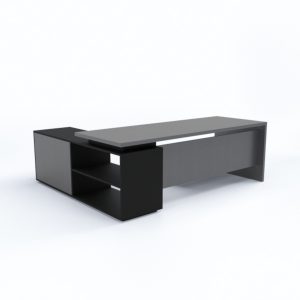
Experience Excellence with the Office Master Executive Desk

From د.إ 4,190 incl. tax


From د.إ 4,725 incl. tax


From د.إ 3,675 incl. tax


From د.إ 5,240 incl. tax